Music
Bad Bunny’s First Emmy Shows How Pop Stars Became Studios
His Super Bowl show won seven Emmys across direction, choreography, sound, cameras and lighting. The credit beside Benito’s name explains where pop is going next: producer.

Text

Noah Cruz

Bad Bunny’s first Emmy did not arrive for stepping into somebody else’s television universe. It arrived because he built one.

On September 5, the 78th Emmys gave The Apple Music Super Bowl LX Halftime Show Starring Bad Bunny seven awards from nine nominations. The programme won Outstanding Variety Special (Live), directing, music direction, choreography, sound mixing, technical direction and camerawork, and lighting design. Bad Bunny personally received one Emmy: the Television Academy lists Benito Antonio Martínez Ocasio as a producer/performer on the winning live special.

That distinction matters. The show won seven; he did not walk away carrying seven individual trophies. His award recognizes the role he played inside a machine shared with a long production team and the companies Roc Nation, Rimas, Jesse Collins Entertainment and DPS. The category is not Best Singing at Halftime. It is a prize for making live television hold together.

Pitchfork announced the news as another first in a career full of them, but the credit beneath his name tells the more interesting story. At this scale, a pop star is no longer contained by a song, an album or even a stage. The artist starts to look like a studio: an authored point of view translated through directors, designers, cameras, clothes, platforms and hundreds of people working at once.

Not a literal studio, and not the tired fantasy of one genius doing every job. A studio in the older, more useful sense: a place where one language can survive many departments.

Bad Bunny dressed in white performing atop a car amid dancers and sugarcane at the Super Bowl LX halftime show
The biggest field in American television became an authored place.Image via Apple

The trophy has departments

The most revealing thing about the Emmy result is its spread. The winning categories form a diagram of how a feeling becomes live television. Music needed arrangement. Bodies needed choreography. A stadium needed lighting. Movement needed cameras capable of finding it in real time. Sound had to hold together for the crowd inside Levi’s Stadium and for the audience hearing it through televisions and phones. Director Hamish Hamilton had to make the whole event read as one continuous thought.

This is what a pop spectacle looks like once the celebrity is removed from the centre of the sentence: coordinated labour under impossible timing. The artist provides the reason for the machine to exist, but the machine still needs operators, rehearsals, budgets, contingency plans and people who know where every cable is buried.

Bad Bunny’s achievement was not making those specialists disappear behind his charisma. It was allowing their work to remain legible as part of his world. The seven awards did not fracture the show into technical accomplishments; they revealed how consistently one idea travelled through them. The lighting spoke the same language as the clothes. The cameras understood the choreography. The stage knew what the music remembered.

That is the difference between scale and bigness. Bigness fills the field. Scale lets hundreds of decisions feel related.

The pop star is no longer the product. The point of view is.

Puerto Rico was the architecture

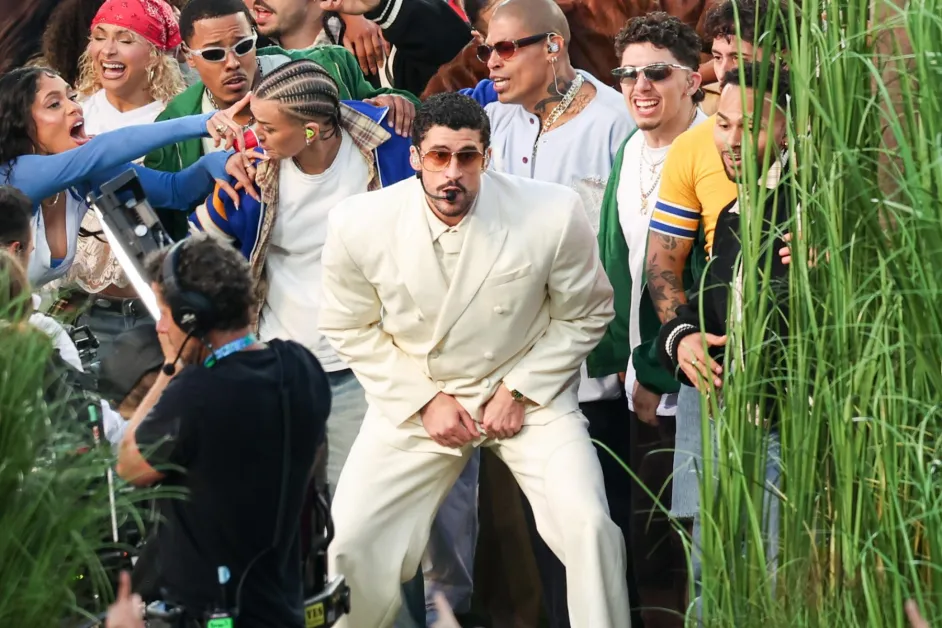
Super Bowl stages usually arrive as demonstrations of engineering: polished platforms, hydraulic surprises and formations designed to be understood from the highest camera. Bad Bunny’s show used that machinery to produce something closer to a place. Sugarcane, electrical poles and casitas occupied the field. A wedding appeared. So did barbers, nail workers, vendors and people performing recognizable forms of ordinary life.

Creative director Harriet Cuddeford developed the production with show designer Yellow Studio, stylist Karla Miranda, art director Leticia León, Rimas and Bad Bunny himself. In PAPER’s interview with Cuddeford, she describes ideas moving back and forth over months while he toured. The team pushed against the halftime show’s default wide-shot grammar, beginning inside the sugarcane and among people at ground level before allowing the spectacle to expand. More than 330 performers took part.

Lady Gaga and Ricky Martin appeared, but the cameos did not replace the social texture. The biggest stage in American television became briefly local, crowded and specific. Puerto Rican references were not placed around a conventional show as decoration. The field itself had to behave differently.

Apple’s post-show figures measured what happened next in platform terms: simultaneous Bad Bunny listeners rose sevenfold immediately after halftime, while press-conference content generated more than 63 million views in its first 48 hours. Those numbers describe reach, but not surrender. The huge audience had to enter through Puerto Rican culture to reach the star.

For decades, “crossing over” often meant making an artist smoother, more translated and easier for an imagined mainstream to consume. Bad Bunny reversed the direction. He made the mainstream cross toward him.

Bad Bunny performing Baile Inolvidable on a blue-lit stage during his Puerto Rico residency
Before television entered the world, the residency taught scale how to stay local.Comecoquito / Wikimedia Commons · CC0

The album became an address

The halftime show did not invent this world in February. It enlarged an ecosystem already built around DeBÍ TiRAR MáS FOToS: a record in which salsa, plena, bomba and reggaetón carry memory, pleasure, grief and political unease without being arranged as a lesson for outsiders.

The album won the 2026 Grammy for Album of the Year. The Recording Academy’s credit extends far past the name on the cover: producers Big Jay, La Paciencia, MAG and Tainy; engineers and mixers Antonio Caraballo, Josh Gudwin, Luis Amed Irizarry and Roberto José Rosado Torres; multiple songwriters; and mastering engineer Colin Leonard. Again, an institutional prize exposes the collective underneath the singular face.

The music then became the foundation of No Me Quiero Ir de Aquí, the sold-out Puerto Rico residency staged from July to September 2025. Fans did not only stream a fantasy of the island. They travelled toward the place from which the work spoke. The traditional campaign sends the artist everywhere; this one made everywhere move toward Puerto Rico.

That decision produced effects beyond entertainment. Visa’s analysis found that total spending in San Juan rose almost 20 percent across the ten residency weekends it studied compared with the same period in 2024. International cardholder spending in the city grew more than 35 percent year over year, while spending near the venue increased on concert days.

Economic impact is not automatically cultural justice. Tourism money does not distribute itself fairly, and a superstar cannot resolve the pressures facing the place he represents. But the residency showed what happens when an album stops behaving like content and starts behaving like infrastructure. It rearranged travel, retail, hospitality and attention around one creative instruction: come here.

Tall view of the casita-inspired stage, lasers and audience at Bad Bunny’s No Me Quiero Ir de Aquí residency
The residency asked the audience to travel toward the album’s geography.Comecoquito / Wikimedia Commons · CC0

Every platform gets the same brief

The studio metaphor becomes clearest where music meets everything sold beside it. Celebrity collaborations usually operate through transfer: a famous person lends heat to an object, the object borrows an audience, and both sides post the same image. Bad Bunny’s strongest extensions are asked to enter a visual and cultural system already in motion.

In March, adidas expanded the BadBo 1.0—his first signature shoe—into a full apparel capsule. The company connected its star mark to the Puerto Rican flag and described the clothing through his off-stage style. Whether a sneaker can carry all the cultural meaning assigned to it is a fair question. What matters here is that the product received the same brief as the record and the stage: origin, motion and self-definition.

Television works the same way. When Bad Bunny walks onto Saturday Night Live, the appearance is not only promotion before the next song begins. Language, clothes, comic timing and performance become another room in the same public architecture. One person meets him in a monologue, another in a shoe, another in ten seconds of “BAILE INoLVIDABLE,” another on a flight to San Juan. Each fragment has to carry enough of the world to stand alone.

The old model treated these channels as separate promotional lanes leading back to an album. The newer one treats them as departments. Music is one entrance. Fashion is another. Live performance, film and television are not side quests; they are forms through which the same point of view keeps moving.

Bad Bunny smiling in sunglasses during his Saturday Night Live monologue
Television is no longer a visit outside the music; it is another set inside the system.Saturday Night Live / NBC, via YouTube

A hit travels. A world makes people move toward it.

The auteur fantasy needs a crew

There is an obvious danger in describing a pop star as a studio. The phrase can flatten everyone else into an extension of one famous person’s imagination. It can turn collaboration into mythology and labour into atmosphere. The Emmy credits resist that reading.

Shawn Carter, Desiree Perez, Jesse Collins and Noah Assad are listed as executive producers; Dave Meyers as co-executive producer; Jody Kolozsvari as supervising producer; and Benito as producer/performer alongside producers Jana Fleishman and Darren Pfeffer and line producers Chelsea Gonnering and John Kilgore. Hamilton directed. Cuddeford led creative direction. Yellow Studio designed the show. Miranda styled it. León handled art direction. Choreographers, camera operators, mixers, lighting teams and performers turned ideas into a live broadcast where failure would have been visible immediately.

Bad Bunny’s contribution is not diminished by that list. It becomes more precise. He is not compelling because he can supposedly do every job. He is compelling because a growing network of specialists can recognize the same creative logic, interpret it within their discipline and return something that still feels coherent.

That is authorship without lonely-genius cosplay. The best creative systems are not factories producing identical objects. They are strong enough to let different people make different decisions without losing the centre. A nail salon added days before broadcast can belong beside a choreographed stadium sequence. A folkloric rhythm can enter the largest American sporting event without turning into a museum exhibit. An empty plastic chair can sit on an album cover while hundreds of performers fill a football field, and both can express the same tension between absence and belonging.

The Emmy belongs to that coordination. It rewards a production whose departments did not merely execute scale; they protected specificity inside it.

Interior of the Coliseo de Puerto Rico as the audience gathers around Bad Bunny’s residency stage
A universe this large is built from crews, systems and rooms full of coordination.Aj83400 / Wikimedia Commons · CC BY-SA 4.0

The institution has a face

Pop stars have always been businesses. They have employed managers, publicists, choreographers, stylists and touring crews for generations. What has changed is how visibly the creative and commercial systems now merge—and how much authorship audiences expect the artist to retain across them.

A release is no longer judged only by its songs. It arrives with an image system, a performance grammar, a fashion position, a platform strategy and a politics of place. The artist is expected to make every encounter feel intentional while remaining spontaneous, global while still specific, accessible without becoming generic. That is an absurd job description for one human. It is a reasonable brief for a studio.

Bad Bunny is especially fluent in that structure because he refuses the old bargain in which scale requires cultural neutralization. The Spanish remains. Puerto Rico remains. The local references are not removed as the audience expands; they become the mechanism of expansion. His world grows without pretending it came from nowhere.

The first Emmy is therefore less interesting as proof that Bad Bunny conquered television than as evidence that television briefly entered his system. The show passed through the machinery of the NFL, Apple’s global platform and the Television Academy’s categories. It emerged recognizably his—and recognizably the work of a team.

That is the new power position in pop. Not omnipresence for its own sake, and not a résumé built by collecting industries. It is the ability to let one idea move through many forms without making it smaller each time.

Bad Bunny did not win an Emmy by leaving music behind. He won because the music had already become a place large enough for television to enter.

Music
Bad Bunny’s First Emmy Shows How Pop Stars Became Studios
His Super Bowl show won seven Emmys across direction, choreography, sound, cameras and lighting. The credit beside Benito’s name explains where pop is going next: producer.

Text

Noah Cruz

Bad Bunny’s first Emmy did not arrive for stepping into somebody else’s television universe. It arrived because he built one.

On September 5, the 78th Emmys gave The Apple Music Super Bowl LX Halftime Show Starring Bad Bunny seven awards from nine nominations. The programme won Outstanding Variety Special (Live), directing, music direction, choreography, sound mixing, technical direction and camerawork, and lighting design. Bad Bunny personally received one Emmy: the Television Academy lists Benito Antonio Martínez Ocasio as a producer/performer on the winning live special.

That distinction matters. The show won seven; he did not walk away carrying seven individual trophies. His award recognizes the role he played inside a machine shared with a long production team and the companies Roc Nation, Rimas, Jesse Collins Entertainment and DPS. The category is not Best Singing at Halftime. It is a prize for making live television hold together.

Pitchfork announced the news as another first in a career full of them, but the credit beneath his name tells the more interesting story. At this scale, a pop star is no longer contained by a song, an album or even a stage. The artist starts to look like a studio: an authored point of view translated through directors, designers, cameras, clothes, platforms and hundreds of people working at once.

Not a literal studio, and not the tired fantasy of one genius doing every job. A studio in the older, more useful sense: a place where one language can survive many departments.

Bad Bunny dressed in white performing atop a car amid dancers and sugarcane at the Super Bowl LX halftime show
The biggest field in American television became an authored place.Image via Apple

The trophy has departments

The most revealing thing about the Emmy result is its spread. The winning categories form a diagram of how a feeling becomes live television. Music needed arrangement. Bodies needed choreography. A stadium needed lighting. Movement needed cameras capable of finding it in real time. Sound had to hold together for the crowd inside Levi’s Stadium and for the audience hearing it through televisions and phones. Director Hamish Hamilton had to make the whole event read as one continuous thought.

This is what a pop spectacle looks like once the celebrity is removed from the centre of the sentence: coordinated labour under impossible timing. The artist provides the reason for the machine to exist, but the machine still needs operators, rehearsals, budgets, contingency plans and people who know where every cable is buried.

Bad Bunny’s achievement was not making those specialists disappear behind his charisma. It was allowing their work to remain legible as part of his world. The seven awards did not fracture the show into technical accomplishments; they revealed how consistently one idea travelled through them. The lighting spoke the same language as the clothes. The cameras understood the choreography. The stage knew what the music remembered.

That is the difference between scale and bigness. Bigness fills the field. Scale lets hundreds of decisions feel related.

The pop star is no longer the product. The point of view is.

Puerto Rico was the architecture

Super Bowl stages usually arrive as demonstrations of engineering: polished platforms, hydraulic surprises and formations designed to be understood from the highest camera. Bad Bunny’s show used that machinery to produce something closer to a place. Sugarcane, electrical poles and casitas occupied the field. A wedding appeared. So did barbers, nail workers, vendors and people performing recognizable forms of ordinary life.

Creative director Harriet Cuddeford developed the production with show designer Yellow Studio, stylist Karla Miranda, art director Leticia León, Rimas and Bad Bunny himself. In PAPER’s interview with Cuddeford, she describes ideas moving back and forth over months while he toured. The team pushed against the halftime show’s default wide-shot grammar, beginning inside the sugarcane and among people at ground level before allowing the spectacle to expand. More than 330 performers took part.

Lady Gaga and Ricky Martin appeared, but the cameos did not replace the social texture. The biggest stage in American television became briefly local, crowded and specific. Puerto Rican references were not placed around a conventional show as decoration. The field itself had to behave differently.

Apple’s post-show figures measured what happened next in platform terms: simultaneous Bad Bunny listeners rose sevenfold immediately after halftime, while press-conference content generated more than 63 million views in its first 48 hours. Those numbers describe reach, but not surrender. The huge audience had to enter through Puerto Rican culture to reach the star.

For decades, “crossing over” often meant making an artist smoother, more translated and easier for an imagined mainstream to consume. Bad Bunny reversed the direction. He made the mainstream cross toward him.

Bad Bunny performing Baile Inolvidable on a blue-lit stage during his Puerto Rico residency
Before television entered the world, the residency taught scale how to stay local.Comecoquito / Wikimedia Commons · CC0

The album became an address

The halftime show did not invent this world in February. It enlarged an ecosystem already built around DeBÍ TiRAR MáS FOToS: a record in which salsa, plena, bomba and reggaetón carry memory, pleasure, grief and political unease without being arranged as a lesson for outsiders.

The album won the 2026 Grammy for Album of the Year. The Recording Academy’s credit extends far past the name on the cover: producers Big Jay, La Paciencia, MAG and Tainy; engineers and mixers Antonio Caraballo, Josh Gudwin, Luis Amed Irizarry and Roberto José Rosado Torres; multiple songwriters; and mastering engineer Colin Leonard. Again, an institutional prize exposes the collective underneath the singular face.

The music then became the foundation of No Me Quiero Ir de Aquí, the sold-out Puerto Rico residency staged from July to September 2025. Fans did not only stream a fantasy of the island. They travelled toward the place from which the work spoke. The traditional campaign sends the artist everywhere; this one made everywhere move toward Puerto Rico.

That decision produced effects beyond entertainment. Visa’s analysis found that total spending in San Juan rose almost 20 percent across the ten residency weekends it studied compared with the same period in 2024. International cardholder spending in the city grew more than 35 percent year over year, while spending near the venue increased on concert days.

Economic impact is not automatically cultural justice. Tourism money does not distribute itself fairly, and a superstar cannot resolve the pressures facing the place he represents. But the residency showed what happens when an album stops behaving like content and starts behaving like infrastructure. It rearranged travel, retail, hospitality and attention around one creative instruction: come here.

Tall view of the casita-inspired stage, lasers and audience at Bad Bunny’s No Me Quiero Ir de Aquí residency
The residency asked the audience to travel toward the album’s geography.Comecoquito / Wikimedia Commons · CC0

Every platform gets the same brief

The studio metaphor becomes clearest where music meets everything sold beside it. Celebrity collaborations usually operate through transfer: a famous person lends heat to an object, the object borrows an audience, and both sides post the same image. Bad Bunny’s strongest extensions are asked to enter a visual and cultural system already in motion.

In March, adidas expanded the BadBo 1.0—his first signature shoe—into a full apparel capsule. The company connected its star mark to the Puerto Rican flag and described the clothing through his off-stage style. Whether a sneaker can carry all the cultural meaning assigned to it is a fair question. What matters here is that the product received the same brief as the record and the stage: origin, motion and self-definition.

Television works the same way. When Bad Bunny walks onto Saturday Night Live, the appearance is not only promotion before the next song begins. Language, clothes, comic timing and performance become another room in the same public architecture. One person meets him in a monologue, another in a shoe, another in ten seconds of “BAILE INoLVIDABLE,” another on a flight to San Juan. Each fragment has to carry enough of the world to stand alone.

The old model treated these channels as separate promotional lanes leading back to an album. The newer one treats them as departments. Music is one entrance. Fashion is another. Live performance, film and television are not side quests; they are forms through which the same point of view keeps moving.

Bad Bunny smiling in sunglasses during his Saturday Night Live monologue
Television is no longer a visit outside the music; it is another set inside the system.Saturday Night Live / NBC, via YouTube

A hit travels. A world makes people move toward it.

The auteur fantasy needs a crew

There is an obvious danger in describing a pop star as a studio. The phrase can flatten everyone else into an extension of one famous person’s imagination. It can turn collaboration into mythology and labour into atmosphere. The Emmy credits resist that reading.

Shawn Carter, Desiree Perez, Jesse Collins and Noah Assad are listed as executive producers; Dave Meyers as co-executive producer; Jody Kolozsvari as supervising producer; and Benito as producer/performer alongside producers Jana Fleishman and Darren Pfeffer and line producers Chelsea Gonnering and John Kilgore. Hamilton directed. Cuddeford led creative direction. Yellow Studio designed the show. Miranda styled it. León handled art direction. Choreographers, camera operators, mixers, lighting teams and performers turned ideas into a live broadcast where failure would have been visible immediately.

Bad Bunny’s contribution is not diminished by that list. It becomes more precise. He is not compelling because he can supposedly do every job. He is compelling because a growing network of specialists can recognize the same creative logic, interpret it within their discipline and return something that still feels coherent.

That is authorship without lonely-genius cosplay. The best creative systems are not factories producing identical objects. They are strong enough to let different people make different decisions without losing the centre. A nail salon added days before broadcast can belong beside a choreographed stadium sequence. A folkloric rhythm can enter the largest American sporting event without turning into a museum exhibit. An empty plastic chair can sit on an album cover while hundreds of performers fill a football field, and both can express the same tension between absence and belonging.

The Emmy belongs to that coordination. It rewards a production whose departments did not merely execute scale; they protected specificity inside it.

Interior of the Coliseo de Puerto Rico as the audience gathers around Bad Bunny’s residency stage
A universe this large is built from crews, systems and rooms full of coordination.Aj83400 / Wikimedia Commons · CC BY-SA 4.0

The institution has a face

Pop stars have always been businesses. They have employed managers, publicists, choreographers, stylists and touring crews for generations. What has changed is how visibly the creative and commercial systems now merge—and how much authorship audiences expect the artist to retain across them.

A release is no longer judged only by its songs. It arrives with an image system, a performance grammar, a fashion position, a platform strategy and a politics of place. The artist is expected to make every encounter feel intentional while remaining spontaneous, global while still specific, accessible without becoming generic. That is an absurd job description for one human. It is a reasonable brief for a studio.

Bad Bunny is especially fluent in that structure because he refuses the old bargain in which scale requires cultural neutralization. The Spanish remains. Puerto Rico remains. The local references are not removed as the audience expands; they become the mechanism of expansion. His world grows without pretending it came from nowhere.

The first Emmy is therefore less interesting as proof that Bad Bunny conquered television than as evidence that television briefly entered his system. The show passed through the machinery of the NFL, Apple’s global platform and the Television Academy’s categories. It emerged recognizably his—and recognizably the work of a team.

That is the new power position in pop. Not omnipresence for its own sake, and not a résumé built by collecting industries. It is the ability to let one idea move through many forms without making it smaller each time.

Bad Bunny did not win an Emmy by leaving music behind. He won because the music had already become a place large enough for television to enter.

Music
Bad Bunny’s First Emmy Shows How Pop Stars Became Studios
His Super Bowl show won seven Emmys across direction, choreography, sound, cameras and lighting. The credit beside Benito’s name explains where pop is going next: producer.

Text

Noah Cruz

Bad Bunny’s first Emmy did not arrive for stepping into somebody else’s television universe. It arrived because he built one.

On September 5, the 78th Emmys gave The Apple Music Super Bowl LX Halftime Show Starring Bad Bunny seven awards from nine nominations. The programme won Outstanding Variety Special (Live), directing, music direction, choreography, sound mixing, technical direction and camerawork, and lighting design. Bad Bunny personally received one Emmy: the Television Academy lists Benito Antonio Martínez Ocasio as a producer/performer on the winning live special.

That distinction matters. The show won seven; he did not walk away carrying seven individual trophies. His award recognizes the role he played inside a machine shared with a long production team and the companies Roc Nation, Rimas, Jesse Collins Entertainment and DPS. The category is not Best Singing at Halftime. It is a prize for making live television hold together.

Pitchfork announced the news as another first in a career full of them, but the credit beneath his name tells the more interesting story. At this scale, a pop star is no longer contained by a song, an album or even a stage. The artist starts to look like a studio: an authored point of view translated through directors, designers, cameras, clothes, platforms and hundreds of people working at once.

Not a literal studio, and not the tired fantasy of one genius doing every job. A studio in the older, more useful sense: a place where one language can survive many departments.

Bad Bunny dressed in white performing atop a car amid dancers and sugarcane at the Super Bowl LX halftime show
The biggest field in American television became an authored place.Image via Apple

The trophy has departments

The most revealing thing about the Emmy result is its spread. The winning categories form a diagram of how a feeling becomes live television. Music needed arrangement. Bodies needed choreography. A stadium needed lighting. Movement needed cameras capable of finding it in real time. Sound had to hold together for the crowd inside Levi’s Stadium and for the audience hearing it through televisions and phones. Director Hamish Hamilton had to make the whole event read as one continuous thought.

This is what a pop spectacle looks like once the celebrity is removed from the centre of the sentence: coordinated labour under impossible timing. The artist provides the reason for the machine to exist, but the machine still needs operators, rehearsals, budgets, contingency plans and people who know where every cable is buried.

Bad Bunny’s achievement was not making those specialists disappear behind his charisma. It was allowing their work to remain legible as part of his world. The seven awards did not fracture the show into technical accomplishments; they revealed how consistently one idea travelled through them. The lighting spoke the same language as the clothes. The cameras understood the choreography. The stage knew what the music remembered.

That is the difference between scale and bigness. Bigness fills the field. Scale lets hundreds of decisions feel related.

The pop star is no longer the product. The point of view is.

Puerto Rico was the architecture

Super Bowl stages usually arrive as demonstrations of engineering: polished platforms, hydraulic surprises and formations designed to be understood from the highest camera. Bad Bunny’s show used that machinery to produce something closer to a place. Sugarcane, electrical poles and casitas occupied the field. A wedding appeared. So did barbers, nail workers, vendors and people performing recognizable forms of ordinary life.

Creative director Harriet Cuddeford developed the production with show designer Yellow Studio, stylist Karla Miranda, art director Leticia León, Rimas and Bad Bunny himself. In PAPER’s interview with Cuddeford, she describes ideas moving back and forth over months while he toured. The team pushed against the halftime show’s default wide-shot grammar, beginning inside the sugarcane and among people at ground level before allowing the spectacle to expand. More than 330 performers took part.

Lady Gaga and Ricky Martin appeared, but the cameos did not replace the social texture. The biggest stage in American television became briefly local, crowded and specific. Puerto Rican references were not placed around a conventional show as decoration. The field itself had to behave differently.

Apple’s post-show figures measured what happened next in platform terms: simultaneous Bad Bunny listeners rose sevenfold immediately after halftime, while press-conference content generated more than 63 million views in its first 48 hours. Those numbers describe reach, but not surrender. The huge audience had to enter through Puerto Rican culture to reach the star.

For decades, “crossing over” often meant making an artist smoother, more translated and easier for an imagined mainstream to consume. Bad Bunny reversed the direction. He made the mainstream cross toward him.

Bad Bunny performing Baile Inolvidable on a blue-lit stage during his Puerto Rico residency
Before television entered the world, the residency taught scale how to stay local.Comecoquito / Wikimedia Commons · CC0

The album became an address

The halftime show did not invent this world in February. It enlarged an ecosystem already built around DeBÍ TiRAR MáS FOToS: a record in which salsa, plena, bomba and reggaetón carry memory, pleasure, grief and political unease without being arranged as a lesson for outsiders.

The album won the 2026 Grammy for Album of the Year. The Recording Academy’s credit extends far past the name on the cover: producers Big Jay, La Paciencia, MAG and Tainy; engineers and mixers Antonio Caraballo, Josh Gudwin, Luis Amed Irizarry and Roberto José Rosado Torres; multiple songwriters; and mastering engineer Colin Leonard. Again, an institutional prize exposes the collective underneath the singular face.

The music then became the foundation of No Me Quiero Ir de Aquí, the sold-out Puerto Rico residency staged from July to September 2025. Fans did not only stream a fantasy of the island. They travelled toward the place from which the work spoke. The traditional campaign sends the artist everywhere; this one made everywhere move toward Puerto Rico.

That decision produced effects beyond entertainment. Visa’s analysis found that total spending in San Juan rose almost 20 percent across the ten residency weekends it studied compared with the same period in 2024. International cardholder spending in the city grew more than 35 percent year over year, while spending near the venue increased on concert days.

Economic impact is not automatically cultural justice. Tourism money does not distribute itself fairly, and a superstar cannot resolve the pressures facing the place he represents. But the residency showed what happens when an album stops behaving like content and starts behaving like infrastructure. It rearranged travel, retail, hospitality and attention around one creative instruction: come here.

Tall view of the casita-inspired stage, lasers and audience at Bad Bunny’s No Me Quiero Ir de Aquí residency
The residency asked the audience to travel toward the album’s geography.Comecoquito / Wikimedia Commons · CC0

Every platform gets the same brief

The studio metaphor becomes clearest where music meets everything sold beside it. Celebrity collaborations usually operate through transfer: a famous person lends heat to an object, the object borrows an audience, and both sides post the same image. Bad Bunny’s strongest extensions are asked to enter a visual and cultural system already in motion.

In March, adidas expanded the BadBo 1.0—his first signature shoe—into a full apparel capsule. The company connected its star mark to the Puerto Rican flag and described the clothing through his off-stage style. Whether a sneaker can carry all the cultural meaning assigned to it is a fair question. What matters here is that the product received the same brief as the record and the stage: origin, motion and self-definition.

Television works the same way. When Bad Bunny walks onto Saturday Night Live, the appearance is not only promotion before the next song begins. Language, clothes, comic timing and performance become another room in the same public architecture. One person meets him in a monologue, another in a shoe, another in ten seconds of “BAILE INoLVIDABLE,” another on a flight to San Juan. Each fragment has to carry enough of the world to stand alone.

The old model treated these channels as separate promotional lanes leading back to an album. The newer one treats them as departments. Music is one entrance. Fashion is another. Live performance, film and television are not side quests; they are forms through which the same point of view keeps moving.

Bad Bunny smiling in sunglasses during his Saturday Night Live monologue
Television is no longer a visit outside the music; it is another set inside the system.Saturday Night Live / NBC, via YouTube

A hit travels. A world makes people move toward it.

The auteur fantasy needs a crew

There is an obvious danger in describing a pop star as a studio. The phrase can flatten everyone else into an extension of one famous person’s imagination. It can turn collaboration into mythology and labour into atmosphere. The Emmy credits resist that reading.

Shawn Carter, Desiree Perez, Jesse Collins and Noah Assad are listed as executive producers; Dave Meyers as co-executive producer; Jody Kolozsvari as supervising producer; and Benito as producer/performer alongside producers Jana Fleishman and Darren Pfeffer and line producers Chelsea Gonnering and John Kilgore. Hamilton directed. Cuddeford led creative direction. Yellow Studio designed the show. Miranda styled it. León handled art direction. Choreographers, camera operators, mixers, lighting teams and performers turned ideas into a live broadcast where failure would have been visible immediately.

Bad Bunny’s contribution is not diminished by that list. It becomes more precise. He is not compelling because he can supposedly do every job. He is compelling because a growing network of specialists can recognize the same creative logic, interpret it within their discipline and return something that still feels coherent.

That is authorship without lonely-genius cosplay. The best creative systems are not factories producing identical objects. They are strong enough to let different people make different decisions without losing the centre. A nail salon added days before broadcast can belong beside a choreographed stadium sequence. A folkloric rhythm can enter the largest American sporting event without turning into a museum exhibit. An empty plastic chair can sit on an album cover while hundreds of performers fill a football field, and both can express the same tension between absence and belonging.

The Emmy belongs to that coordination. It rewards a production whose departments did not merely execute scale; they protected specificity inside it.

Interior of the Coliseo de Puerto Rico as the audience gathers around Bad Bunny’s residency stage
A universe this large is built from crews, systems and rooms full of coordination.Aj83400 / Wikimedia Commons · CC BY-SA 4.0

The institution has a face

Pop stars have always been businesses. They have employed managers, publicists, choreographers, stylists and touring crews for generations. What has changed is how visibly the creative and commercial systems now merge—and how much authorship audiences expect the artist to retain across them.

A release is no longer judged only by its songs. It arrives with an image system, a performance grammar, a fashion position, a platform strategy and a politics of place. The artist is expected to make every encounter feel intentional while remaining spontaneous, global while still specific, accessible without becoming generic. That is an absurd job description for one human. It is a reasonable brief for a studio.

Bad Bunny is especially fluent in that structure because he refuses the old bargain in which scale requires cultural neutralization. The Spanish remains. Puerto Rico remains. The local references are not removed as the audience expands; they become the mechanism of expansion. His world grows without pretending it came from nowhere.

The first Emmy is therefore less interesting as proof that Bad Bunny conquered television than as evidence that television briefly entered his system. The show passed through the machinery of the NFL, Apple’s global platform and the Television Academy’s categories. It emerged recognizably his—and recognizably the work of a team.

That is the new power position in pop. Not omnipresence for its own sake, and not a résumé built by collecting industries. It is the ability to let one idea move through many forms without making it smaller each time.

Bad Bunny did not win an Emmy by leaving music behind. He won because the music had already become a place large enough for television to enter.

Get Frenzy straight to your inbox!
Latest