Beauty
The FRENZY Interview: Bo Quinn Makes Beauty Misbehave
In this visual interview, Bo Quinn opens the sketchbooks, studio archive and afterlife of the looks—and explains why beauty becomes interesting only when it stops trying to be beautiful.

Text

Noah Cruz

Bo Quinn does not paint a face. Bo stages a hostile takeover.

An eye becomes a warning sign. A mouth grows barbs. White paint erases the polite evidence of skin, then cobalt, latex red and glossy black move in like squatters with excellent taste. Even the lashes refuse moderation. They do not flutter; they announce an event.

This is beauty dragged out of the flattering light and made to develop a point of view. Quinn’s work is exact without becoming obedient, theatrical without hiding behind costume and strange without begging to be understood. The face is still a face. It has simply stopped behaving like one.

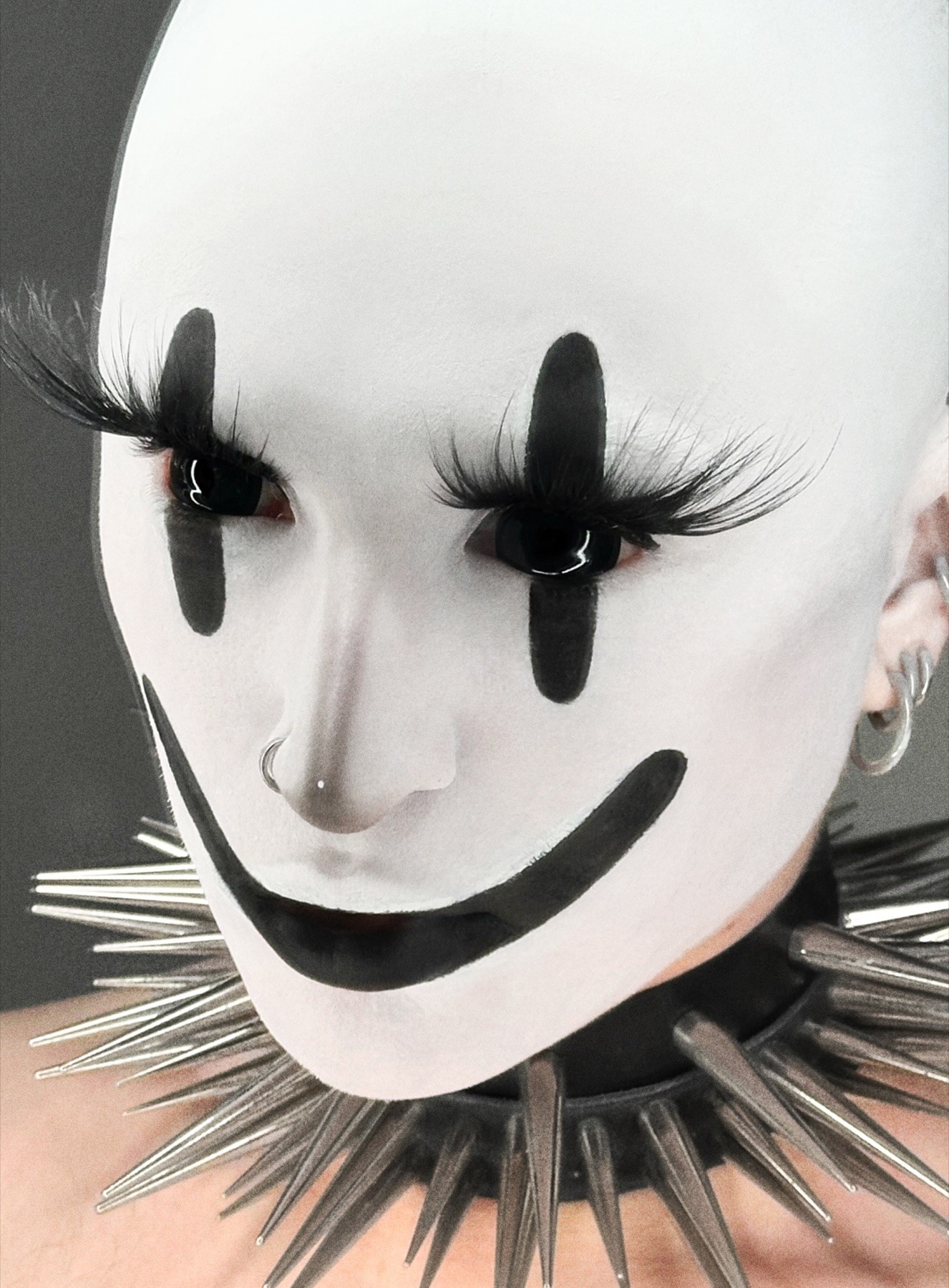
Extreme close-up of Bo Quinn in white makeup, black liner and lacquered red lips above a metal spike collar
Red lacquer, white ground, metal punctuation. Image courtesy of Bo Quinn.

When you look at a bare face, what do you see first: a person, a canvas, an architecture or the beginning of a character?

Bo Quinn: When looking at a bare face, I see a canvas to create whatever I may be feeling that day. The architecture of different faces, however, organically informs the avenue I may take. Some things work on people; some don’t. Because I mainly work on myself, over time I have figured out what works on my features and how I like to present myself in makeup. This is why, for me, working on others is exciting because the possibilities suddenly become endless.

Traditional beauty often tries to soften, flatter and perfect. Your work exaggerates, disrupts and sometimes unnerves. What becomes possible once “pretty” is no longer the goal?

Bo Quinn: Anything and everything becomes possible once ‘pretty’ is no longer the goal. Once you let go of social norms or what other people consider ‘beautiful’ you can immerse yourself in any world you feel fits. There are so many boring ‘pretty’ people in this world contributing absolutely nothing; why not be the weirdo with a point of view in the corner?
Bo Quinn in white face makeup with black graphic eyes, an exaggerated black smile and a metal spike collar
Bo Quinn wearing a white knitted mask edged in red with red horns and metal neck spikes

The face as graphic system; the face as wearable architecture. Images courtesy of Bo Quinn.

Pretty is a compliance department

Mainstream beauty still loves the language of liberation while selling the same obedient face: lifted, glazed, poreless, reassuring. Every feature is encouraged to become its most socially legible self. Quinn takes that administrative fantasy and puts it through a shredder.

The seduction is not gone. It has simply developed teeth. A black sclera lens can be menacing and magnetic at once; a latex mouth can read as glamour even while it resembles a trap. Quinn is not trying to settle the argument between beautiful and grotesque. The argument is the look.

Do you want someone encountering one of your looks to feel seduced first—or disturbed first?

Bo Quinn: As long as it’s making some sort of impact and creating a response of any kind, then I’m happy. I like that my work evokes so many different reactions from people. Often when one of my looks blows up online, some of the comments are wild. Once it hits the wrong side of socials, I know I’ve done my job correctly. It’s also not important or useful for me to get too heavily focused on what other people with no interest or experience in makeup think of me or my work.

Where does beauty end and the grotesque begin for you? Does that distinction even matter?

Bo Quinn: I don’t think the distinction between the grotesque and beauty matters to me so much. There will always be aspects of both within my work, as that’s what I’m naturally drawn to. I don’t think about it too deeply; I like to add a little spook into anything I do because I think it’s cool.
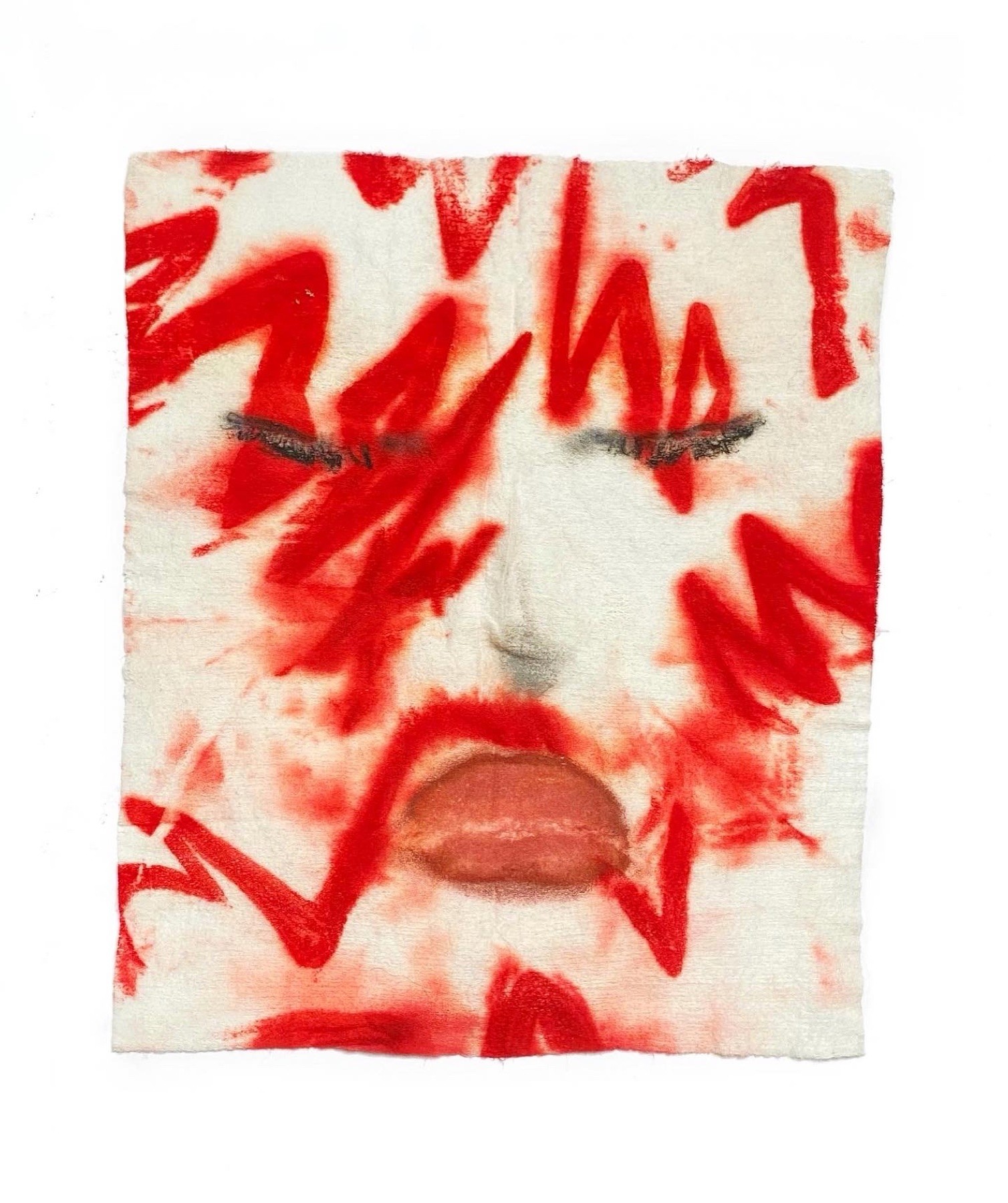
White face wipe carrying an abstract red face print and closed lashes
Face wipe printed with yellow star-shaped eyes and a red mouth
Bo Quinn process board with a red face-wipe print, sketch, horn props and silver chain

Selections from Swipe for the Wipe and the studio process. Images courtesy of Bo Quinn.

The evidence refuses to disappear

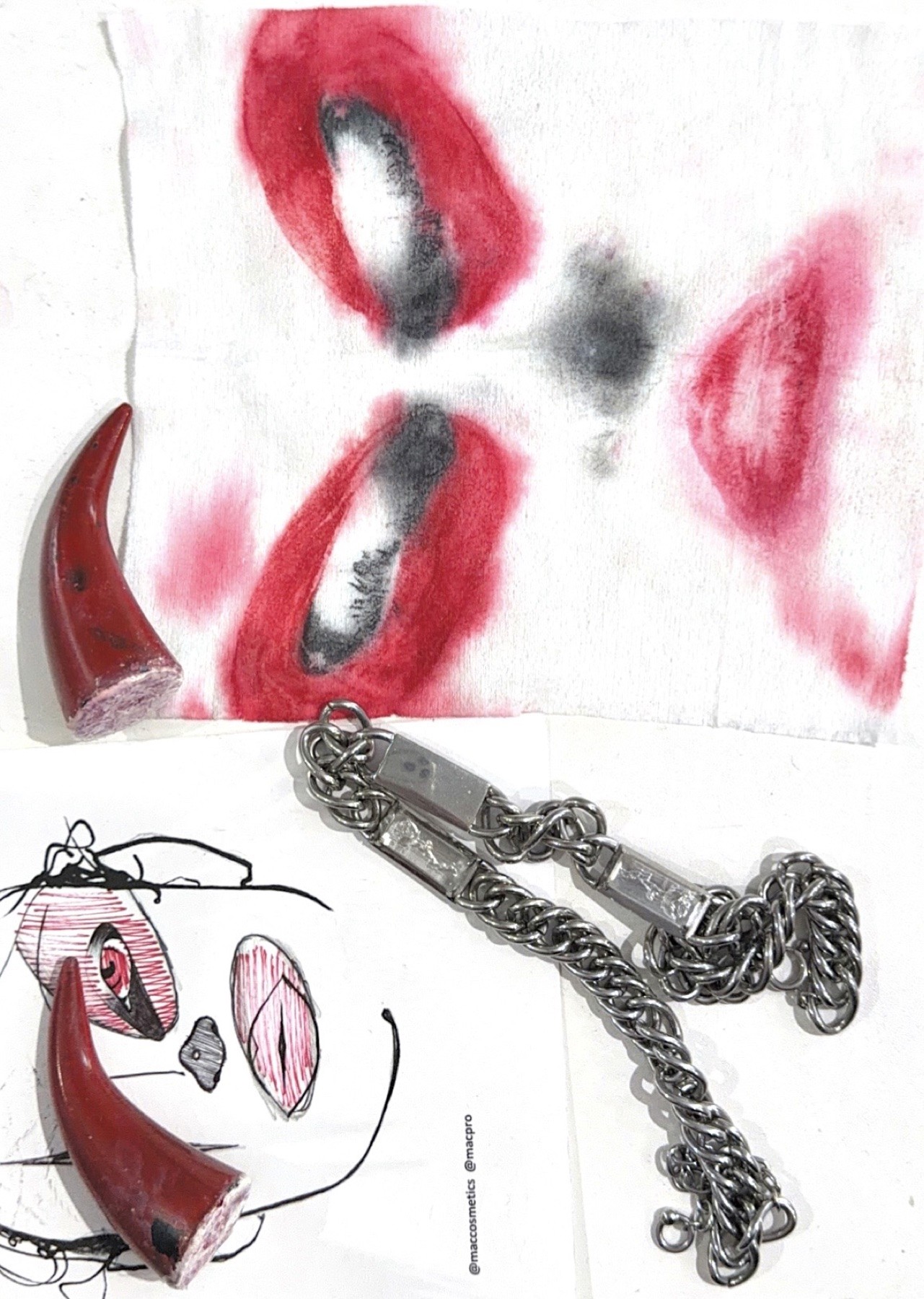
Most makeup content worships the reveal and deletes the wreckage. Quinn keeps the wreckage. Swipe for the Wipe catches each look at the moment it should vanish: pigment pressed into cloth, lashes leaving little soot signatures, mouths surviving as stains. Removal becomes printmaking. The discarded thing develops an afterlife.

They look like beauty’s crime scenes, but also its receipts. A face happened here. Labour happened here. Time happened here. The images refuse the industry’s favourite lie—that transformation arrives cleanly, lives forever and leaves no mess.

Your Swipe for the Wipe pieces turn the destruction of a look into another artwork. Does removing the makeup feel like the end of the performance—or its final creative act?

Bo Quinn: Removing makeup for me is the final creative act. I’ve been collecting and sometimes selling my face wipe prints for 6+ years now, and this has been an opportunity for me to share my work with people all around the world that usually would sit inside a screen.

Bo Quinn process board showing a black spiked lip print and pencil studies
Sketch, test, transfer, mutate. Process image courtesy of Bo Quinn.

A sketch is not a command

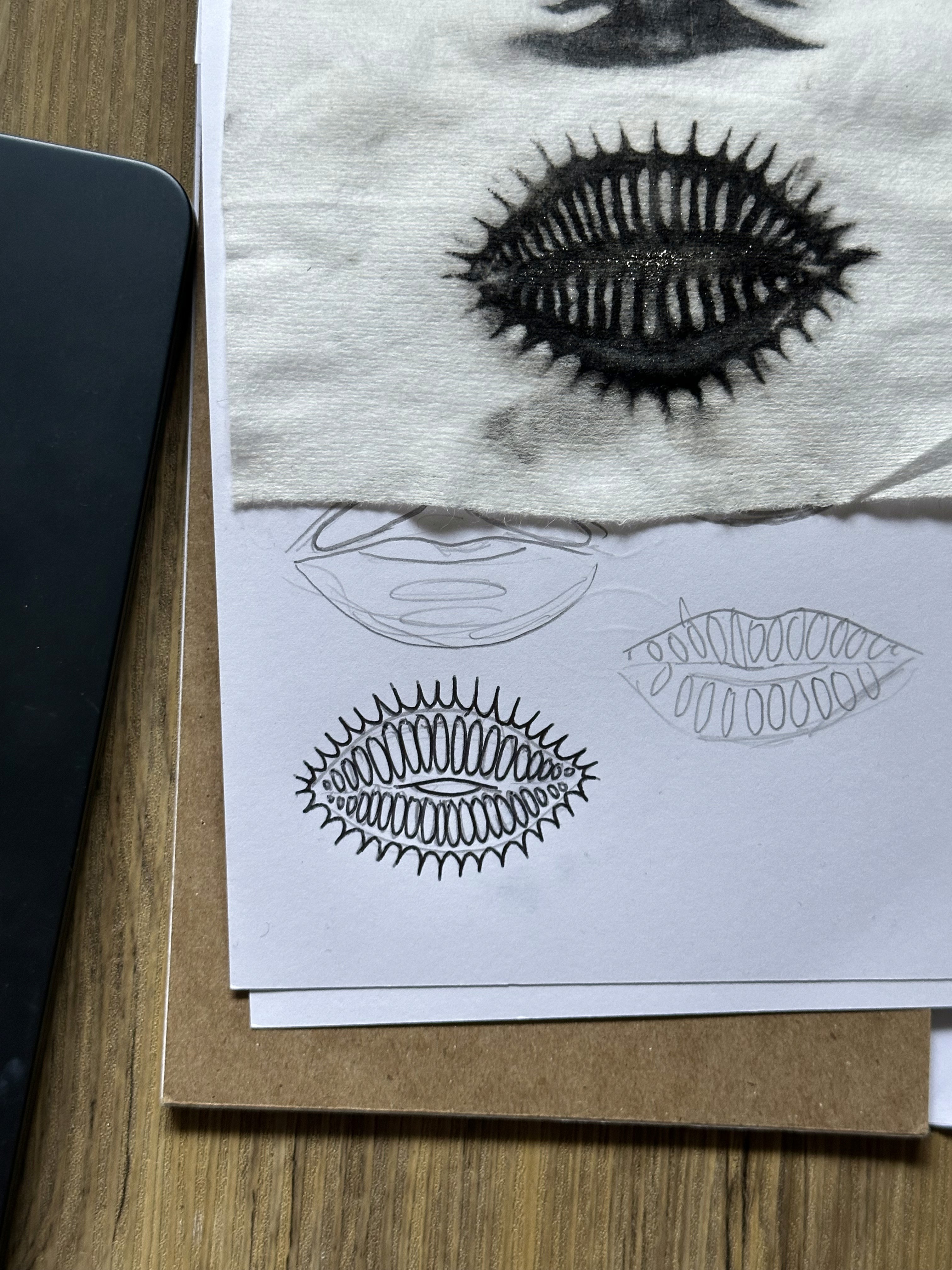
Quinn draws before the brush reaches skin, but the paper is not a contract. Anatomy interrupts. A lid folds where a line was meant to remain flat. A lash changes the proportions. A character arrives and begins editing the plan from inside it.

That tension gives the work its charge. Precision establishes the rules; the body breaks them. Control builds the room; chaos finds the hidden door.

Your faces often feel like fully formed characters. Do you know who they are before you begin, or do they reveal themselves through the makeup?

Bo Quinn: I think it’s a bit of both; I often have an idea as to where something is going to end up before I begin. I always draw up sketches prior to doing any makeup looks; I’ve found this works well for me, having something to refer to if I need. However, often the characters that form through the looks do reveal themselves in the moment and can determine how things evolve throughout the process. 9 times out of 10, the final look is never a direct copy of the sketch; I like to allow myself the freedom to change things as ideas may come in the moment.

There’s incredible precision behind even your strangest transformations. How do control and chaos coexist in your process?

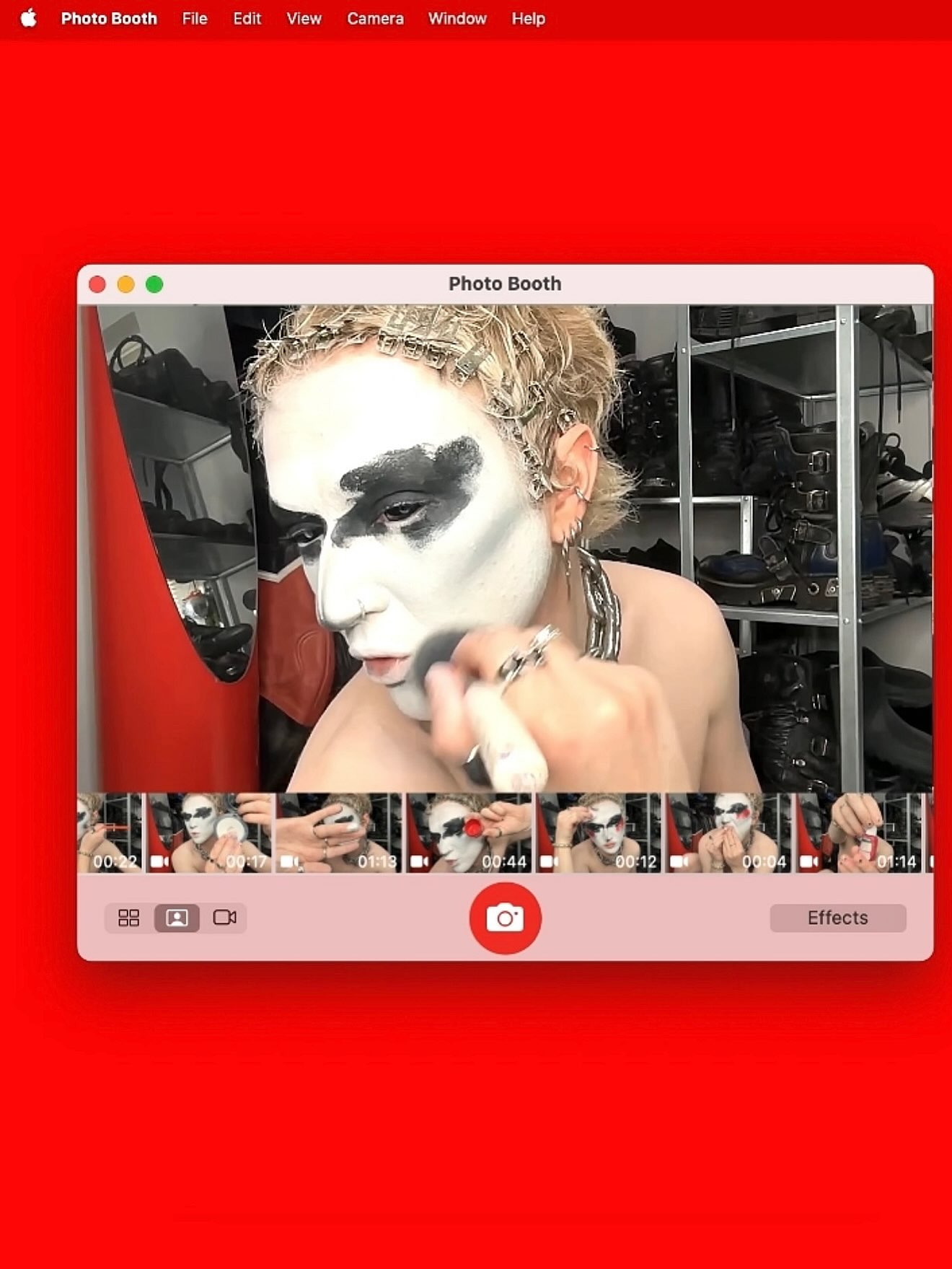
Bo Quinn: Both control and chaos definitely coexist in my process. I have recently been enjoying doing more messy makeup looks. I have done a couple and filmed them on Photobooth. I think because for so long I’ve done super precise work, I’m just enjoying having some fun with it and welcoming the chaos I sometimes push back because why not. But I will always be gravitated towards the clean, symmetry-focused makeup style that I’ve become known for. Having the balance there is important to me because, as an artist, I need to change it up sometimes to stay interested in what I’m doing.

What usually survives from the original sketch—and what only becomes possible once the idea reaches skin?

Bo Quinn: I think the idea and overall shapes and vibe will always survive the sketch, but when you put the makeup brush to the skin, the anatomy of your face gets in the way of some things you’ve drawn and aren’t achievable with makeup alone. Colours often stay consistent from sketch to final makeup. I think visually I like to decide that before; I have a thing with colours, and in my brain only a few work together at a time, I keep it pretty minimal usually anyway. Often, lashes I decide in the moment; I like to see what length/fullness will lend itself best to the eye. I’ve only been reaching for my Bo Quinn X Eldora eyelash collab recently, I’m back in on a dramatic lash. I was wearing smaller ones for a second, but I’m back; I just love the drama of a fucking massive lash.

Are there any shapes, colours, materials or visual ideas currently taking over your mind?

Bo Quinn: Red, cobalt blue, mirror chrome, dots, symmetry & asymmetry, glossy black eyes, high shine latex, silhouettes of bodies, mess contrasting perfection.

Bo Quinn with red hair, white face makeup, soft blue eyes and glossy red lips
Bo Quinn in red latex with angular black hair and asymmetric red and black eye makeup

Bo as vessel, character and image-maker. Images courtesy of Bo Quinn.

How much of Bo Quinn is an alter ego, and how much is simply an intensified version of you?

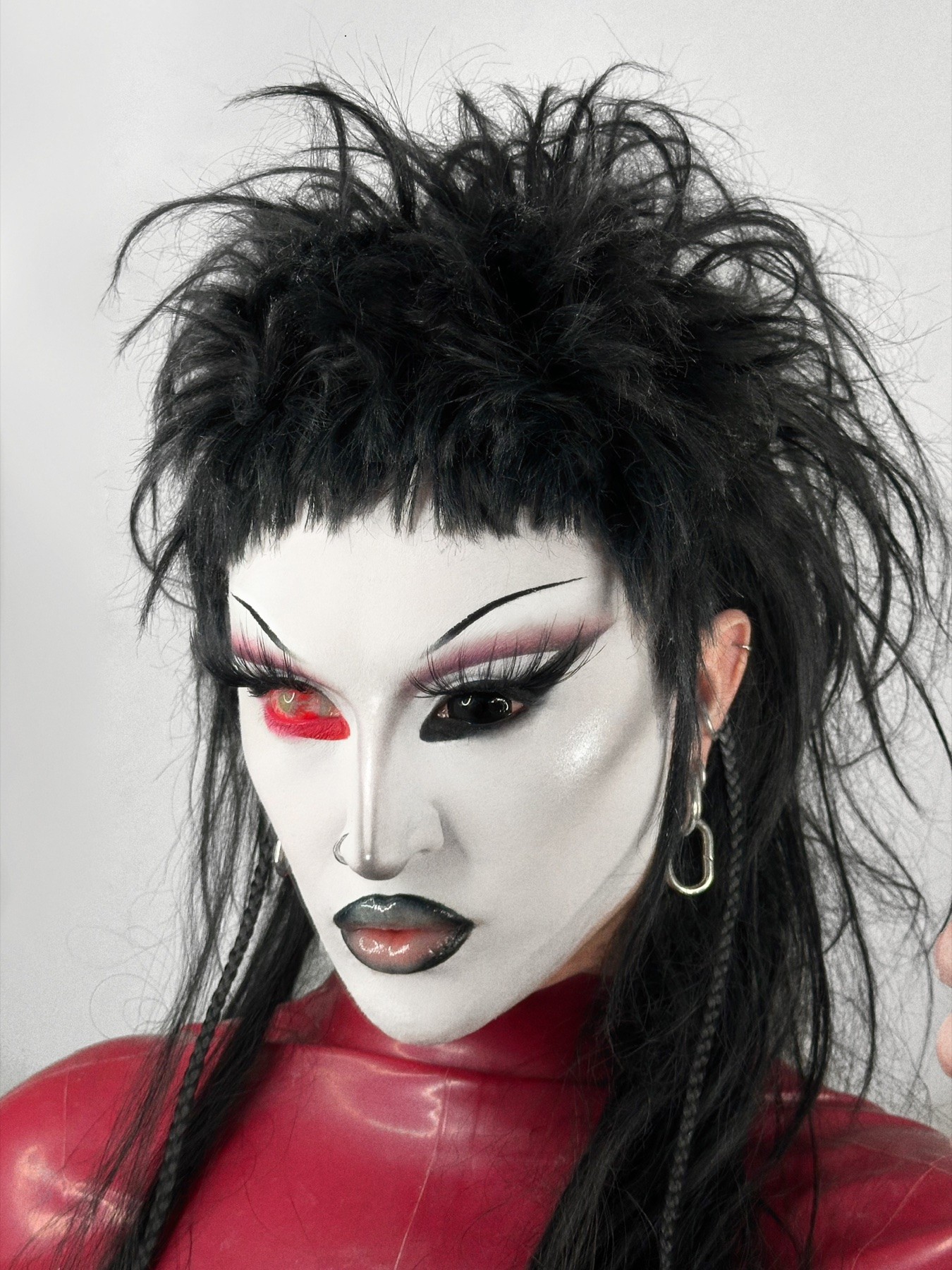
Bo Quinn: Bo Quinn is both an alter ego as well as an intensified version of myself. In terms of makeup and styling, Bo’s aesthetic is mine, just taken to the limit I don’t take it to in my day-to-day life. I think if the transformation was more practical, I’d spend more time living as Bo, but it’s not achievable a lot of the time day-to-day, and not to mention it's uncomfortable to be in, as drag tends to be, which is something I think people who don’t do it don’t fully understand. It is cool and super important to me to have a vessel that allows me to embrace and explore these parts of myself.

Bo Quinn off duty with short blond hair, a striped top and spike collar
Bo Quinn outdoors in sunglasses and a black sweatshirt between transformations
Bo Quinn without stage makeup in a green-lit mirror self-portrait

The artist behind the armour, between transformations. Images via @bo.quinn.

One window back to the source: follow Bo Quinn on Instagram.

Bo Quinn taking a mirror selfie with black star-shaped eye makeup and a spike chain collar
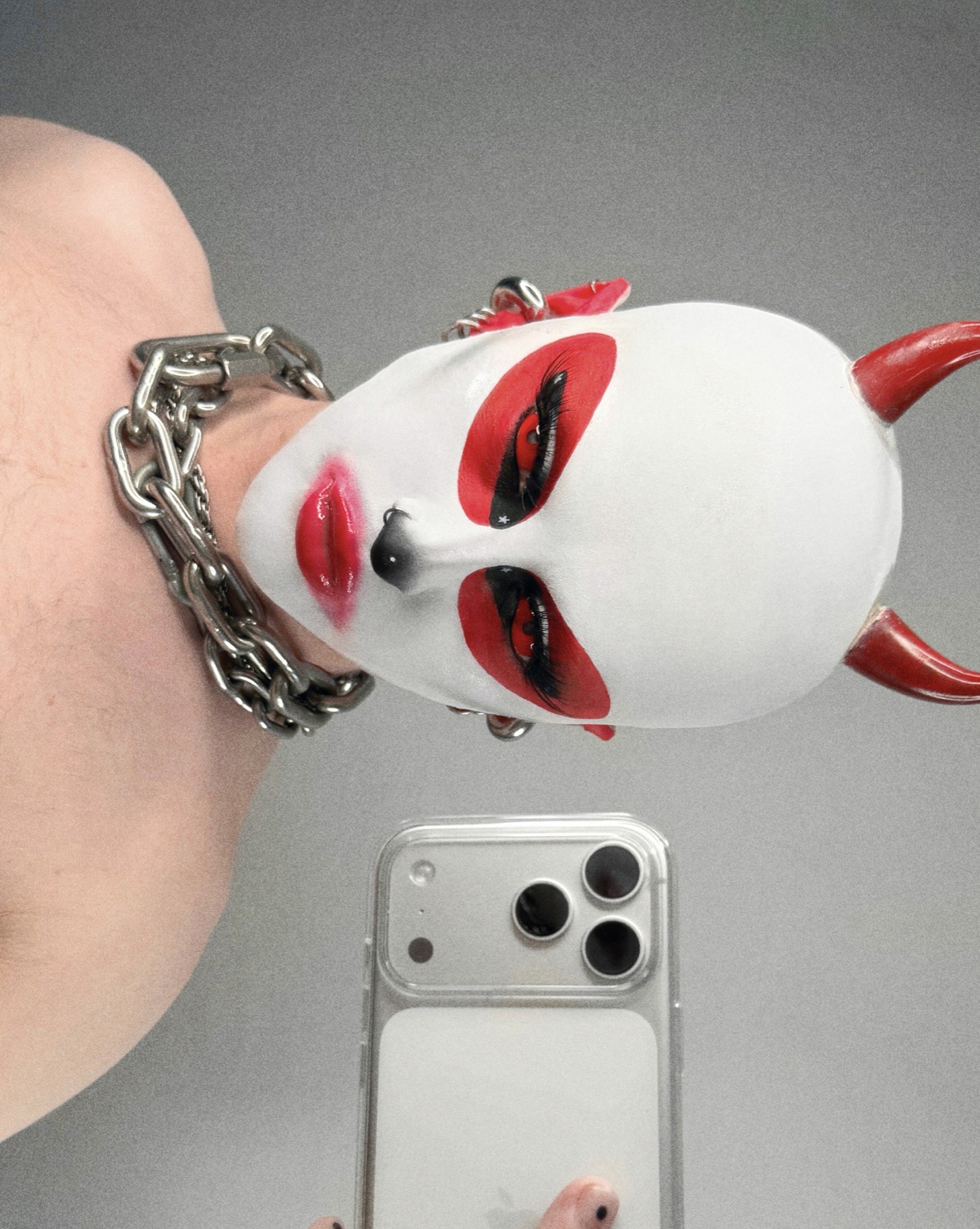
Sideways mirror selfie of Bo Quinn with red oval eye makeup, red horns and silver chains

The artist, the subject and the camera operator occupy the same mirror. Images courtesy of Bo Quinn.

No committee can make this face

Quinn makes the makeup, inhabits it, photographs it, films it and shapes the final frame. In another context, that degree of control might sound obsessive. Here it reads as protection. The image reaches the world before a committee can sand off the dangerous parts.

That matters in an industry fluent in asking artists for their signature and then requesting it in a safer font. Bo’s face will not enter the “clean girl commercial box” without leaving claw marks on the packaging. The work can collaborate; it simply refuses to disappear inside the collaboration.

You create the makeup, embody the character, photograph it, film it and shape the final image. Does having that much authorship feel liberating, exhausting—or both?

Bo Quinn: I think a bit of both; it's hard sometimes to trust someone else to achieve a creative vision you have. Being able to have a hand in the whole process usually creates a more authentic piece of work. However, I know collaborating can be super valuable and is important for development; I’ve just found in the past that the work I’ve created alone is the work I’m most proud of and happy with. I enjoy the process of each step for different reasons; for instance, capturing the images, I just know which angles I like and can easily determine which shots I’ll be able to use, and often in the editing I’ll experiment in the moment and see where that takes me rather than have a fully realised idea beforehand that I can then pass over to an editor.

Social media rewards instant recognisability. Do you ever feel pressure to keep producing the version of Bo people already understand?

Bo Quinn: I do, and I don’t - I haven’t yet felt the need to stray too far from what I imagine people already recognise Bo as. I do wonder what would happen if, for some reason, one day I wake up and never want to use white face paint or black sclera contact lenses again; where would that leave me? I do feel the pressure of constantly creating something new and exciting, but not so much from the audience but from myself. I’ve always been like that and strived for more satisfaction within my own work, which can unfortunately be a detriment to myself and the self-worth I hold. However, I know this is only because I care, and I think it’s a positive to always want to create work better than the last. Often very soon after I create and post a makeup look, I go off it and am looking at how I can one-up myself.

Brands often want an artist’s signature while still asking for something commercially accessible. How do you protect the strangeness of your work inside those collaborations?

Bo Quinn: I think if someone has come to me and wants to collaborate, they know what they’ve signed up for and that whatever that is isn’t going to fit into the clean girl commercial box. However, I have found in a couple of incidents that sometimes there is an attempt to dull down what I do or the suggestion to try something different or softer for me, which often ends in disaster. I will bend if I think it still fits my vibe, but usually during any collaborations I’ve been allowed to create what I like and have full creative direction.

Disembodied pink oval eye, yellow star eye and blue lips arranged on white
Eyes, mouth, symbols: the face dismantled and re-authored. Image courtesy of Bo Quinn.

A body can become a line

The newest idea is hiding in plain sight: silhouettes of bodies stretched across the eye. From a distance they read as severe black liner. Up close, the line acquires hips, heels, posture, attitude. A cosmetic gesture becomes a cast of characters.

It is a perfect Quinn move. The familiar shape arrives first; the visual sabotage reveals itself second. Beauty gets the viewer close enough to notice that beauty was never the whole subject.

Which recent look feels most representative of where your work is heading now?

Bo Quinn: I think the Silhouette eyeliner I did recently is super interesting and there’s something exciting within that I want to continue to explore. I see a lot of different avenues within that theme I can play with. I want to have fun with that a little more; it’s been a while since I’ve felt like that, so that’s exciting. I also have been trying to be a bit more experimental with my filming and environments. I may continue to explore that as I am getting a little bored of sitting in front of a stagnant white background.

If scale, money and practicality disappeared completely, what would you create?

Bo Quinn: I’d love to do a huge exhibition of my wipe prints one day - I imagine a huge white wall covered in all the different variations. I think it would be cool to see them all together and almost as one piece of work. If there were no financial or practical limitations, I’d take what I’m already doing and push it to a completely different scale – props, costumes, hair, sets, the whole thing.

Finish this sentence: Beauty becomes interesting when…

Bo Quinn: Beauty becomes interesting when you don’t care about being beautiful.

That sentence is the key and the exit wound. Quinn is not arguing that beauty is dead. The work catches beauty pretending innocence, removes its alibi and makes it testify. Every hard line, massive lash and stained wipe insists that a face can be more than acceptable.

It can be authored. It can be uncomfortable. It can be funny, severe, excessive and alive. It can make the wrong side of the internet recoil. Good. A face with a point of view was never supposed to pass quietly.

Beauty
The FRENZY Interview: Bo Quinn Makes Beauty Misbehave
In this visual interview, Bo Quinn opens the sketchbooks, studio archive and afterlife of the looks—and explains why beauty becomes interesting only when it stops trying to be beautiful.

Text

Noah Cruz

Bo Quinn does not paint a face. Bo stages a hostile takeover.

An eye becomes a warning sign. A mouth grows barbs. White paint erases the polite evidence of skin, then cobalt, latex red and glossy black move in like squatters with excellent taste. Even the lashes refuse moderation. They do not flutter; they announce an event.

This is beauty dragged out of the flattering light and made to develop a point of view. Quinn’s work is exact without becoming obedient, theatrical without hiding behind costume and strange without begging to be understood. The face is still a face. It has simply stopped behaving like one.

Extreme close-up of Bo Quinn in white makeup, black liner and lacquered red lips above a metal spike collar
Red lacquer, white ground, metal punctuation. Image courtesy of Bo Quinn.

When you look at a bare face, what do you see first: a person, a canvas, an architecture or the beginning of a character?

Bo Quinn: When looking at a bare face, I see a canvas to create whatever I may be feeling that day. The architecture of different faces, however, organically informs the avenue I may take. Some things work on people; some don’t. Because I mainly work on myself, over time I have figured out what works on my features and how I like to present myself in makeup. This is why, for me, working on others is exciting because the possibilities suddenly become endless.

Traditional beauty often tries to soften, flatter and perfect. Your work exaggerates, disrupts and sometimes unnerves. What becomes possible once “pretty” is no longer the goal?

Bo Quinn: Anything and everything becomes possible once ‘pretty’ is no longer the goal. Once you let go of social norms or what other people consider ‘beautiful’ you can immerse yourself in any world you feel fits. There are so many boring ‘pretty’ people in this world contributing absolutely nothing; why not be the weirdo with a point of view in the corner?

Bo Quinn in white face makeup with black graphic eyes, an exaggerated black smile and a metal spike collar
Bo Quinn wearing a white knitted mask edged in red with red horns and metal neck spikes

The face as graphic system; the face as wearable architecture. Images courtesy of Bo Quinn.

Pretty is a compliance department

Mainstream beauty still loves the language of liberation while selling the same obedient face: lifted, glazed, poreless, reassuring. Every feature is encouraged to become its most socially legible self. Quinn takes that administrative fantasy and puts it through a shredder.

The seduction is not gone. It has simply developed teeth. A black sclera lens can be menacing and magnetic at once; a latex mouth can read as glamour even while it resembles a trap. Quinn is not trying to settle the argument between beautiful and grotesque. The argument is the look.

Do you want someone encountering one of your looks to feel seduced first—or disturbed first?

Bo Quinn: As long as it’s making some sort of impact and creating a response of any kind, then I’m happy. I like that my work evokes so many different reactions from people. Often when one of my looks blows up online, some of the comments are wild. Once it hits the wrong side of socials, I know I’ve done my job correctly. It’s also not important or useful for me to get too heavily focused on what other people with no interest or experience in makeup think of me or my work.

Where does beauty end and the grotesque begin for you? Does that distinction even matter?

Bo Quinn: I don’t think the distinction between the grotesque and beauty matters to me so much. There will always be aspects of both within my work, as that’s what I’m naturally drawn to. I don’t think about it too deeply; I like to add a little spook into anything I do because I think it’s cool.
White face wipe carrying an abstract red face print and closed lashes
Face wipe printed with yellow star-shaped eyes and a red mouth
Bo Quinn process board with a red face-wipe print, sketch, horn props and silver chain

Selections from Swipe for the Wipe and the studio process. Images courtesy of Bo Quinn.

The evidence refuses to disappear

Most makeup content worships the reveal and deletes the wreckage. Quinn keeps the wreckage. Swipe for the Wipe catches each look at the moment it should vanish: pigment pressed into cloth, lashes leaving little soot signatures, mouths surviving as stains. Removal becomes printmaking. The discarded thing develops an afterlife.

They look like beauty’s crime scenes, but also its receipts. A face happened here. Labour happened here. Time happened here. The images refuse the industry’s favourite lie—that transformation arrives cleanly, lives forever and leaves no mess.

Your Swipe for the Wipe pieces turn the destruction of a look into another artwork. Does removing the makeup feel like the end of the performance—or its final creative act?

Bo Quinn: Removing makeup for me is the final creative act. I’ve been collecting and sometimes selling my face wipe prints for 6+ years now, and this has been an opportunity for me to share my work with people all around the world that usually would sit inside a screen.
Bo Quinn process board showing a black spiked lip print and pencil studies
Sketch, test, transfer, mutate. Process image courtesy of Bo Quinn.

A sketch is not a command

Quinn draws before the brush reaches skin, but the paper is not a contract. Anatomy interrupts. A lid folds where a line was meant to remain flat. A lash changes the proportions. A character arrives and begins editing the plan from inside it.

That tension gives the work its charge. Precision establishes the rules; the body breaks them. Control builds the room; chaos finds the hidden door.

Your faces often feel like fully formed characters. Do you know who they are before you begin, or do they reveal themselves through the makeup?

Bo Quinn: I think it’s a bit of both; I often have an idea as to where something is going to end up before I begin. I always draw up sketches prior to doing any makeup looks; I’ve found this works well for me, having something to refer to if I need. However, often the characters that form through the looks do reveal themselves in the moment and can determine how things evolve throughout the process. 9 times out of 10, the final look is never a direct copy of the sketch; I like to allow myself the freedom to change things as ideas may come in the moment.

There’s incredible precision behind even your strangest transformations. How do control and chaos coexist in your process?

Bo Quinn: Both control and chaos definitely coexist in my process. I have recently been enjoying doing more messy makeup looks. I have done a couple and filmed them on Photobooth. I think because for so long I’ve done super precise work, I’m just enjoying having some fun with it and welcoming the chaos I sometimes push back because why not. But I will always be gravitated towards the clean, symmetry-focused makeup style that I’ve become known for. Having the balance there is important to me because, as an artist, I need to change it up sometimes to stay interested in what I’m doing.

What usually survives from the original sketch—and what only becomes possible once the idea reaches skin?

Bo Quinn: I think the idea and overall shapes and vibe will always survive the sketch, but when you put the makeup brush to the skin, the anatomy of your face gets in the way of some things you’ve drawn and aren’t achievable with makeup alone. Colours often stay consistent from sketch to final makeup. I think visually I like to decide that before; I have a thing with colours, and in my brain only a few work together at a time, I keep it pretty minimal usually anyway. Often, lashes I decide in the moment; I like to see what length/fullness will lend itself best to the eye. I’ve only been reaching for my Bo Quinn X Eldora eyelash collab recently, I’m back in on a dramatic lash. I was wearing smaller ones for a second, but I’m back; I just love the drama of a fucking massive lash.

Are there any shapes, colours, materials or visual ideas currently taking over your mind?

Bo Quinn: Red, cobalt blue, mirror chrome, dots, symmetry & asymmetry, glossy black eyes, high shine latex, silhouettes of bodies, mess contrasting perfection.

Bo Quinn with red hair, white face makeup, soft blue eyes and glossy red lips
Bo Quinn in red latex with angular black hair and asymmetric red and black eye makeup

Bo as vessel, character and image-maker. Images courtesy of Bo Quinn.

How much of Bo Quinn is an alter ego, and how much is simply an intensified version of you?

Bo Quinn: Bo Quinn is both an alter ego as well as an intensified version of myself. In terms of makeup and styling, Bo’s aesthetic is mine, just taken to the limit I don’t take it to in my day-to-day life. I think if the transformation was more practical, I’d spend more time living as Bo, but it’s not achievable a lot of the time day-to-day, and not to mention it's uncomfortable to be in, as drag tends to be, which is something I think people who don’t do it don’t fully understand. It is cool and super important to me to have a vessel that allows me to embrace and explore these parts of myself.
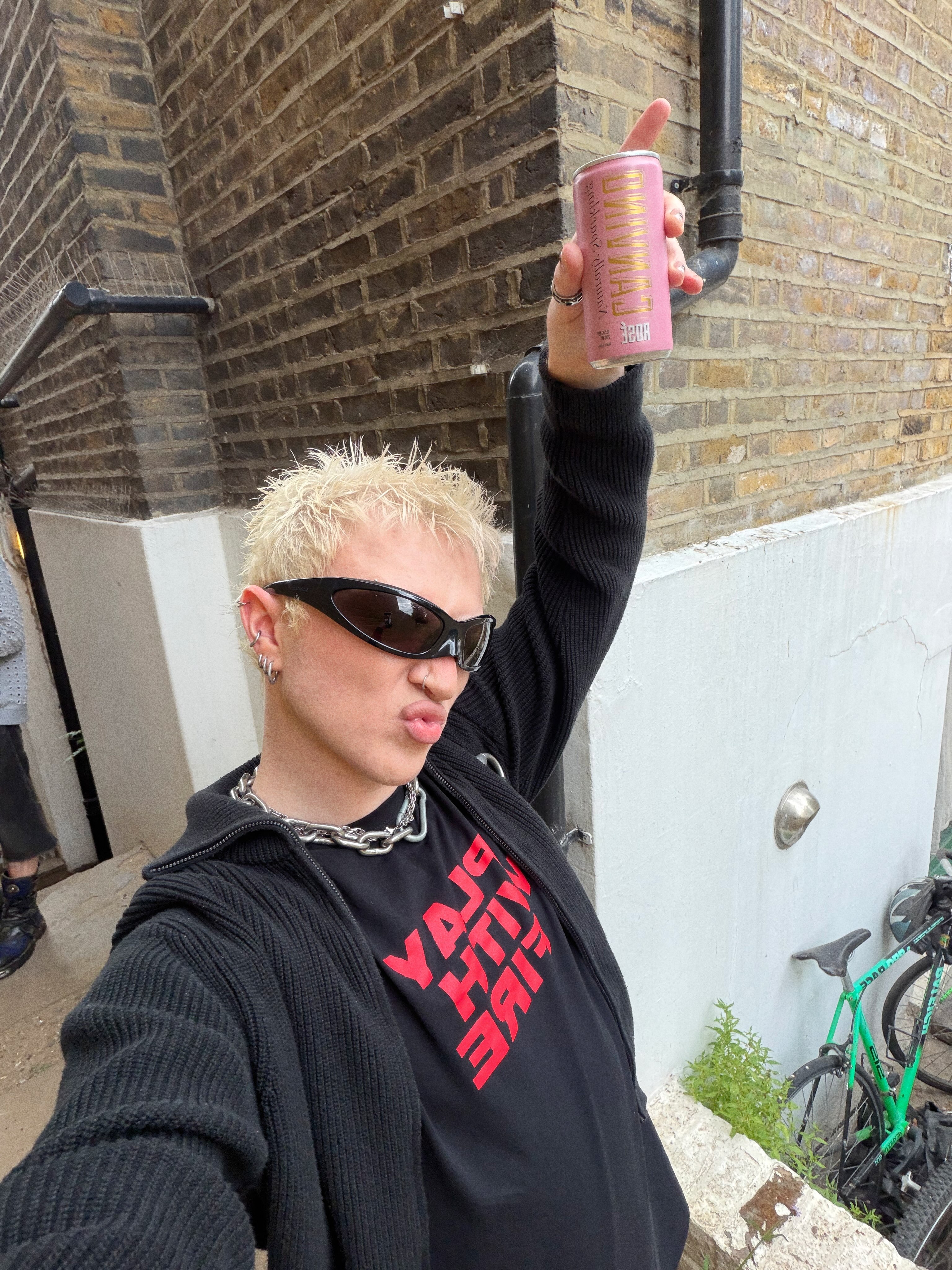
Bo Quinn off duty with short blond hair, a striped top and spike collar
Bo Quinn outdoors in sunglasses and a black sweatshirt between transformations
Bo Quinn without stage makeup in a green-lit mirror self-portrait

The artist behind the armour, between transformations. Images via @bo.quinn.

One window back to the source: follow Bo Quinn on Instagram.

Bo Quinn taking a mirror selfie with black star-shaped eye makeup and a spike chain collar
Sideways mirror selfie of Bo Quinn with red oval eye makeup, red horns and silver chains

The artist, the subject and the camera operator occupy the same mirror. Images courtesy of Bo Quinn.

No committee can make this face

Quinn makes the makeup, inhabits it, photographs it, films it and shapes the final frame. In another context, that degree of control might sound obsessive. Here it reads as protection. The image reaches the world before a committee can sand off the dangerous parts.

That matters in an industry fluent in asking artists for their signature and then requesting it in a safer font. Bo’s face will not enter the “clean girl commercial box” without leaving claw marks on the packaging. The work can collaborate; it simply refuses to disappear inside the collaboration.

You create the makeup, embody the character, photograph it, film it and shape the final image. Does having that much authorship feel liberating, exhausting—or both?

Bo Quinn: I think a bit of both; it's hard sometimes to trust someone else to achieve a creative vision you have. Being able to have a hand in the whole process usually creates a more authentic piece of work. However, I know collaborating can be super valuable and is important for development; I’ve just found in the past that the work I’ve created alone is the work I’m most proud of and happy with. I enjoy the process of each step for different reasons; for instance, capturing the images, I just know which angles I like and can easily determine which shots I’ll be able to use, and often in the editing I’ll experiment in the moment and see where that takes me rather than have a fully realised idea beforehand that I can then pass over to an editor.

Social media rewards instant recognisability. Do you ever feel pressure to keep producing the version of Bo people already understand?

Bo Quinn: I do, and I don’t - I haven’t yet felt the need to stray too far from what I imagine people already recognise Bo as. I do wonder what would happen if, for some reason, one day I wake up and never want to use white face paint or black sclera contact lenses again; where would that leave me? I do feel the pressure of constantly creating something new and exciting, but not so much from the audience but from myself. I’ve always been like that and strived for more satisfaction within my own work, which can unfortunately be a detriment to myself and the self-worth I hold. However, I know this is only because I care, and I think it’s a positive to always want to create work better than the last. Often very soon after I create and post a makeup look, I go off it and am looking at how I can one-up myself.

Brands often want an artist’s signature while still asking for something commercially accessible. How do you protect the strangeness of your work inside those collaborations?

Bo Quinn: I think if someone has come to me and wants to collaborate, they know what they’ve signed up for and that whatever that is isn’t going to fit into the clean girl commercial box. However, I have found in a couple of incidents that sometimes there is an attempt to dull down what I do or the suggestion to try something different or softer for me, which often ends in disaster. I will bend if I think it still fits my vibe, but usually during any collaborations I’ve been allowed to create what I like and have full creative direction.

Disembodied pink oval eye, yellow star eye and blue lips arranged on white
Eyes, mouth, symbols: the face dismantled and re-authored. Image courtesy of Bo Quinn.

A body can become a line

The newest idea is hiding in plain sight: silhouettes of bodies stretched across the eye. From a distance they read as severe black liner. Up close, the line acquires hips, heels, posture, attitude. A cosmetic gesture becomes a cast of characters.

It is a perfect Quinn move. The familiar shape arrives first; the visual sabotage reveals itself second. Beauty gets the viewer close enough to notice that beauty was never the whole subject.

Which recent look feels most representative of where your work is heading now?

Bo Quinn: I think the Silhouette eyeliner I did recently is super interesting and there’s something exciting within that I want to continue to explore. I see a lot of different avenues within that theme I can play with. I want to have fun with that a little more; it’s been a while since I’ve felt like that, so that’s exciting. I also have been trying to be a bit more experimental with my filming and environments. I may continue to explore that as I am getting a little bored of sitting in front of a stagnant white background.

If scale, money and practicality disappeared completely, what would you create?

Bo Quinn: I’d love to do a huge exhibition of my wipe prints one day - I imagine a huge white wall covered in all the different variations. I think it would be cool to see them all together and almost as one piece of work. If there were no financial or practical limitations, I’d take what I’m already doing and push it to a completely different scale – props, costumes, hair, sets, the whole thing.

Finish this sentence: Beauty becomes interesting when…

Bo Quinn: Beauty becomes interesting when you don’t care about being beautiful.

That sentence is the key and the exit wound. Quinn is not arguing that beauty is dead. The work catches beauty pretending innocence, removes its alibi and makes it testify. Every hard line, massive lash and stained wipe insists that a face can be more than acceptable.

It can be authored. It can be uncomfortable. It can be funny, severe, excessive and alive. It can make the wrong side of the internet recoil. Good. A face with a point of view was never supposed to pass quietly.

Beauty
The FRENZY Interview: Bo Quinn Makes Beauty Misbehave
In this visual interview, Bo Quinn opens the sketchbooks, studio archive and afterlife of the looks—and explains why beauty becomes interesting only when it stops trying to be beautiful.

Text

Noah Cruz

Bo Quinn does not paint a face. Bo stages a hostile takeover.

An eye becomes a warning sign. A mouth grows barbs. White paint erases the polite evidence of skin, then cobalt, latex red and glossy black move in like squatters with excellent taste. Even the lashes refuse moderation. They do not flutter; they announce an event.

This is beauty dragged out of the flattering light and made to develop a point of view. Quinn’s work is exact without becoming obedient, theatrical without hiding behind costume and strange without begging to be understood. The face is still a face. It has simply stopped behaving like one.

Extreme close-up of Bo Quinn in white makeup, black liner and lacquered red lips above a metal spike collar
Red lacquer, white ground, metal punctuation. Image courtesy of Bo Quinn.

When you look at a bare face, what do you see first: a person, a canvas, an architecture or the beginning of a character?

Bo Quinn: When looking at a bare face, I see a canvas to create whatever I may be feeling that day. The architecture of different faces, however, organically informs the avenue I may take. Some things work on people; some don’t. Because I mainly work on myself, over time I have figured out what works on my features and how I like to present myself in makeup. This is why, for me, working on others is exciting because the possibilities suddenly become endless.

Traditional beauty often tries to soften, flatter and perfect. Your work exaggerates, disrupts and sometimes unnerves. What becomes possible once “pretty” is no longer the goal?

Bo Quinn: Anything and everything becomes possible once ‘pretty’ is no longer the goal. Once you let go of social norms or what other people consider ‘beautiful’ you can immerse yourself in any world you feel fits. There are so many boring ‘pretty’ people in this world contributing absolutely nothing; why not be the weirdo with a point of view in the corner?

Bo Quinn in white face makeup with black graphic eyes, an exaggerated black smile and a metal spike collar
Bo Quinn wearing a white knitted mask edged in red with red horns and metal neck spikes

The face as graphic system; the face as wearable architecture. Images courtesy of Bo Quinn.

Pretty is a compliance department

Mainstream beauty still loves the language of liberation while selling the same obedient face: lifted, glazed, poreless, reassuring. Every feature is encouraged to become its most socially legible self. Quinn takes that administrative fantasy and puts it through a shredder.

The seduction is not gone. It has simply developed teeth. A black sclera lens can be menacing and magnetic at once; a latex mouth can read as glamour even while it resembles a trap. Quinn is not trying to settle the argument between beautiful and grotesque. The argument is the look.

Do you want someone encountering one of your looks to feel seduced first—or disturbed first?

Bo Quinn: As long as it’s making some sort of impact and creating a response of any kind, then I’m happy. I like that my work evokes so many different reactions from people. Often when one of my looks blows up online, some of the comments are wild. Once it hits the wrong side of socials, I know I’ve done my job correctly. It’s also not important or useful for me to get too heavily focused on what other people with no interest or experience in makeup think of me or my work.

Where does beauty end and the grotesque begin for you? Does that distinction even matter?

Bo Quinn: I don’t think the distinction between the grotesque and beauty matters to me so much. There will always be aspects of both within my work, as that’s what I’m naturally drawn to. I don’t think about it too deeply; I like to add a little spook into anything I do because I think it’s cool.

White face wipe carrying an abstract red face print and closed lashes
Face wipe printed with yellow star-shaped eyes and a red mouth
Bo Quinn process board with a red face-wipe print, sketch, horn props and silver chain

Selections from Swipe for the Wipe and the studio process. Images courtesy of Bo Quinn.

The evidence refuses to disappear

Most makeup content worships the reveal and deletes the wreckage. Quinn keeps the wreckage. Swipe for the Wipe catches each look at the moment it should vanish: pigment pressed into cloth, lashes leaving little soot signatures, mouths surviving as stains. Removal becomes printmaking. The discarded thing develops an afterlife.

They look like beauty’s crime scenes, but also its receipts. A face happened here. Labour happened here. Time happened here. The images refuse the industry’s favourite lie—that transformation arrives cleanly, lives forever and leaves no mess.

Your Swipe for the Wipe pieces turn the destruction of a look into another artwork. Does removing the makeup feel like the end of the performance—or its final creative act?

Bo Quinn: Removing makeup for me is the final creative act. I’ve been collecting and sometimes selling my face wipe prints for 6+ years now, and this has been an opportunity for me to share my work with people all around the world that usually would sit inside a screen.

Bo Quinn process board showing a black spiked lip print and pencil studies
Sketch, test, transfer, mutate. Process image courtesy of Bo Quinn.

A sketch is not a command

Quinn draws before the brush reaches skin, but the paper is not a contract. Anatomy interrupts. A lid folds where a line was meant to remain flat. A lash changes the proportions. A character arrives and begins editing the plan from inside it.

That tension gives the work its charge. Precision establishes the rules; the body breaks them. Control builds the room; chaos finds the hidden door.

Your faces often feel like fully formed characters. Do you know who they are before you begin, or do they reveal themselves through the makeup?

Bo Quinn: I think it’s a bit of both; I often have an idea as to where something is going to end up before I begin. I always draw up sketches prior to doing any makeup looks; I’ve found this works well for me, having something to refer to if I need. However, often the characters that form through the looks do reveal themselves in the moment and can determine how things evolve throughout the process. 9 times out of 10, the final look is never a direct copy of the sketch; I like to allow myself the freedom to change things as ideas may come in the moment.

There’s incredible precision behind even your strangest transformations. How do control and chaos coexist in your process?

Bo Quinn: Both control and chaos definitely coexist in my process. I have recently been enjoying doing more messy makeup looks. I have done a couple and filmed them on Photobooth. I think because for so long I’ve done super precise work, I’m just enjoying having some fun with it and welcoming the chaos I sometimes push back because why not. But I will always be gravitated towards the clean, symmetry-focused makeup style that I’ve become known for. Having the balance there is important to me because, as an artist, I need to change it up sometimes to stay interested in what I’m doing.

What usually survives from the original sketch—and what only becomes possible once the idea reaches skin?

Bo Quinn: I think the idea and overall shapes and vibe will always survive the sketch, but when you put the makeup brush to the skin, the anatomy of your face gets in the way of some things you’ve drawn and aren’t achievable with makeup alone. Colours often stay consistent from sketch to final makeup. I think visually I like to decide that before; I have a thing with colours, and in my brain only a few work together at a time, I keep it pretty minimal usually anyway. Often, lashes I decide in the moment; I like to see what length/fullness will lend itself best to the eye. I’ve only been reaching for my Bo Quinn X Eldora eyelash collab recently, I’m back in on a dramatic lash. I was wearing smaller ones for a second, but I’m back; I just love the drama of a fucking massive lash.

Are there any shapes, colours, materials or visual ideas currently taking over your mind?

Bo Quinn: Red, cobalt blue, mirror chrome, dots, symmetry & asymmetry, glossy black eyes, high shine latex, silhouettes of bodies, mess contrasting perfection.

Bo Quinn with red hair, white face makeup, soft blue eyes and glossy red lips
Bo Quinn in red latex with angular black hair and asymmetric red and black eye makeup

Bo as vessel, character and image-maker. Images courtesy of Bo Quinn.

How much of Bo Quinn is an alter ego, and how much is simply an intensified version of you?

Bo Quinn: Bo Quinn is both an alter ego as well as an intensified version of myself. In terms of makeup and styling, Bo’s aesthetic is mine, just taken to the limit I don’t take it to in my day-to-day life. I think if the transformation was more practical, I’d spend more time living as Bo, but it’s not achievable a lot of the time day-to-day, and not to mention it's uncomfortable to be in, as drag tends to be, which is something I think people who don’t do it don’t fully understand. It is cool and super important to me to have a vessel that allows me to embrace and explore these parts of myself.

Bo Quinn off duty with short blond hair, a striped top and spike collar
Bo Quinn outdoors in sunglasses and a black sweatshirt between transformations
Bo Quinn without stage makeup in a green-lit mirror self-portrait

The artist behind the armour, between transformations. Images via @bo.quinn.

One window back to the source: follow Bo Quinn on Instagram.

Bo Quinn taking a mirror selfie with black star-shaped eye makeup and a spike chain collar
Sideways mirror selfie of Bo Quinn with red oval eye makeup, red horns and silver chains

The artist, the subject and the camera operator occupy the same mirror. Images courtesy of Bo Quinn.

No committee can make this face

Quinn makes the makeup, inhabits it, photographs it, films it and shapes the final frame. In another context, that degree of control might sound obsessive. Here it reads as protection. The image reaches the world before a committee can sand off the dangerous parts.

That matters in an industry fluent in asking artists for their signature and then requesting it in a safer font. Bo’s face will not enter the “clean girl commercial box” without leaving claw marks on the packaging. The work can collaborate; it simply refuses to disappear inside the collaboration.

You create the makeup, embody the character, photograph it, film it and shape the final image. Does having that much authorship feel liberating, exhausting—or both?

Bo Quinn: I think a bit of both; it's hard sometimes to trust someone else to achieve a creative vision you have. Being able to have a hand in the whole process usually creates a more authentic piece of work. However, I know collaborating can be super valuable and is important for development; I’ve just found in the past that the work I’ve created alone is the work I’m most proud of and happy with. I enjoy the process of each step for different reasons; for instance, capturing the images, I just know which angles I like and can easily determine which shots I’ll be able to use, and often in the editing I’ll experiment in the moment and see where that takes me rather than have a fully realised idea beforehand that I can then pass over to an editor.

Social media rewards instant recognisability. Do you ever feel pressure to keep producing the version of Bo people already understand?

Bo Quinn: I do, and I don’t - I haven’t yet felt the need to stray too far from what I imagine people already recognise Bo as. I do wonder what would happen if, for some reason, one day I wake up and never want to use white face paint or black sclera contact lenses again; where would that leave me? I do feel the pressure of constantly creating something new and exciting, but not so much from the audience but from myself. I’ve always been like that and strived for more satisfaction within my own work, which can unfortunately be a detriment to myself and the self-worth I hold. However, I know this is only because I care, and I think it’s a positive to always want to create work better than the last. Often very soon after I create and post a makeup look, I go off it and am looking at how I can one-up myself.

Brands often want an artist’s signature while still asking for something commercially accessible. How do you protect the strangeness of your work inside those collaborations?

Bo Quinn: I think if someone has come to me and wants to collaborate, they know what they’ve signed up for and that whatever that is isn’t going to fit into the clean girl commercial box. However, I have found in a couple of incidents that sometimes there is an attempt to dull down what I do or the suggestion to try something different or softer for me, which often ends in disaster. I will bend if I think it still fits my vibe, but usually during any collaborations I’ve been allowed to create what I like and have full creative direction.
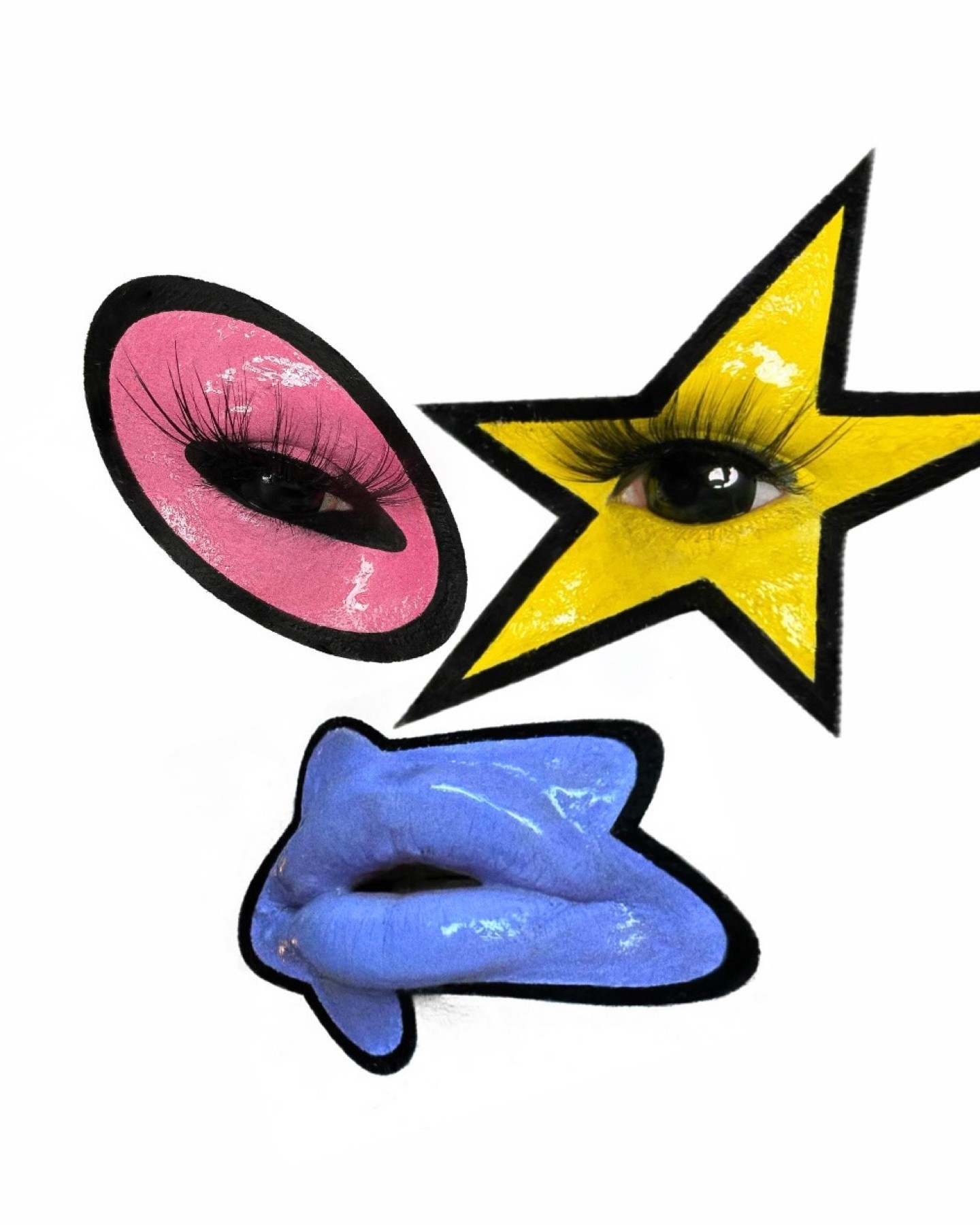
Disembodied pink oval eye, yellow star eye and blue lips arranged on white
Eyes, mouth, symbols: the face dismantled and re-authored. Image courtesy of Bo Quinn.

A body can become a line

The newest idea is hiding in plain sight: silhouettes of bodies stretched across the eye. From a distance they read as severe black liner. Up close, the line acquires hips, heels, posture, attitude. A cosmetic gesture becomes a cast of characters.

It is a perfect Quinn move. The familiar shape arrives first; the visual sabotage reveals itself second. Beauty gets the viewer close enough to notice that beauty was never the whole subject.

Which recent look feels most representative of where your work is heading now?

Bo Quinn: I think the Silhouette eyeliner I did recently is super interesting and there’s something exciting within that I want to continue to explore. I see a lot of different avenues within that theme I can play with. I want to have fun with that a little more; it’s been a while since I’ve felt like that, so that’s exciting. I also have been trying to be a bit more experimental with my filming and environments. I may continue to explore that as I am getting a little bored of sitting in front of a stagnant white background.

If scale, money and practicality disappeared completely, what would you create?

Bo Quinn: I’d love to do a huge exhibition of my wipe prints one day - I imagine a huge white wall covered in all the different variations. I think it would be cool to see them all together and almost as one piece of work. If there were no financial or practical limitations, I’d take what I’m already doing and push it to a completely different scale – props, costumes, hair, sets, the whole thing.

Finish this sentence: Beauty becomes interesting when…

Bo Quinn: Beauty becomes interesting when you don’t care about being beautiful.

That sentence is the key and the exit wound. Quinn is not arguing that beauty is dead. The work catches beauty pretending innocence, removes its alibi and makes it testify. Every hard line, massive lash and stained wipe insists that a face can be more than acceptable.

It can be authored. It can be uncomfortable. It can be funny, severe, excessive and alive. It can make the wrong side of the internet recoil. Good. A face with a point of view was never supposed to pass quietly.

Get Frenzy straight to your inbox!
Latest