Phoebe Bridgers arrived at the Venice film festival in a fitted black Gucci skirt suit, neat blonde updo and exposed legs. The clothes were precise. The grooming looked expensive. The leg hair was ordinary. That last detail became the story.
The response was mostly celebratory: fans called the visible hair refreshing, rare and unexpectedly moving. The Guardian’s reporting found young women describing it as rebellious and reassuring. The approval was real. So was the strange condition attached to it. Hair could enter the image because every other part of the image announced control.
This is the new body-hair agreement. A celebrity armpit can be editorial. Dyed hair can be playful. A carefully framed portrait can become empowerment content. Growth becomes acceptable when it behaves like a choice the audience can recognise: styled, captioned, photographed, explained.
What still unsettles people is hair without a concept. The leg missed before work. The underarm visible at the supermarket. The body that offers no manifesto, no celebrity and no evidence that its owner has turned non-removal into a project.

The celebrity body arrives with a caption
Celebrity changes the visual grammar of neglect. On an ordinary person, visible body hair is often read as evidence: she did not prepare, she stopped caring, she failed to anticipate the gaze. On a red carpet, preparation is assumed. Stylists, fittings, cameras and brand credits surround the body. Nothing appears accidental, so the hair cannot be dismissed as an accident.
That protection lets the same feature move from “unpresentable” to “unapologetic.” Emma Corrin’s visible armpit hair on a magazine cover triggered another cycle of commentary in 2024. Julia Roberts’ unshaven underarm at the 1999 Notting Hill premiere still resurfaces as cultural evidence. Each appearance is treated as a fresh rupture, even though the body is doing the least novel thing possible: growing hair.
The repetition exposes how little the norm has moved. A feature does not become news because it is common. It becomes news because its commonness has been kept outside polished images. Celebrity visibility interrupts that absence, but it also keeps the body hair exceptional. We are invited to admire the confidence of the wearer instead of questioning why confidence was required.

Ordinary growth has no production value
Beauty culture has become fluent in the language of choice. Shave if it feels good. Grow it if it feels good. Dye it pink if that feels better. The sentence sounds neutral because the verbs belong to the individual. The social consequences do not.
A person who removes hair rarely has to explain the decision. Removal disappears into the baseline. Non-removal remains visible as a position, especially on feminine bodies and in workplaces, formal settings, gyms, beaches and dating. Even indifference is interpreted as ideology. The body cannot simply be; it must either conform or communicate.
Class changes the reading. Expensive clothes, recognisable beauty work and thinness can make hair appear intentional. The same growth on a body already judged outside the ideal—fat, disabled, trans, poor, older or racially marked by different expectations—can be treated as further evidence of disorder. “Natural” beauty is welcomed most easily when the person displaying it is already understood as beautiful.
The apparent liberation is therefore uneven. The hair may be free, but the image around it is doing unpaid security work.
The hair is acceptable. The loss of control around it is not.
The hygiene story was sold
The demand for hairlessness often hides inside the language of cleanliness, as though biology had assigned different hygiene rules to different genders. The distinction is cultural, not clinical. Hair on a man can be neutral, rugged or merely present. Hair on a woman is asked to prove it has not arrived through laziness.
The commercial history is unusually clear. The Smithsonian’s National Museum of American History notes that early twentieth-century razor manufacturers, seeking new customers, promoted women’s body hair as masculine, indelicate and unhygienic. Marketing avoided the masculine-coded word “shaving” while building a new category of products around smoothness. A bodily feature became a consumer problem, then the solution became routine.
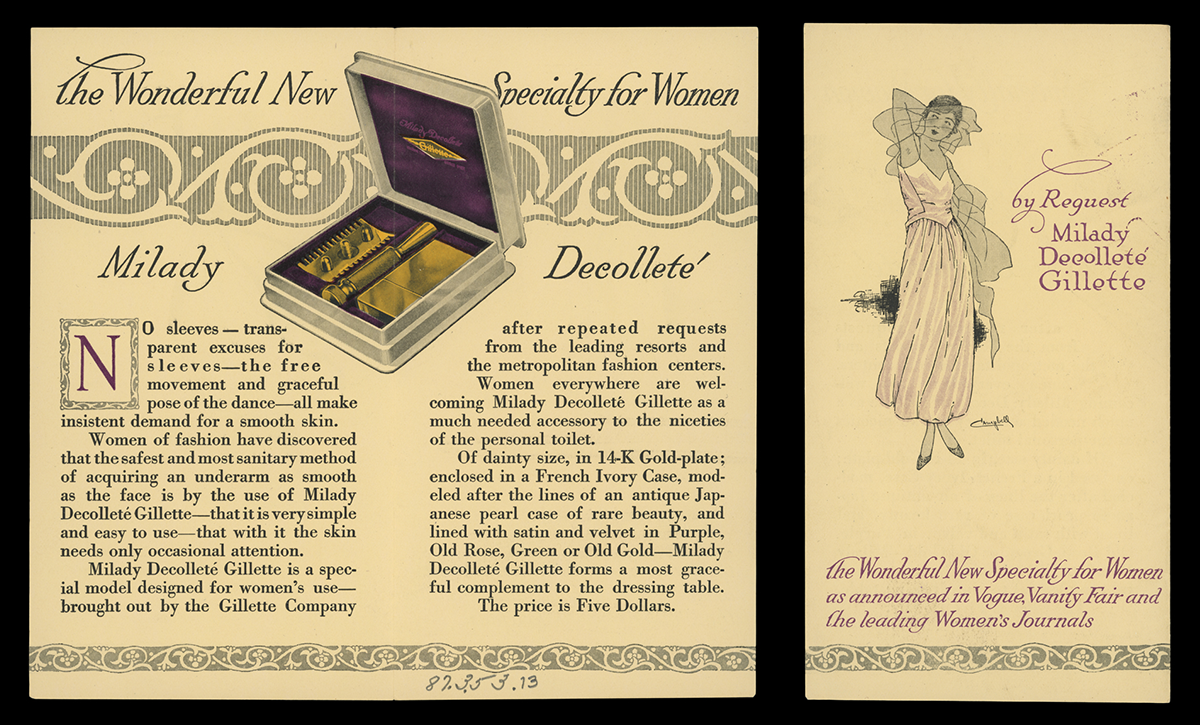
Gillette’s 1915 Milady Décolleté material tied the new women’s razor to sleeveless fashion and metropolitan sophistication. The argument was not simply that hair could be removed. It was that modern clothing made removal necessary. Exposed skin opened a market; advertising taught the exposed body how it was supposed to look.
A century later, the product vocabulary has expanded from razors and depilatory creams to waxing subscriptions, home devices and permanent laser packages. The promise has shifted from avoiding embarrassment to saving time. The destination remains the same: a body so consistently managed that management becomes invisible.
Choice is not free of consequence
None of this makes shaving false or politically suspect. Pleasure is real. Sensory preference is real. Hair removal can feel erotic, practical, expressive or simply familiar. A feminist analysis that turns every shaved body into a victim only creates a new inspection regime.
But choice becomes a weak explanation when one option attracts punishment and the other passes without comment. Research on body-hair attitudes has repeatedly connected the hairlessness norm to disgust and negative judgements. A qualitative study of young women’s pubic-hair practices found participants describing non-removal with words associated with dirtiness and abnormality even while discussing grooming as individual choice. The language reveals where private preference has borrowed its emotional charge.
The important question is not whether somebody “really” wants to shave. Desire is never assembled outside culture. The better question is what happens when they do not. Can they attend a formal event without becoming a debate? Can they change their mind from week to week? Can hair exist without being interpreted as a statement about sexuality, politics, femininity or mental order?

Radical enough to trend, polished enough to sell
Beauty media loves a controlled transgression. It produces contrast without threatening the frame: one disruptive detail held inside an otherwise recognisable fantasy. The bleached brow, visible root, chipped manicure and unshaven underarm can all function this way. Difference becomes an accessory.
Photography is central to the conversion. Ben Hopper’s Natural Beauty portraits place underarm hair inside formal studio lighting and direct attention. The series helped make the taboo visible and gave participants images in which a hidden feature could appear composed, sensual and self-possessed. It also demonstrates the bargain representation often requires. The natural body becomes culturally readable once art has made it look intentional.
Social media intensifies the bargain because the image must announce itself quickly. Hair dyed a bright colour communicates choice before a caption is opened. A posed arm says “this is the point.” Ordinary growth is visually ambiguous. It may signal politics, exhaustion, taste, a change in routine or absolutely nothing. Platforms prefer the declaration because declaration can be packaged.
The result is not fake progress. Styled visibility can genuinely widen what people imagine for themselves. It is simply incomplete. A beauty standard has not disappeared when breaking it requires better art direction.
Visibility is not freedom if every visible body still has to perform a reason.
Normality has no campaign
Celebrity moments can still matter. A fan seeing Bridgers’ legs beside a Gucci credit may experience recognition that ordinary media has denied them. The image places hair where smoothness was expected and refuses to treat it as a contradiction. Permission is not liberation, but it can be useful.
The next step is less photogenic. It is the disappearance of the discourse: visible hair that does not generate a headline, a compliment, an insult or a think piece. It is a body allowed to look unfinished without being considered careless and allowed to look finished without being hairless.
That future will include shaving, waxing, dyeing, trimming, laser and growth. It will include people who make body hair central to their style and people who forget it is there. The measure of acceptance is not how beautifully culture can photograph the exception. It is how little explanation the ordinary person needs.
Body hair does not require confidence. The gaze does.