Dove Cameron wore the suit. Damiano David lost the shirt. Marriage roles: successfully redistributed.
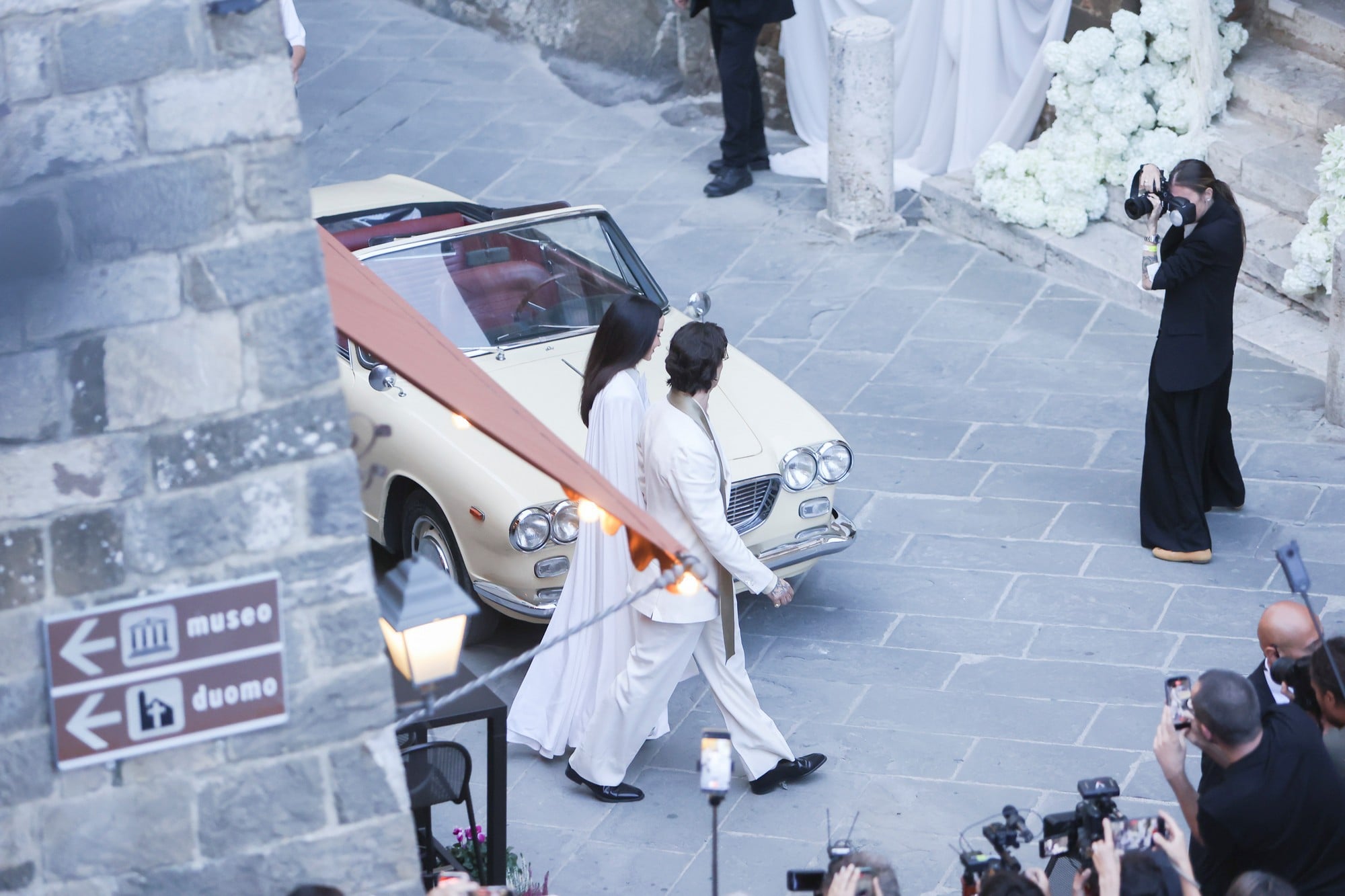
On 24 September, the two pop stars arrived at the Palazzo dei Priori in Montalcino in two different temperatures of white. She was sharp, belted and caped in custom Giorgio Armani. He was soft, cream and almost entirely open at the chest. She carried calla lilies. He carried the energy of a man who had been told the dress code was formal and treated the word as a creative prompt.
It was not matching. It was better: coordination without surrender. In a wedding culture that still loves assigning one person the fantasy and the other the background, Cameron and David made both bodies part of the picture.

The bride wore authority
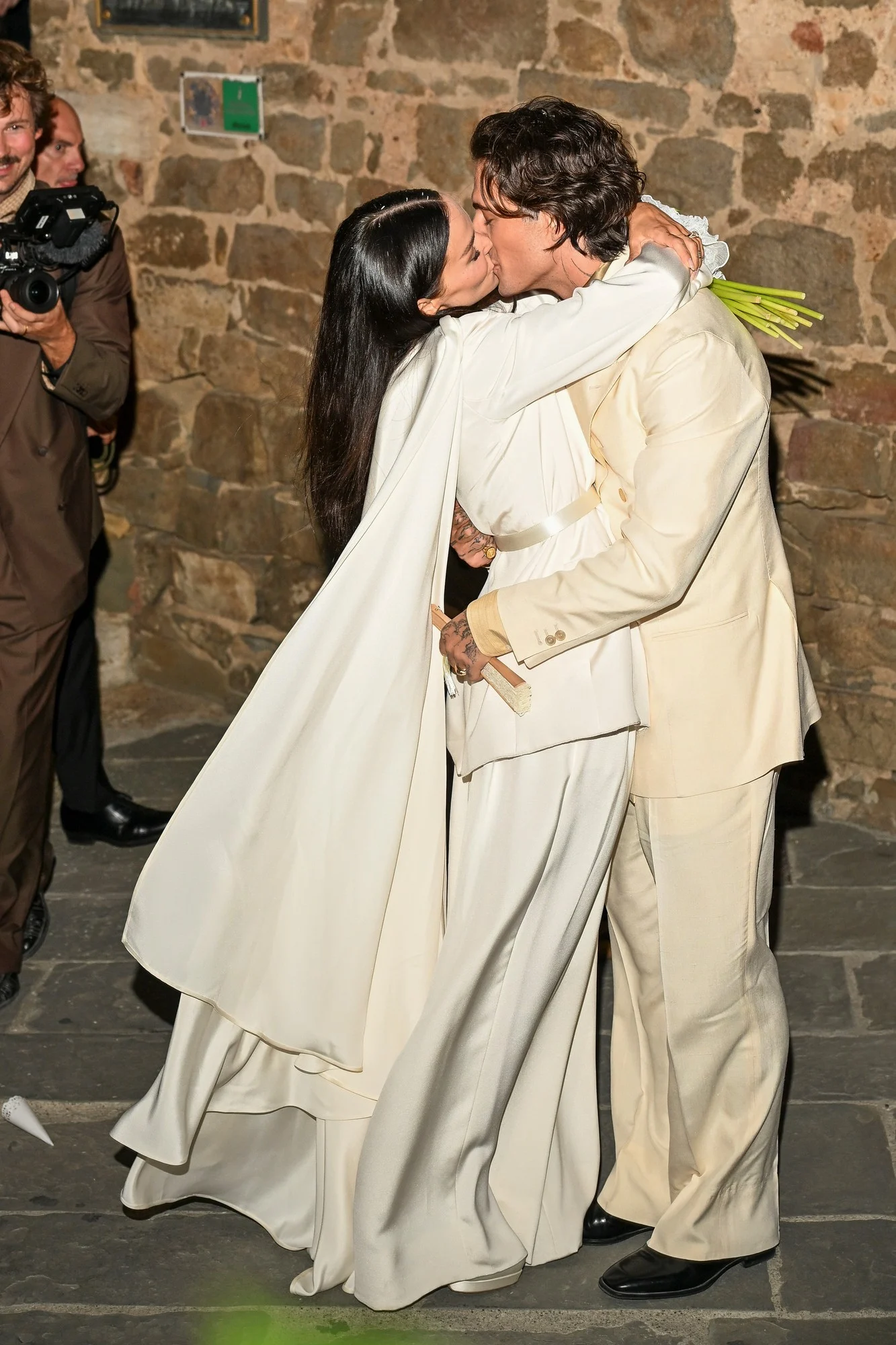
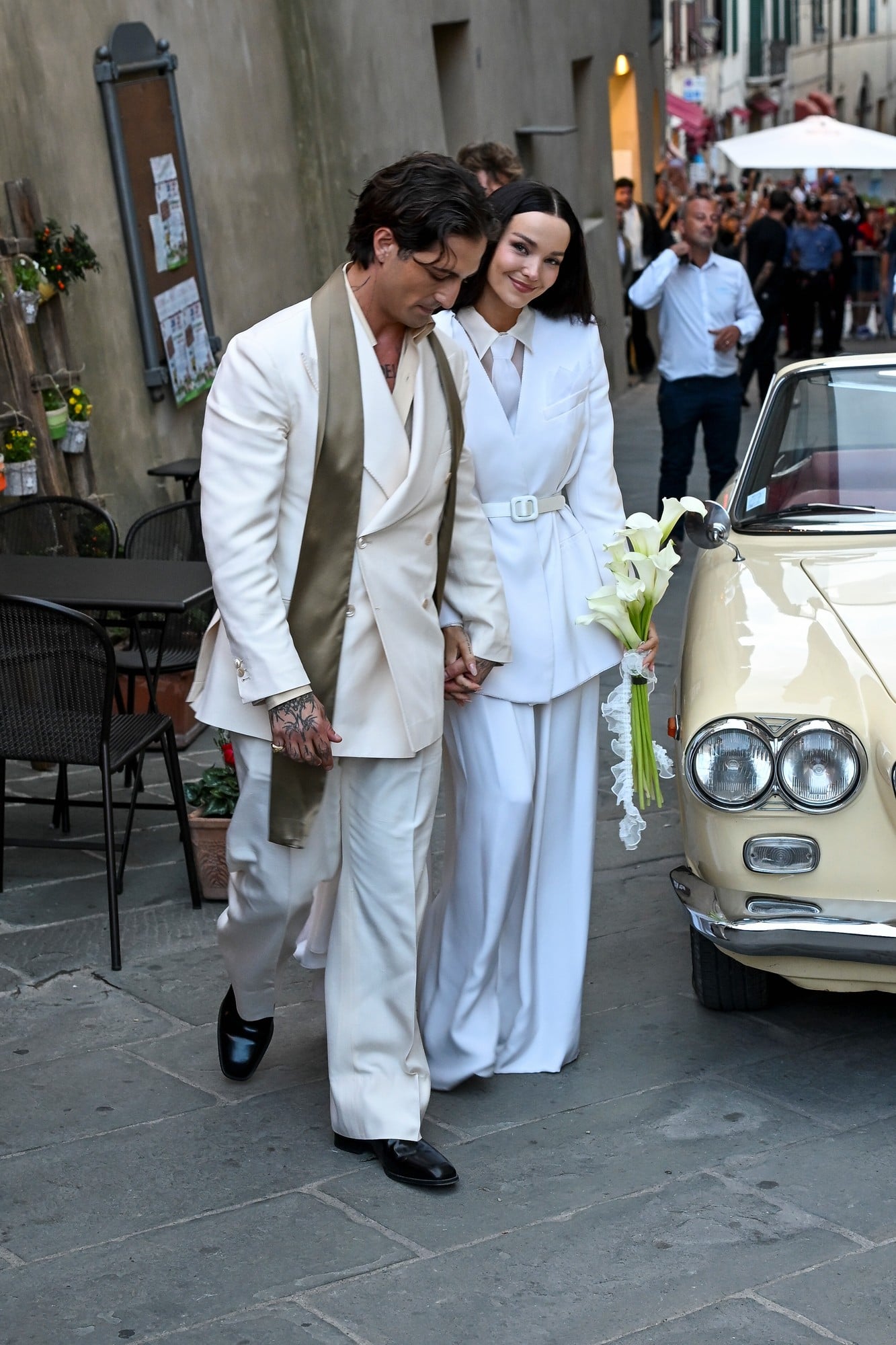
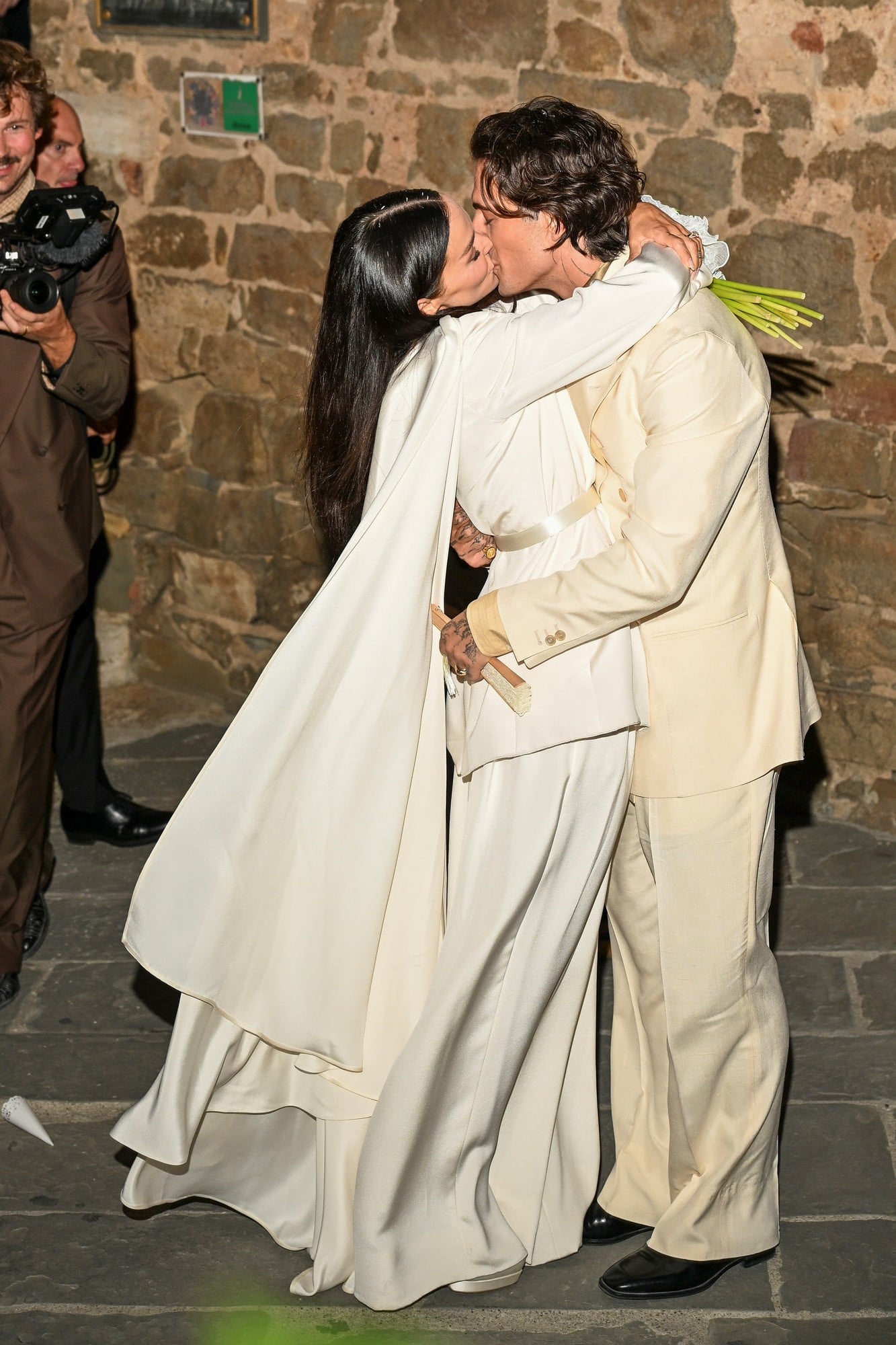
Cameron did not reject bridal white. She occupied it. Her custom Armani look used the grammar of menswear—wide trousers, a structured shirt, a tie-like neck detail and a cinched jacket—then stretched one shoulder into a long cape that followed her down the stone steps. The result was not a tuxedo pretending to be a wedding dress. It was a wedding dress that had raided the tuxedo’s office, taken the keys and promoted itself.
The styling kept the tension intact. Her black hair stayed long and severe against the white. A belt pulled the volume back to the body. The calla-lily bouquet supplied the only conventional bridal punctuation, but even those flowers looked more sculptural than sweet.
There is an old idea that a bride in trousers is opting out of romance. Cameron made the opposite case. The romance was everywhere; the compulsory silhouette was gone. She looked dressed for a vow, a board meeting and the final scene of a film in which she owns the hotel.

The bride wore the power suit. The groom supplied the décolletage.
Two whites. No uniform.
David answered the tailoring with its pressure released. His cream suit came loose through the leg and open through the torso, with a long scarf falling down the front and black shoes cutting through all that softness. Where Cameron’s look controlled the line, his let it drift.
Calling it a gender-role reversal would be too tidy. She was not simply “the masculine one” and he was not performing a feminised groom. Both looks were doing several things at once: severe and romantic, covered and exposed, ceremonial and slightly improper. The point was not to exchange costumes. It was to stop pretending those costumes belonged to one person in the first place.
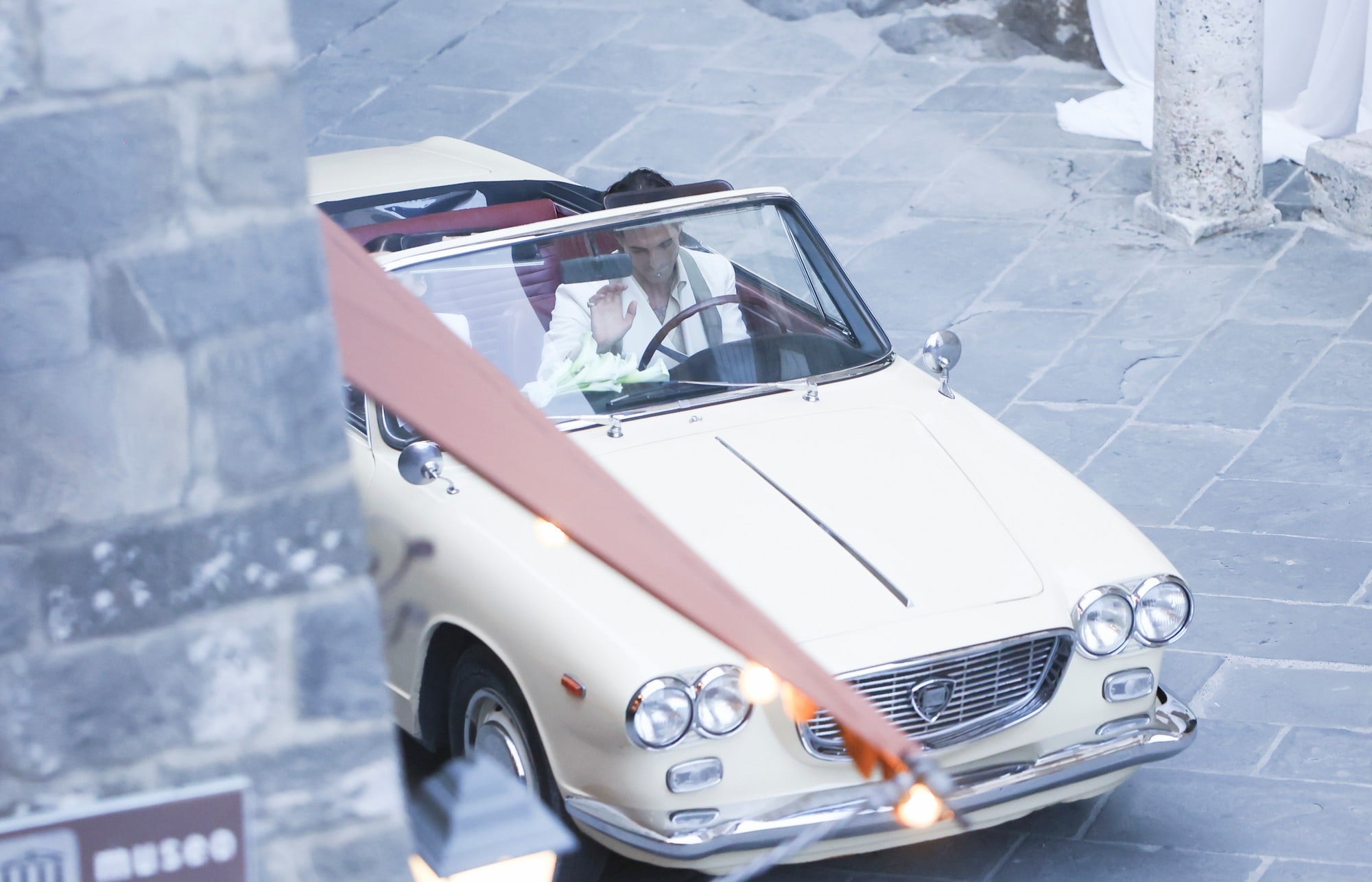
The visual pleasure came from the near-match. Her white was clean and bright; his cream was warmer, almost the colour of the vintage Lancia Fulvia that delivered them to the town hall. Their clothes spoke to one another without becoming a couple’s Halloween costume. They looked married, not merged.


The civil ceremony was the loudest choice
The wedding itself took place inside Montalcino’s historic Palazzo dei Priori, with mayor Silvio Franceschelli conducting the civil rite and the ceremony translated into English. White flowers filled the room. Roughly fifty guests watched. Outside, fans and photographers waited in the square. The couple arrived together in the vintage Lancia, kissed for the crowd and then moved the celebration to Castiglion del Bosco, the wine resort in the Tuscan countryside.
This was intimate, but it was not invisible. The clothes were custom. The car was immaculate. The stone town hall photographed like a set. Event planner Alessandra Grillo handled the production. Cameron and David did not escape celebrity for the day; they edited it. The public got a crisp sequence—arrival, white flowers, kiss, cape in motion—while the actual vows remained inside.
That balance fits them. Their relationship has always looked intensely styled from the outside: two dark-pop faces, two global schedules, two wardrobes with an allergy to beige normality. Yet their own account of it is stubbornly domestic. The wedding had spectacle at the perimeter and paperwork at the centre.


The wedding looked editorial. The promise was domestic.
Pop’s hottest couple wants the boring parts
Eight days before the ceremony, Cameron and David told Vogue Italia that they do everything possible to make their relationship feel normal. Their recent highlights were not red carpets but grocery shopping, cooking and learning how to use a new juicer. “Home” had become less an address than the feeling of being together somewhere between Rome, Los Angeles and tour.
Even the proposal happened at home while they were packing. Cameron had wet hair, no makeup and an oversized T-shirt. David’s logic was that their work already manufactured enough spectacular moments. Romance, for them, meant chores, meals and the possibility of getting old in the same room.
That makes the wedding clothes more interesting, not less. The suit and the scarf were not proof that these two cannot stop performing. They were the controlled image surrounding a deliberately ordinary idea: marriage as access to the unphotographed hours.
They first met at the 2022 MTV Video Music Awards, began dating the following year, made the relationship public in 2024 and confirmed their engagement in January 2026. In that time, Cameron has kept moving beyond the Disney machinery that introduced her, while David has stepped from Måneskin’s arena-scale mythology into a solo career built around a softer voice. Neither arrived at this wedding in the same public role that made them famous. Why would they arrive in the roles tradition assigned?
The pictures will travel because they are excellent: the cape, the open chest, the black hair, the cream car, the kiss against old Tuscan stone. The marriage will happen somewhere less visible—inside the grocery runs, the half-packed suitcases and the kitchen appliance that still needs instructions. One day got the suit. The rest gets the life.