
Fashion
Louise Trotter’s Bottega Veneta Is Off to a Very Good Start
For her first Bottega Veneta collection, Louise Trotter doesn’t tear the house apart. She gets closer to what made it special in the first place.
Text
Noah Cruz
Taking over Bottega Veneta comes with an unusual problem. The house has no giant monogram to fall back on and no single archive silhouette that can simply be revived every few seasons. Its identity lives somewhere harder to define: in leather, construction, touch and the belief that people should recognise an object because of how well it is made rather than what is printed across it.
For her first collection as creative director, Louise Trotter understood that immediately. Summer 2026 does not arrive with the desperation of a designer trying to erase what came before. Instead, it goes directly into Bottega Veneta's workshop mentality and asks how much further its obsession with making things can be pushed.

CRAFT GETS LOUDER
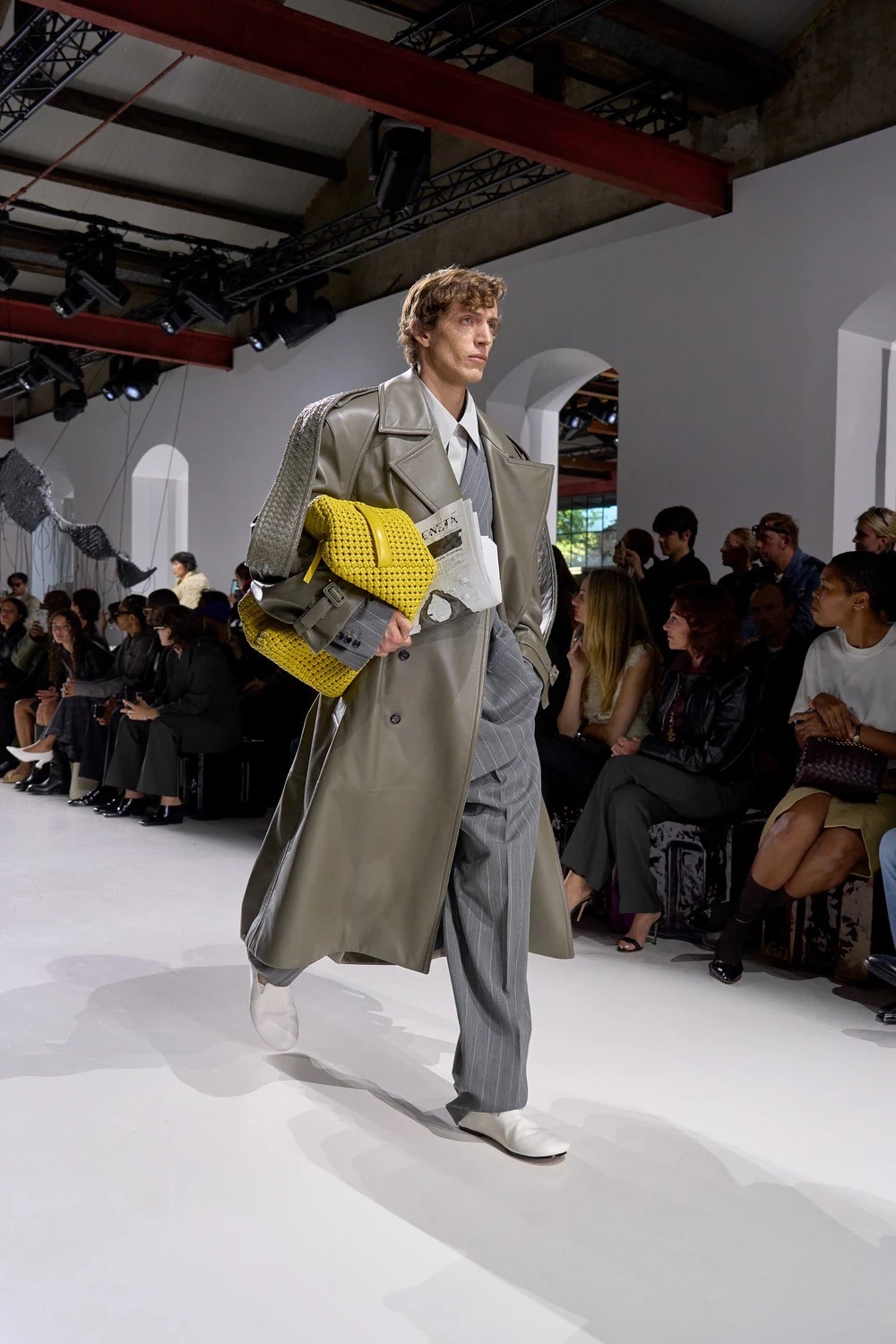
Bottega Veneta has always been associated with Intrecciato, but Trotter refuses to treat the weave like a sacred museum piece. Across Summer 2026, the idea of weaving expands into exaggerated textures, fringes, tassels and surfaces that almost stop behaving like conventional fabric. One of the collection's most extreme pieces, a fringed Nappa leather cape, required 4,000 hours of work.
That level of craftsmanship could easily become precious. Instead, Trotter makes it physical. Tailoring is precise and sculptural, while other pieces seem to explode away from the body in shaggy reds, yellows and creams. Recycled fiberglass is transformed into shimmering jackets and skirts. The contrast makes the collection feel luxurious without falling into the quiet, beige anonymity that has consumed so much of modern luxury.

BOTTEGA STILL LOOKS LIKE BOTTEGA
The smartest thing Trotter does is resist treating a new creative director as an excuse for a completely new brand. The house's familiar codes remain visible, particularly in the leatherwork and bags, but they are stretched into different proportions and personalities. Intrecciato becomes larger, softer and more expressive, while established bags sit beside new shapes including the Squash, a tasselled evening clutch and a framed tote.
That continuity gives the stranger pieces room to work. A huge grey woven coat can exist beside an almost weightless white dress; severe tailoring can be followed by something covered in moving strands of colour. Rather than forcing everything into one neat silhouette, Trotter seems interested in what happens when the same standard of craft is applied to completely different characters.
A DEBUT THAT DOESN'T TRY TOO HARD TO BE ONE
Perhaps that is why Summer 2026 feels so convincing. Trotter is clearly changing Bottega Veneta, but she does not spend the collection constantly reminding us that a new designer has arrived. Her starting point is the house itself: the workshop, the people making the clothes and the idea that craftsmanship can be a creative language rather than simply a luxury selling point.
The result feels respectful without becoming cautious. There is enough Bottega in the collection to recognise immediately, and enough Louise Trotter to make the next chapter worth watching. For a debut at a house this closely associated with the designers who came before her, that balance might be the most impressive thing of all.
© 2026 Frenzy Haus. All rights reserved.


Fashion
Louise Trotter’s Bottega Veneta Is Off to a Very Good Start
For her first Bottega Veneta collection, Louise Trotter doesn’t tear the house apart. She gets closer to what made it special in the first place.
Text
Noah Cruz
Taking over Bottega Veneta comes with an unusual problem. The house has no giant monogram to fall back on and no single archive silhouette that can simply be revived every few seasons. Its identity lives somewhere harder to define: in leather, construction, touch and the belief that people should recognise an object because of how well it is made rather than what is printed across it.
For her first collection as creative director, Louise Trotter understood that immediately. Summer 2026 does not arrive with the desperation of a designer trying to erase what came before. Instead, it goes directly into Bottega Veneta's workshop mentality and asks how much further its obsession with making things can be pushed.
CRAFT GETS LOUDER
Bottega Veneta has always been associated with Intrecciato, but Trotter refuses to treat the weave like a sacred museum piece. Across Summer 2026, the idea of weaving expands into exaggerated textures, fringes, tassels and surfaces that almost stop behaving like conventional fabric. One of the collection's most extreme pieces, a fringed Nappa leather cape, required 4,000 hours of work.
That level of craftsmanship could easily become precious. Instead, Trotter makes it physical. Tailoring is precise and sculptural, while other pieces seem to explode away from the body in shaggy reds, yellows and creams. Recycled fiberglass is transformed into shimmering jackets and skirts. The contrast makes the collection feel luxurious without falling into the quiet, beige anonymity that has consumed so much of modern luxury.
BOTTEGA STILL LOOKS LIKE BOTTEGA
The smartest thing Trotter does is resist treating a new creative director as an excuse for a completely new brand. The house's familiar codes remain visible, particularly in the leatherwork and bags, but they are stretched into different proportions and personalities. Intrecciato becomes larger, softer and more expressive, while established bags sit beside new shapes including the Squash, a tasselled evening clutch and a framed tote.
That continuity gives the stranger pieces room to work. A huge grey woven coat can exist beside an almost weightless white dress; severe tailoring can be followed by something covered in moving strands of colour. Rather than forcing everything into one neat silhouette, Trotter seems interested in what happens when the same standard of craft is applied to completely different characters.
A DEBUT THAT DOESN'T TRY TOO HARD TO BE ONE
Perhaps that is why Summer 2026 feels so convincing. Trotter is clearly changing Bottega Veneta, but she does not spend the collection constantly reminding us that a new designer has arrived. Her starting point is the house itself: the workshop, the people making the clothes and the idea that craftsmanship can be a creative language rather than simply a luxury selling point.
The result feels respectful without becoming cautious. There is enough Bottega in the collection to recognise immediately, and enough Louise Trotter to make the next chapter worth watching. For a debut at a house this closely associated with the designers who came before her, that balance might be the most impressive thing of all.
© 2026 Frenzy Haus. All rights reserved.

Fashion
Louise Trotter’s Bottega Veneta Is Off to a Very Good Start
For her first Bottega Veneta collection, Louise Trotter doesn’t tear the house apart. She gets closer to what made it special in the first place.
Text
Noah Cruz
Taking over Bottega Veneta comes with an unusual problem. The house has no giant monogram to fall back on and no single archive silhouette that can simply be revived every few seasons. Its identity lives somewhere harder to define: in leather, construction, touch and the belief that people should recognise an object because of how well it is made rather than what is printed across it.
For her first collection as creative director, Louise Trotter understood that immediately. Summer 2026 does not arrive with the desperation of a designer trying to erase what came before. Instead, it goes directly into Bottega Veneta's workshop mentality and asks how much further its obsession with making things can be pushed.
CRAFT GETS LOUDER
Bottega Veneta has always been associated with Intrecciato, but Trotter refuses to treat the weave like a sacred museum piece. Across Summer 2026, the idea of weaving expands into exaggerated textures, fringes, tassels and surfaces that almost stop behaving like conventional fabric. One of the collection's most extreme pieces, a fringed Nappa leather cape, required 4,000 hours of work.
That level of craftsmanship could easily become precious. Instead, Trotter makes it physical. Tailoring is precise and sculptural, while other pieces seem to explode away from the body in shaggy reds, yellows and creams. Recycled fiberglass is transformed into shimmering jackets and skirts. The contrast makes the collection feel luxurious without falling into the quiet, beige anonymity that has consumed so much of modern luxury.
BOTTEGA STILL LOOKS LIKE BOTTEGA
The smartest thing Trotter does is resist treating a new creative director as an excuse for a completely new brand. The house's familiar codes remain visible, particularly in the leatherwork and bags, but they are stretched into different proportions and personalities. Intrecciato becomes larger, softer and more expressive, while established bags sit beside new shapes including the Squash, a tasselled evening clutch and a framed tote.
That continuity gives the stranger pieces room to work. A huge grey woven coat can exist beside an almost weightless white dress; severe tailoring can be followed by something covered in moving strands of colour. Rather than forcing everything into one neat silhouette, Trotter seems interested in what happens when the same standard of craft is applied to completely different characters.
A DEBUT THAT DOESN'T TRY TOO HARD TO BE ONE
Perhaps that is why Summer 2026 feels so convincing. Trotter is clearly changing Bottega Veneta, but she does not spend the collection constantly reminding us that a new designer has arrived. Her starting point is the house itself: the workshop, the people making the clothes and the idea that craftsmanship can be a creative language rather than simply a luxury selling point.
The result feels respectful without becoming cautious. There is enough Bottega in the collection to recognise immediately, and enough Louise Trotter to make the next chapter worth watching. For a debut at a house this closely associated with the designers who came before her, that balance might be the most impressive thing of all.
Get Frenzy straight to your inbox!
Latest
Alicia Creti Makes Losing Your Shit Sound Expensive
Music
Miu Miu Killed the Outfit and Left It in Micro-Shorts
Fashion
Hermès Put Quiet Luxury in Its Underwear
Fashion

Lacoste Just Kicked Tennis Whites Out of the Club
Fashion
The Vampire Diaries’ Deadliest Parties, Ranked
Film & TV
Vivienne Westwood Just Put Good Taste Through a Nervous Breakdown
Fashion

The FRENZY Interview: Bo Quinn Makes Beauty Misbehave
Beauty

Megan Fox Is Giving Erectile Dysfunction a Red-Hot Rebrand
Life & Culture

Tom Ford Made Voyeurism Look Expensive
Fashion
Balenciaga Made Couture Lose Its Manners
Fashion
© 2026 Frenzy Haus. All rights reserved.