Fashion
Matières Fécales Gave the 99% a Monument
Inside Matières Fécales Spring 2027, where 99 models of colour transformed Paris’s Place de la République through fashion, family and protest.

Text

Noah Cruz

Paris Fashion Week loves the language of access: the invitation, the car, the security line, the seat close enough to be photographed. Matières Fécales took that private grammar to the Place de la République and made it answer to the street. Ninety-nine models crossed one of Paris’s most politically charged public squares. Every one of them was a person of colour. Above them stood Marianne, the stone body of the French Republic. Around them stood the people luxury usually calls an audience only after checking the list.

The Spring/Summer 2027 collection was called Ninety Nine Percent. The number was not decorative. Last season, Hannah Rose Dalton and Steven Raj Bhaskaran staged The One Percent inside the former Paris stock exchange and dressed wealth as a disturbed family portrait. This time, they took the source of power from that room and redistributed the image. The show did not soften the house’s appetite for grotesque glamour. It gave that appetite a public.

This matters because Matières Fécales has never been interested in making rebellion look hygienic. The label’s own name translates to fecal matter: waste made French, then made fabulous. Its world is populated by prosthetic bodies, impossible shoes, ruined surfaces and silhouettes that look as if couture has survived contact with another species. Yet beneath the provocation is a precise belief: beauty gets more interesting the second it stops asking permission.

At République, that belief became collective. Ninety Nine Percent was not a diversity slogan taped onto a casting board. It was family history, immigrant memory, queer possibility, working-class references and high craft made visible at the same scale. Fashion loves to claim that clothes can change the world. Matières Fécales made a sharper proposition: change who gets to occupy the image, and the world inside that image has already moved.

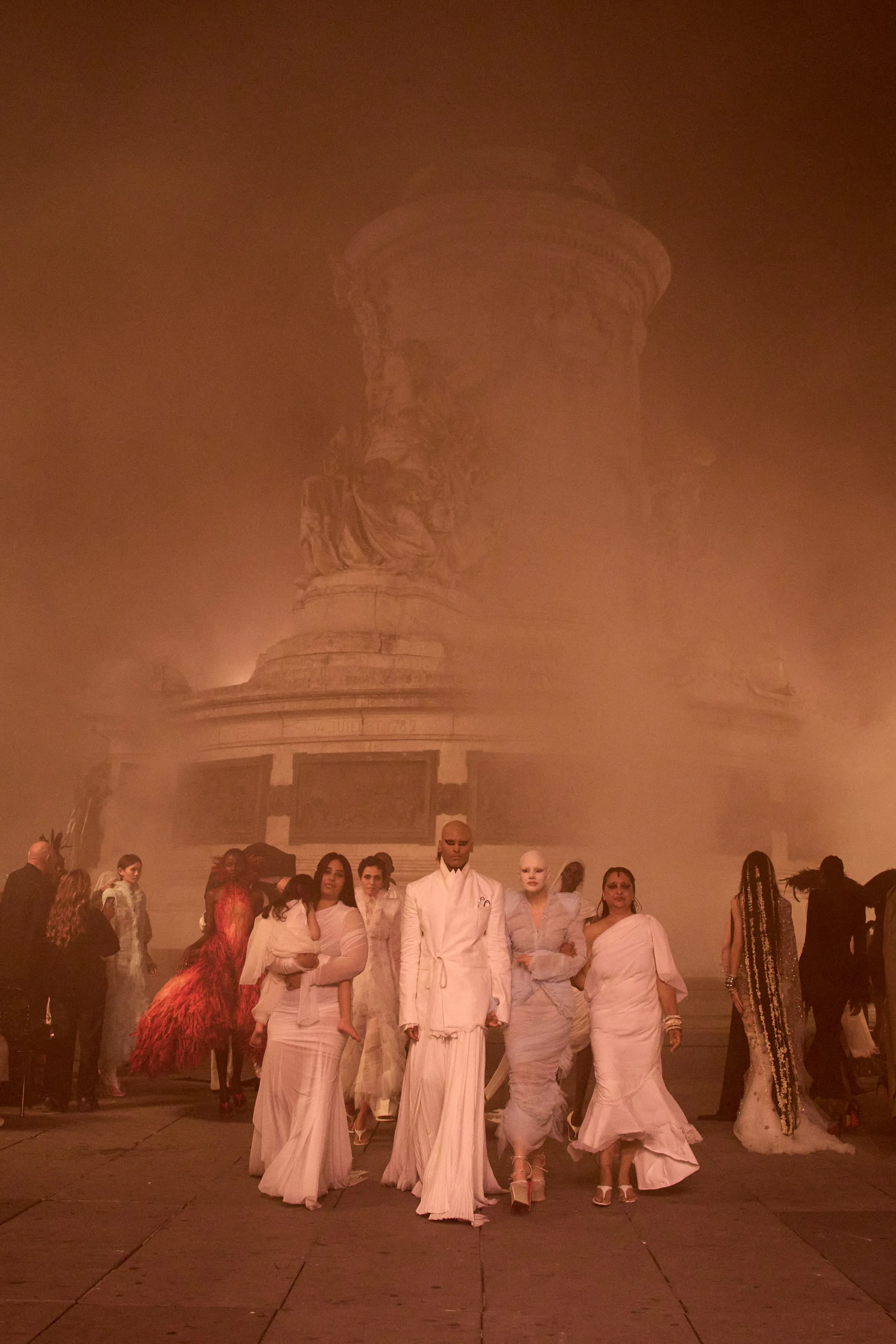
Opening white look at the Matières Fécales Spring 2027 runway show in Place de la République
The first act began in white, but nothing about it was blank.Photo: Filippo Fior / Gorunway.com

The square was already saying something

Place de la République is not neutral architecture. It is where Paris gathers to march, mourn, argue and refuse. Liberty, Equality and Fraternity are carved into the monument; political desire is carved into the life around it. To place a fashion show beneath Marianne is to walk directly into a conversation about who France imagines when it says “the people.” The clothes arrived inside that tension rather than pretending to float above it.

The production carried its own contradiction. Safety rules required barriers around a site associated with public assembly, so a runway about access temporarily built a perimeter. Dalton and Bhaskaran did not hide the irony. Members of the public were brought inside, while everyone else found a view wherever the city allowed one—including the first-floor windows of a Five Guys across the road. Fashion’s usual hierarchy of visibility became delightfully unstable. A front-row chair was one vantage point. A burger and a window were another.

Then Rihanna arrived, wearing gold that appeared almost liquid, and the flashbulbs briefly tried to turn the evening back into the old system: star at the centre, everybody else as scenery. The show resisted that gravity. Once the procession began, celebrity became part of the crowd. The monument, the models and the city were too large to become somebody else’s backdrop.

That scale is what made the setting more than spectacle. A palace can make every garment appear precious by association. République forced the clothes to produce their own authority. White tulle, sharpened tailoring, collapsing surfaces and curved shoes had to hold against stone, traffic, smoke and hundreds of bodies. They did. The house’s fantasy did not shrink outdoors. It became harder to contain.

The house released the collection in chapters, letting the runway keep moving after the square emptied. The first two official carousels move through looks 1 to 24: white begins as ceremony, then starts collecting shape, tension and memory. Swipe them. This is the show itself, not a profile page pretending to be content.

Family, but make it public

The first act was called FAMILY. A procession of white looks moved across the square: tulle tailoring, sculpted shoulders, expansive skirts and the house’s familiar tension between ceremony and disintegration. White can suggest innocence, weddings, mourning, institutional power or the fantasy of beginning again. Matières Fécales allowed all of those meanings to collide. The garments looked formal enough to inherit something and strange enough to refuse the conditions attached.

Bhaskaran has connected the collection to his childhood in Montreal public housing and to the collision of cultures, religions and chosen communities that shaped him. That history prevents FAMILY from becoming a sentimental opening chapter. Family here is not a polished unit posed around matching furniture. It is an expanded structure: inherited relatives, friends, collaborators, people who recognise one another before the institution learns their names.

The act ended with Bhaskaran walking beside his mother, sister and niece. In another show, that image might have been engineered as an emotional pause. Here it completed the argument. The runway was not borrowing intimacy to make the collection feel human; the collection had grown out of intimacy in the first place. Fashion became the frame around a relationship, not the other way around.

The clothes carried that intimacy through their construction. Draped tulle softened the violence of exaggerated proportions. Frayed edges allowed labour to remain visible. Jackets held the torso with the confidence of armour, then dissolved into transparency. The body was neither concealed nor placed on display as evidence. It was given an atmosphere.

This is the house at its most convincing: not when it simply makes a beautiful object look corrupted, but when corruption and beauty become impossible to separate. The finish is immaculate because the ruin is intentional. The romance works because it has a pulse beneath the powder. These are clothes that understand elegance as something alive enough to misbehave.

The flip-flop gets a red sole

The most revealing accessory was also the least obedient to luxury’s class codes: a flip-flop extended into a thigh-high, curved-heel construction through the house’s continuing collaboration with Christian Louboutin. The everyday shoe of heat, work, transit and domestic life was not “elevated” by being disguised as something else. Its familiar thong remained visible. It entered couture on its own terms and took the red sole with it.

That move summarised the collection’s intelligence. Representation is not only about who appears in the frame; it is also about which objects are allowed to signify sophistication. Luxury has always raided ordinary life, then erased the origin story before raising the price. Matières Fécales kept the reference legible. The joke lands, but the shoe is not a joke. It is strange, erotic, technically absurd and instantly understandable.

Worn beneath tulle, tailoring and denim, it also made walking visible again. The curved heel pitched the body into the house’s uncanny gait, while the flip-flop strap preserved the memory of something casual and democratic. Each step carried two realities at once: pavement and podium, convenience and spectacle, the object people dismiss and the object people photograph.

Protest does not need a dress code

TRIBE entered with less whiteness and more friction. Strobe light, smoke and groups of models changed the pace from procession to demonstration. Military references appeared in tulle tweed. Leather capes looked weathered rather than pristine. Khaki knits unravelled at the edge. Balaclavas, facial spikes and body augmentations treated the human outline as material still under construction.

The section drew from the punk and metal scenes where Bhaskaran found community after leaving home in Montreal. Importantly, the reference did not reduce subculture to a mood board of hardware and distressed black. The casting complicated the narrow image of who gets to look punk, who gets read as French and who gets to occupy an alternative scene without being treated as a guest. Rebellion was not a costume placed on the models. It was permission to arrive without translating themselves first.

Bbyafricka cut through the smoke in denim, towering Louboutin flip-flop boots, facial spikes and violent red nails. Elsewhere, the French tricolore appeared with the word RESIST. A trio of women in twisted red, white and blue dresses brought the section to its close, honouring mothers who so often become the front line when a community’s rights are threatened. National colour stopped behaving like branding and became a claim.

The clothes were strongest when they held contradiction without resolving it. Military shapes were fragile. Tulle became armour. Leather looked as if time had already attacked it and lost. A shredded hem did not cancel the precision of the cut; it exposed it. The garments were able to look damaged, expensive, protective and vulnerable in the same breath. That is more interesting than shock for its own sake. It is an aesthetic with a nervous system.

Matières Fécales has often been described through the language of monstrosity, but TRIBE made the monster feel less like an outsider than an upgrade. The prosthetic face, the sharpened nail, the impossible boot and the distorted shoulder did not conceal humanity. They expanded its available forms. In a culture obsessed with making difference legible, the show made illegibility look powerful.

A dark subcultural look from the Tribe act of Matières Fécales Spring 2027
TRIBE turned the runway into a moving crowd rather than a line of isolated looks.Photo: Filippo Fior / Gorunway.com

The official carousels pick up the procession at looks 25 to 57. Read together, they make the collection’s escalation visible: tailoring hardens, silhouettes lengthen and the crowd becomes the image. These are individual show posts, embedded directly from Matières Fécales.

Mounia does not enter as a footnote

Then came GODS, the final act, where the craft moved closer to couture and history entered the casting with a body. Look 75 was worn by Monique-Antoine Orosemane—Mounia—the Martinican model whose work with Yves Saint Laurent in the late 1970s made her one of the defining Black presences in Paris couture. Her appearance connected the show’s demand for representation to a woman who had already altered the image decades earlier.

Mounia was not presented as archival proof that progress had happened. She was present tense. The tulle train, the controlled volume and the pace of her walk gave the collection a different authority: not the thrill of a new face being “discovered,” but the force of a career refusing to be compressed into a reference slide. Fashion has a habit of celebrating pioneers while keeping its current rooms narrow. Her presence made that habit impossible to ignore.

It also clarified the collection’s use of the word GODS. Divinity here did not mean distance from ordinary life. It meant accumulated presence—the kind built through survival, work, memory and the ability to remain visible inside an industry addicted to replacement. The clothes did not turn Mounia into an icon. They recognised that she had arrived as one.

Mounia wearing look 75 in the Matières Fécales Spring 2027 show
Mounia in look 75: history walking in the present tense.Photo: Filippo Fior / Gorunway.com

Then power had to carry its own image

The finale made the show’s reversal impossible to miss. Young Black models carried hyper-realistic sculptures by Sarah Sitkin: well-fed old white men with dollar-bill blindfolds, transported around the monument like the physical remains of the previous season’s ruling class. The image was outrageous enough to travel instantly, but its power came from the choreography of weight. Privilege was no longer invisible. It had mass. Somebody had been carrying it all along.

Runway symbolism often collapses the moment it is explained. This did not. The bodies below and the bodies above occupied different realities without becoming a tidy morality play. The sculptures were absurd, comic and unnervingly lifelike. The models beneath them were not reduced to anonymous labour; they remained the visual authority. What had once looked untouchable became an object. What the system had treated as background became the subject.

Placed beneath Marianne, the tableau completed the show’s architecture. Liberty, Equality and Fraternity were no longer distant words in stone. They were tested by the bodies moving below them. The finale did not claim that a fashion show could redistribute money, citizenship or safety. It demonstrated that representation can redistribute attention—and attention is one of luxury’s most protected resources.

A portion of sales from the collection is set to support La Maison d’Allanah, a French organisation providing housing for LGBTQIA+ refugees. That continuation matters. The show’s politics do not end as a photograph of radical casting while the clothes disappear into the same old economy. The collection sends part of its value toward people whose right to occupy space is not metaphorical.

Closing scene of the Matières Fécales Spring 2027 show beneath the Monument à la République
Ninety-nine bodies, one square, and no interest in shrinking the image.Photo: Filippo Fior / Gorunway.com

From one percent to ninety-nine

Seen beside The One Percent, the new show feels less like a sequel than a redistribution of camera position. Fall 2026 looked at wealth from the outside and made its grotesque codes visible: money masks, blood-red palms, cosmetic bandages, corrupted pearls and bodies rebuilt by the panic of having too much to lose. Spring 2027 took the energy spent observing the elite and returned it to the people luxury has trained itself not to see.

The continuity is in the clothes. Dalton and Bhaskaran still understand glamour as a dangerous material. Tailoring remains sharply controlled. Tulle remains capable of becoming both wound and cloud. The body is still stretched, augmented and re-authored. What changed was the direction of desire. The new collection did not ask how power dresses. It asked what the rest of us might wear once power stops being the only fantasy available.

That is why the show’s optimism never became polite. Hope did not arrive as pastel branding or a closing smile. It arrived through scale, casting, noise, a family walking together, a veteran model occupying the present and an everyday flip-flop growing a red sole without surrendering its identity. The future looked less like everyone being invited into the same room and more like the room losing control of who it belongs to.

Watch the chapter that came before. The One Percent, Fall 2026, is the spectacle this collection turned inside out.

Before the reversal: The One Percent, the collection that Spring 2027 turned inside out.Video: FF Channel

Matières Fécales did not make inclusion look like good behaviour. It made it look excessive, specific, technically ambitious and impossible to crop out. That distinction is everything. The people on the runway were not there to make the institution appear generous. They were there because the institution’s image of beauty had been too small.

Ninety Nine Percent gave Paris a fashion spectacle built from the people usually asked to watch one. It did so without abandoning fantasy, craft or the delicious arrogance required to put ninety-nine looks beneath a national monument. The collection understood that rebellion does not weaken glamour. It gives glamour a reason to exist.

Culture was never meant to behave. On the Place de la République, neither did the clothes, the crowd or the ninety-nine bodies remaking the picture.

Runway photography: Filippo Fior / Gorunway.com, via Vogue Runway. Instagram posts: Matières Fécales. Video: FF Channel. Reporting context: Fédération de la Haute Couture et de la Mode, Vogue Runway, Hypebae, Vogue France and The Associated Press.
Fashion
Matières Fécales Gave the 99% a Monument
Inside Matières Fécales Spring 2027, where 99 models of colour transformed Paris’s Place de la République through fashion, family and protest.

Text

Noah Cruz

Paris Fashion Week loves the language of access: the invitation, the car, the security line, the seat close enough to be photographed. Matières Fécales took that private grammar to the Place de la République and made it answer to the street. Ninety-nine models crossed one of Paris’s most politically charged public squares. Every one of them was a person of colour. Above them stood Marianne, the stone body of the French Republic. Around them stood the people luxury usually calls an audience only after checking the list.

The Spring/Summer 2027 collection was called Ninety Nine Percent. The number was not decorative. Last season, Hannah Rose Dalton and Steven Raj Bhaskaran staged The One Percent inside the former Paris stock exchange and dressed wealth as a disturbed family portrait. This time, they took the source of power from that room and redistributed the image. The show did not soften the house’s appetite for grotesque glamour. It gave that appetite a public.

This matters because Matières Fécales has never been interested in making rebellion look hygienic. The label’s own name translates to fecal matter: waste made French, then made fabulous. Its world is populated by prosthetic bodies, impossible shoes, ruined surfaces and silhouettes that look as if couture has survived contact with another species. Yet beneath the provocation is a precise belief: beauty gets more interesting the second it stops asking permission.

At République, that belief became collective. Ninety Nine Percent was not a diversity slogan taped onto a casting board. It was family history, immigrant memory, queer possibility, working-class references and high craft made visible at the same scale. Fashion loves to claim that clothes can change the world. Matières Fécales made a sharper proposition: change who gets to occupy the image, and the world inside that image has already moved.

Opening white look at the Matières Fécales Spring 2027 runway show in Place de la République
The first act began in white, but nothing about it was blank.Photo: Filippo Fior / Gorunway.com

The square was already saying something

Place de la République is not neutral architecture. It is where Paris gathers to march, mourn, argue and refuse. Liberty, Equality and Fraternity are carved into the monument; political desire is carved into the life around it. To place a fashion show beneath Marianne is to walk directly into a conversation about who France imagines when it says “the people.” The clothes arrived inside that tension rather than pretending to float above it.

The production carried its own contradiction. Safety rules required barriers around a site associated with public assembly, so a runway about access temporarily built a perimeter. Dalton and Bhaskaran did not hide the irony. Members of the public were brought inside, while everyone else found a view wherever the city allowed one—including the first-floor windows of a Five Guys across the road. Fashion’s usual hierarchy of visibility became delightfully unstable. A front-row chair was one vantage point. A burger and a window were another.

Then Rihanna arrived, wearing gold that appeared almost liquid, and the flashbulbs briefly tried to turn the evening back into the old system: star at the centre, everybody else as scenery. The show resisted that gravity. Once the procession began, celebrity became part of the crowd. The monument, the models and the city were too large to become somebody else’s backdrop.

That scale is what made the setting more than spectacle. A palace can make every garment appear precious by association. République forced the clothes to produce their own authority. White tulle, sharpened tailoring, collapsing surfaces and curved shoes had to hold against stone, traffic, smoke and hundreds of bodies. They did. The house’s fantasy did not shrink outdoors. It became harder to contain.

The house released the collection in chapters, letting the runway keep moving after the square emptied. The first two official carousels move through looks 1 to 24: white begins as ceremony, then starts collecting shape, tension and memory. Swipe them. This is the show itself, not a profile page pretending to be content.

Family, but make it public

The first act was called FAMILY. A procession of white looks moved across the square: tulle tailoring, sculpted shoulders, expansive skirts and the house’s familiar tension between ceremony and disintegration. White can suggest innocence, weddings, mourning, institutional power or the fantasy of beginning again. Matières Fécales allowed all of those meanings to collide. The garments looked formal enough to inherit something and strange enough to refuse the conditions attached.

Bhaskaran has connected the collection to his childhood in Montreal public housing and to the collision of cultures, religions and chosen communities that shaped him. That history prevents FAMILY from becoming a sentimental opening chapter. Family here is not a polished unit posed around matching furniture. It is an expanded structure: inherited relatives, friends, collaborators, people who recognise one another before the institution learns their names.

The act ended with Bhaskaran walking beside his mother, sister and niece. In another show, that image might have been engineered as an emotional pause. Here it completed the argument. The runway was not borrowing intimacy to make the collection feel human; the collection had grown out of intimacy in the first place. Fashion became the frame around a relationship, not the other way around.

The clothes carried that intimacy through their construction. Draped tulle softened the violence of exaggerated proportions. Frayed edges allowed labour to remain visible. Jackets held the torso with the confidence of armour, then dissolved into transparency. The body was neither concealed nor placed on display as evidence. It was given an atmosphere.

This is the house at its most convincing: not when it simply makes a beautiful object look corrupted, but when corruption and beauty become impossible to separate. The finish is immaculate because the ruin is intentional. The romance works because it has a pulse beneath the powder. These are clothes that understand elegance as something alive enough to misbehave.

The flip-flop gets a red sole

The most revealing accessory was also the least obedient to luxury’s class codes: a flip-flop extended into a thigh-high, curved-heel construction through the house’s continuing collaboration with Christian Louboutin. The everyday shoe of heat, work, transit and domestic life was not “elevated” by being disguised as something else. Its familiar thong remained visible. It entered couture on its own terms and took the red sole with it.

That move summarised the collection’s intelligence. Representation is not only about who appears in the frame; it is also about which objects are allowed to signify sophistication. Luxury has always raided ordinary life, then erased the origin story before raising the price. Matières Fécales kept the reference legible. The joke lands, but the shoe is not a joke. It is strange, erotic, technically absurd and instantly understandable.

Worn beneath tulle, tailoring and denim, it also made walking visible again. The curved heel pitched the body into the house’s uncanny gait, while the flip-flop strap preserved the memory of something casual and democratic. Each step carried two realities at once: pavement and podium, convenience and spectacle, the object people dismiss and the object people photograph.

Protest does not need a dress code

TRIBE entered with less whiteness and more friction. Strobe light, smoke and groups of models changed the pace from procession to demonstration. Military references appeared in tulle tweed. Leather capes looked weathered rather than pristine. Khaki knits unravelled at the edge. Balaclavas, facial spikes and body augmentations treated the human outline as material still under construction.

The section drew from the punk and metal scenes where Bhaskaran found community after leaving home in Montreal. Importantly, the reference did not reduce subculture to a mood board of hardware and distressed black. The casting complicated the narrow image of who gets to look punk, who gets read as French and who gets to occupy an alternative scene without being treated as a guest. Rebellion was not a costume placed on the models. It was permission to arrive without translating themselves first.

Bbyafricka cut through the smoke in denim, towering Louboutin flip-flop boots, facial spikes and violent red nails. Elsewhere, the French tricolore appeared with the word RESIST. A trio of women in twisted red, white and blue dresses brought the section to its close, honouring mothers who so often become the front line when a community’s rights are threatened. National colour stopped behaving like branding and became a claim.

The clothes were strongest when they held contradiction without resolving it. Military shapes were fragile. Tulle became armour. Leather looked as if time had already attacked it and lost. A shredded hem did not cancel the precision of the cut; it exposed it. The garments were able to look damaged, expensive, protective and vulnerable in the same breath. That is more interesting than shock for its own sake. It is an aesthetic with a nervous system.

Matières Fécales has often been described through the language of monstrosity, but TRIBE made the monster feel less like an outsider than an upgrade. The prosthetic face, the sharpened nail, the impossible boot and the distorted shoulder did not conceal humanity. They expanded its available forms. In a culture obsessed with making difference legible, the show made illegibility look powerful.

A dark subcultural look from the Tribe act of Matières Fécales Spring 2027
TRIBE turned the runway into a moving crowd rather than a line of isolated looks.Photo: Filippo Fior / Gorunway.com

The official carousels pick up the procession at looks 25 to 57. Read together, they make the collection’s escalation visible: tailoring hardens, silhouettes lengthen and the crowd becomes the image. These are individual show posts, embedded directly from Matières Fécales.

Mounia does not enter as a footnote

Then came GODS, the final act, where the craft moved closer to couture and history entered the casting with a body. Look 75 was worn by Monique-Antoine Orosemane—Mounia—the Martinican model whose work with Yves Saint Laurent in the late 1970s made her one of the defining Black presences in Paris couture. Her appearance connected the show’s demand for representation to a woman who had already altered the image decades earlier.

Mounia was not presented as archival proof that progress had happened. She was present tense. The tulle train, the controlled volume and the pace of her walk gave the collection a different authority: not the thrill of a new face being “discovered,” but the force of a career refusing to be compressed into a reference slide. Fashion has a habit of celebrating pioneers while keeping its current rooms narrow. Her presence made that habit impossible to ignore.

It also clarified the collection’s use of the word GODS. Divinity here did not mean distance from ordinary life. It meant accumulated presence—the kind built through survival, work, memory and the ability to remain visible inside an industry addicted to replacement. The clothes did not turn Mounia into an icon. They recognised that she had arrived as one.

Mounia wearing look 75 in the Matières Fécales Spring 2027 show
Mounia in look 75: history walking in the present tense.Photo: Filippo Fior / Gorunway.com

Then power had to carry its own image

The finale made the show’s reversal impossible to miss. Young Black models carried hyper-realistic sculptures by Sarah Sitkin: well-fed old white men with dollar-bill blindfolds, transported around the monument like the physical remains of the previous season’s ruling class. The image was outrageous enough to travel instantly, but its power came from the choreography of weight. Privilege was no longer invisible. It had mass. Somebody had been carrying it all along.

Runway symbolism often collapses the moment it is explained. This did not. The bodies below and the bodies above occupied different realities without becoming a tidy morality play. The sculptures were absurd, comic and unnervingly lifelike. The models beneath them were not reduced to anonymous labour; they remained the visual authority. What had once looked untouchable became an object. What the system had treated as background became the subject.

Placed beneath Marianne, the tableau completed the show’s architecture. Liberty, Equality and Fraternity were no longer distant words in stone. They were tested by the bodies moving below them. The finale did not claim that a fashion show could redistribute money, citizenship or safety. It demonstrated that representation can redistribute attention—and attention is one of luxury’s most protected resources.

A portion of sales from the collection is set to support La Maison d’Allanah, a French organisation providing housing for LGBTQIA+ refugees. That continuation matters. The show’s politics do not end as a photograph of radical casting while the clothes disappear into the same old economy. The collection sends part of its value toward people whose right to occupy space is not metaphorical.

Closing scene of the Matières Fécales Spring 2027 show beneath the Monument à la République
Ninety-nine bodies, one square, and no interest in shrinking the image.Photo: Filippo Fior / Gorunway.com

From one percent to ninety-nine

Seen beside The One Percent, the new show feels less like a sequel than a redistribution of camera position. Fall 2026 looked at wealth from the outside and made its grotesque codes visible: money masks, blood-red palms, cosmetic bandages, corrupted pearls and bodies rebuilt by the panic of having too much to lose. Spring 2027 took the energy spent observing the elite and returned it to the people luxury has trained itself not to see.

The continuity is in the clothes. Dalton and Bhaskaran still understand glamour as a dangerous material. Tailoring remains sharply controlled. Tulle remains capable of becoming both wound and cloud. The body is still stretched, augmented and re-authored. What changed was the direction of desire. The new collection did not ask how power dresses. It asked what the rest of us might wear once power stops being the only fantasy available.

That is why the show’s optimism never became polite. Hope did not arrive as pastel branding or a closing smile. It arrived through scale, casting, noise, a family walking together, a veteran model occupying the present and an everyday flip-flop growing a red sole without surrendering its identity. The future looked less like everyone being invited into the same room and more like the room losing control of who it belongs to.

Watch the chapter that came before. The One Percent, Fall 2026, is the spectacle this collection turned inside out.

Before the reversal: The One Percent, the collection that Spring 2027 turned inside out.Video: FF Channel

Matières Fécales did not make inclusion look like good behaviour. It made it look excessive, specific, technically ambitious and impossible to crop out. That distinction is everything. The people on the runway were not there to make the institution appear generous. They were there because the institution’s image of beauty had been too small.

Ninety Nine Percent gave Paris a fashion spectacle built from the people usually asked to watch one. It did so without abandoning fantasy, craft or the delicious arrogance required to put ninety-nine looks beneath a national monument. The collection understood that rebellion does not weaken glamour. It gives glamour a reason to exist.

Culture was never meant to behave. On the Place de la République, neither did the clothes, the crowd or the ninety-nine bodies remaking the picture.

Runway photography: Filippo Fior / Gorunway.com, via Vogue Runway. Instagram posts: Matières Fécales. Video: FF Channel. Reporting context: Fédération de la Haute Couture et de la Mode, Vogue Runway, Hypebae, Vogue France and The Associated Press.
Fashion
Matières Fécales Gave the 99% a Monument
Inside Matières Fécales Spring 2027, where 99 models of colour transformed Paris’s Place de la République through fashion, family and protest.

Text

Noah Cruz

Paris Fashion Week loves the language of access: the invitation, the car, the security line, the seat close enough to be photographed. Matières Fécales took that private grammar to the Place de la République and made it answer to the street. Ninety-nine models crossed one of Paris’s most politically charged public squares. Every one of them was a person of colour. Above them stood Marianne, the stone body of the French Republic. Around them stood the people luxury usually calls an audience only after checking the list.

The Spring/Summer 2027 collection was called Ninety Nine Percent. The number was not decorative. Last season, Hannah Rose Dalton and Steven Raj Bhaskaran staged The One Percent inside the former Paris stock exchange and dressed wealth as a disturbed family portrait. This time, they took the source of power from that room and redistributed the image. The show did not soften the house’s appetite for grotesque glamour. It gave that appetite a public.

This matters because Matières Fécales has never been interested in making rebellion look hygienic. The label’s own name translates to fecal matter: waste made French, then made fabulous. Its world is populated by prosthetic bodies, impossible shoes, ruined surfaces and silhouettes that look as if couture has survived contact with another species. Yet beneath the provocation is a precise belief: beauty gets more interesting the second it stops asking permission.

At République, that belief became collective. Ninety Nine Percent was not a diversity slogan taped onto a casting board. It was family history, immigrant memory, queer possibility, working-class references and high craft made visible at the same scale. Fashion loves to claim that clothes can change the world. Matières Fécales made a sharper proposition: change who gets to occupy the image, and the world inside that image has already moved.

Opening white look at the Matières Fécales Spring 2027 runway show in Place de la République
The first act began in white, but nothing about it was blank.Photo: Filippo Fior / Gorunway.com

The square was already saying something

Place de la République is not neutral architecture. It is where Paris gathers to march, mourn, argue and refuse. Liberty, Equality and Fraternity are carved into the monument; political desire is carved into the life around it. To place a fashion show beneath Marianne is to walk directly into a conversation about who France imagines when it says “the people.” The clothes arrived inside that tension rather than pretending to float above it.

The production carried its own contradiction. Safety rules required barriers around a site associated with public assembly, so a runway about access temporarily built a perimeter. Dalton and Bhaskaran did not hide the irony. Members of the public were brought inside, while everyone else found a view wherever the city allowed one—including the first-floor windows of a Five Guys across the road. Fashion’s usual hierarchy of visibility became delightfully unstable. A front-row chair was one vantage point. A burger and a window were another.

Then Rihanna arrived, wearing gold that appeared almost liquid, and the flashbulbs briefly tried to turn the evening back into the old system: star at the centre, everybody else as scenery. The show resisted that gravity. Once the procession began, celebrity became part of the crowd. The monument, the models and the city were too large to become somebody else’s backdrop.

That scale is what made the setting more than spectacle. A palace can make every garment appear precious by association. République forced the clothes to produce their own authority. White tulle, sharpened tailoring, collapsing surfaces and curved shoes had to hold against stone, traffic, smoke and hundreds of bodies. They did. The house’s fantasy did not shrink outdoors. It became harder to contain.

The house released the collection in chapters, letting the runway keep moving after the square emptied. The first two official carousels move through looks 1 to 24: white begins as ceremony, then starts collecting shape, tension and memory. Swipe them. This is the show itself, not a profile page pretending to be content.

Family, but make it public

The first act was called FAMILY. A procession of white looks moved across the square: tulle tailoring, sculpted shoulders, expansive skirts and the house’s familiar tension between ceremony and disintegration. White can suggest innocence, weddings, mourning, institutional power or the fantasy of beginning again. Matières Fécales allowed all of those meanings to collide. The garments looked formal enough to inherit something and strange enough to refuse the conditions attached.

Bhaskaran has connected the collection to his childhood in Montreal public housing and to the collision of cultures, religions and chosen communities that shaped him. That history prevents FAMILY from becoming a sentimental opening chapter. Family here is not a polished unit posed around matching furniture. It is an expanded structure: inherited relatives, friends, collaborators, people who recognise one another before the institution learns their names.

The act ended with Bhaskaran walking beside his mother, sister and niece. In another show, that image might have been engineered as an emotional pause. Here it completed the argument. The runway was not borrowing intimacy to make the collection feel human; the collection had grown out of intimacy in the first place. Fashion became the frame around a relationship, not the other way around.

The clothes carried that intimacy through their construction. Draped tulle softened the violence of exaggerated proportions. Frayed edges allowed labour to remain visible. Jackets held the torso with the confidence of armour, then dissolved into transparency. The body was neither concealed nor placed on display as evidence. It was given an atmosphere.

This is the house at its most convincing: not when it simply makes a beautiful object look corrupted, but when corruption and beauty become impossible to separate. The finish is immaculate because the ruin is intentional. The romance works because it has a pulse beneath the powder. These are clothes that understand elegance as something alive enough to misbehave.

The flip-flop gets a red sole

The most revealing accessory was also the least obedient to luxury’s class codes: a flip-flop extended into a thigh-high, curved-heel construction through the house’s continuing collaboration with Christian Louboutin. The everyday shoe of heat, work, transit and domestic life was not “elevated” by being disguised as something else. Its familiar thong remained visible. It entered couture on its own terms and took the red sole with it.

That move summarised the collection’s intelligence. Representation is not only about who appears in the frame; it is also about which objects are allowed to signify sophistication. Luxury has always raided ordinary life, then erased the origin story before raising the price. Matières Fécales kept the reference legible. The joke lands, but the shoe is not a joke. It is strange, erotic, technically absurd and instantly understandable.

Worn beneath tulle, tailoring and denim, it also made walking visible again. The curved heel pitched the body into the house’s uncanny gait, while the flip-flop strap preserved the memory of something casual and democratic. Each step carried two realities at once: pavement and podium, convenience and spectacle, the object people dismiss and the object people photograph.

Protest does not need a dress code

TRIBE entered with less whiteness and more friction. Strobe light, smoke and groups of models changed the pace from procession to demonstration. Military references appeared in tulle tweed. Leather capes looked weathered rather than pristine. Khaki knits unravelled at the edge. Balaclavas, facial spikes and body augmentations treated the human outline as material still under construction.

The section drew from the punk and metal scenes where Bhaskaran found community after leaving home in Montreal. Importantly, the reference did not reduce subculture to a mood board of hardware and distressed black. The casting complicated the narrow image of who gets to look punk, who gets read as French and who gets to occupy an alternative scene without being treated as a guest. Rebellion was not a costume placed on the models. It was permission to arrive without translating themselves first.

Bbyafricka cut through the smoke in denim, towering Louboutin flip-flop boots, facial spikes and violent red nails. Elsewhere, the French tricolore appeared with the word RESIST. A trio of women in twisted red, white and blue dresses brought the section to its close, honouring mothers who so often become the front line when a community’s rights are threatened. National colour stopped behaving like branding and became a claim.

The clothes were strongest when they held contradiction without resolving it. Military shapes were fragile. Tulle became armour. Leather looked as if time had already attacked it and lost. A shredded hem did not cancel the precision of the cut; it exposed it. The garments were able to look damaged, expensive, protective and vulnerable in the same breath. That is more interesting than shock for its own sake. It is an aesthetic with a nervous system.

Matières Fécales has often been described through the language of monstrosity, but TRIBE made the monster feel less like an outsider than an upgrade. The prosthetic face, the sharpened nail, the impossible boot and the distorted shoulder did not conceal humanity. They expanded its available forms. In a culture obsessed with making difference legible, the show made illegibility look powerful.

A dark subcultural look from the Tribe act of Matières Fécales Spring 2027
TRIBE turned the runway into a moving crowd rather than a line of isolated looks.Photo: Filippo Fior / Gorunway.com

The official carousels pick up the procession at looks 25 to 57. Read together, they make the collection’s escalation visible: tailoring hardens, silhouettes lengthen and the crowd becomes the image. These are individual show posts, embedded directly from Matières Fécales.

Mounia does not enter as a footnote

Then came GODS, the final act, where the craft moved closer to couture and history entered the casting with a body. Look 75 was worn by Monique-Antoine Orosemane—Mounia—the Martinican model whose work with Yves Saint Laurent in the late 1970s made her one of the defining Black presences in Paris couture. Her appearance connected the show’s demand for representation to a woman who had already altered the image decades earlier.

Mounia was not presented as archival proof that progress had happened. She was present tense. The tulle train, the controlled volume and the pace of her walk gave the collection a different authority: not the thrill of a new face being “discovered,” but the force of a career refusing to be compressed into a reference slide. Fashion has a habit of celebrating pioneers while keeping its current rooms narrow. Her presence made that habit impossible to ignore.

It also clarified the collection’s use of the word GODS. Divinity here did not mean distance from ordinary life. It meant accumulated presence—the kind built through survival, work, memory and the ability to remain visible inside an industry addicted to replacement. The clothes did not turn Mounia into an icon. They recognised that she had arrived as one.

Mounia wearing look 75 in the Matières Fécales Spring 2027 show
Mounia in look 75: history walking in the present tense.Photo: Filippo Fior / Gorunway.com

Then power had to carry its own image

The finale made the show’s reversal impossible to miss. Young Black models carried hyper-realistic sculptures by Sarah Sitkin: well-fed old white men with dollar-bill blindfolds, transported around the monument like the physical remains of the previous season’s ruling class. The image was outrageous enough to travel instantly, but its power came from the choreography of weight. Privilege was no longer invisible. It had mass. Somebody had been carrying it all along.

Runway symbolism often collapses the moment it is explained. This did not. The bodies below and the bodies above occupied different realities without becoming a tidy morality play. The sculptures were absurd, comic and unnervingly lifelike. The models beneath them were not reduced to anonymous labour; they remained the visual authority. What had once looked untouchable became an object. What the system had treated as background became the subject.

Placed beneath Marianne, the tableau completed the show’s architecture. Liberty, Equality and Fraternity were no longer distant words in stone. They were tested by the bodies moving below them. The finale did not claim that a fashion show could redistribute money, citizenship or safety. It demonstrated that representation can redistribute attention—and attention is one of luxury’s most protected resources.

A portion of sales from the collection is set to support La Maison d’Allanah, a French organisation providing housing for LGBTQIA+ refugees. That continuation matters. The show’s politics do not end as a photograph of radical casting while the clothes disappear into the same old economy. The collection sends part of its value toward people whose right to occupy space is not metaphorical.

Closing scene of the Matières Fécales Spring 2027 show beneath the Monument à la République
Ninety-nine bodies, one square, and no interest in shrinking the image.Photo: Filippo Fior / Gorunway.com

From one percent to ninety-nine

Seen beside The One Percent, the new show feels less like a sequel than a redistribution of camera position. Fall 2026 looked at wealth from the outside and made its grotesque codes visible: money masks, blood-red palms, cosmetic bandages, corrupted pearls and bodies rebuilt by the panic of having too much to lose. Spring 2027 took the energy spent observing the elite and returned it to the people luxury has trained itself not to see.

The continuity is in the clothes. Dalton and Bhaskaran still understand glamour as a dangerous material. Tailoring remains sharply controlled. Tulle remains capable of becoming both wound and cloud. The body is still stretched, augmented and re-authored. What changed was the direction of desire. The new collection did not ask how power dresses. It asked what the rest of us might wear once power stops being the only fantasy available.

That is why the show’s optimism never became polite. Hope did not arrive as pastel branding or a closing smile. It arrived through scale, casting, noise, a family walking together, a veteran model occupying the present and an everyday flip-flop growing a red sole without surrendering its identity. The future looked less like everyone being invited into the same room and more like the room losing control of who it belongs to.

Watch the chapter that came before. The One Percent, Fall 2026, is the spectacle this collection turned inside out.

Before the reversal: The One Percent, the collection that Spring 2027 turned inside out.Video: FF Channel

Matières Fécales did not make inclusion look like good behaviour. It made it look excessive, specific, technically ambitious and impossible to crop out. That distinction is everything. The people on the runway were not there to make the institution appear generous. They were there because the institution’s image of beauty had been too small.

Ninety Nine Percent gave Paris a fashion spectacle built from the people usually asked to watch one. It did so without abandoning fantasy, craft or the delicious arrogance required to put ninety-nine looks beneath a national monument. The collection understood that rebellion does not weaken glamour. It gives glamour a reason to exist.

Culture was never meant to behave. On the Place de la République, neither did the clothes, the crowd or the ninety-nine bodies remaking the picture.

Runway photography: Filippo Fior / Gorunway.com, via Vogue Runway. Instagram posts: Matières Fécales. Video: FF Channel. Reporting context: Fédération de la Haute Couture et de la Mode, Vogue Runway, Hypebae, Vogue France and The Associated Press.
Get Frenzy straight to your inbox!
Latest