
Art & Photography
PIXIEBLOOD’s Creeps Are Too Alive to Sit Pretty
The sculptress turns psychic pain, horror heroines and pop obsession into glossy little monsters with wet eyes, sharp teeth and absolutely no interest in behaving.

Text
Noah Cruz
PIXIEBLOOD’s sculptures do not sit politely on a shelf. They stare, leak, split, sprout teeth and wear enough lashes to create their own weather. Their skin is glazed like sugar; their wounds shine like lip gloss. Every face seems caught somewhere between a childhood treasure, a club kid at sunrise and the thing watching from the wardrobe after the lights go out.
The artist calls them Creeps. It is the right word because it refuses the safety of “doll” without draining the work of affection. These figures are meticulously dressed, pierced and styled. Bows are tied. Hair is laid. Tiny silver charms hang beside black, bottomless eyes. Care is everywhere, even when the face has been opened, doubled or pulled past the limits of anatomy. They are not damaged cuteness. They are cuteness after it learned what the world was capable of and decided to become stranger.
That tension is the charge running through PIXIEBLOOD’s universe: beauty and body horror are not opposites here. They flirt. Pink meets scar tissue. Glitter sits beside exposed flesh. The monstrous does not interrupt the fantasy; it completes it. In a culture forever trying to make the feminine small, smooth and easy to consume, the Creep arrives glossy, complicated and impossible to swallow whole.
Give the feeling a face
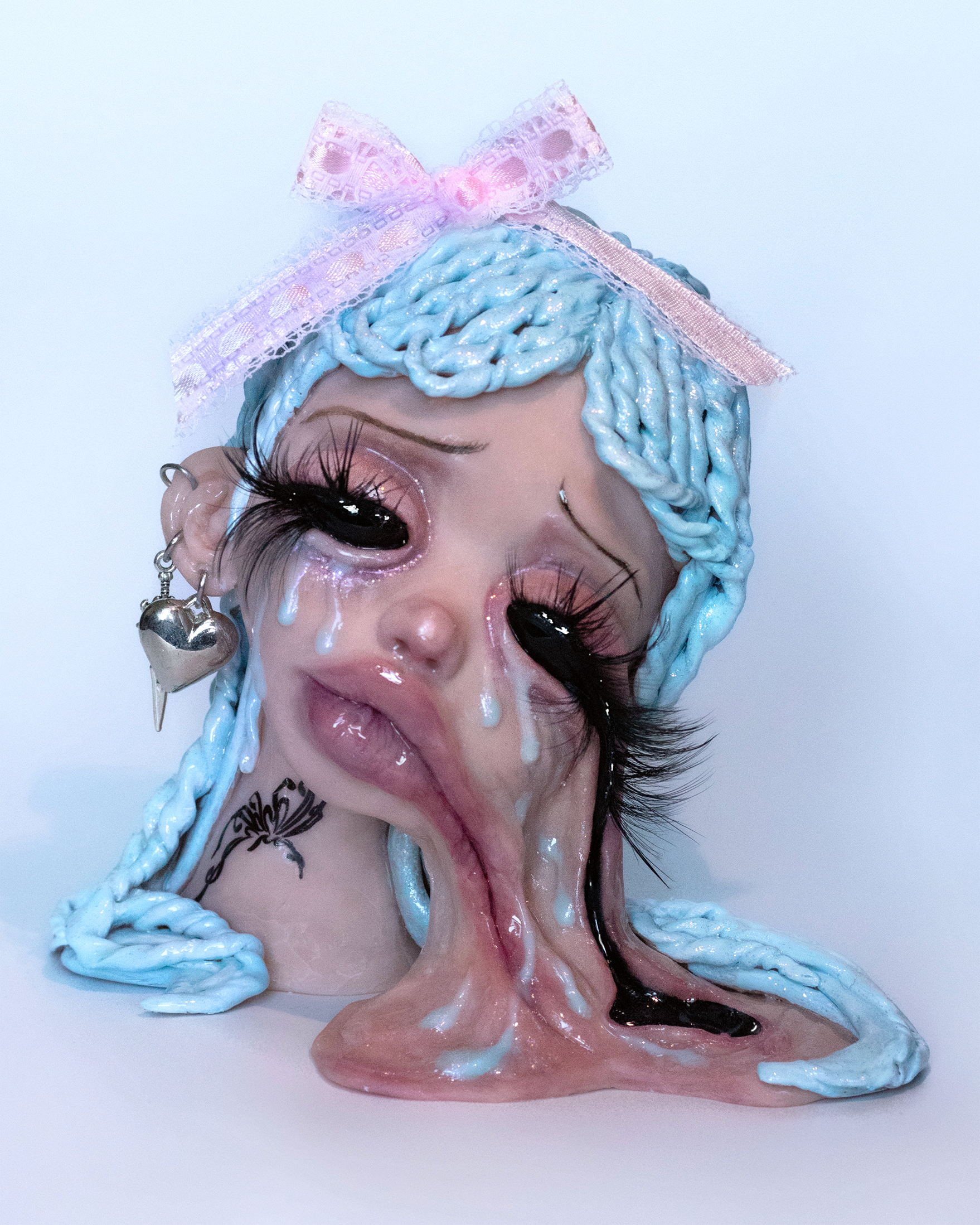
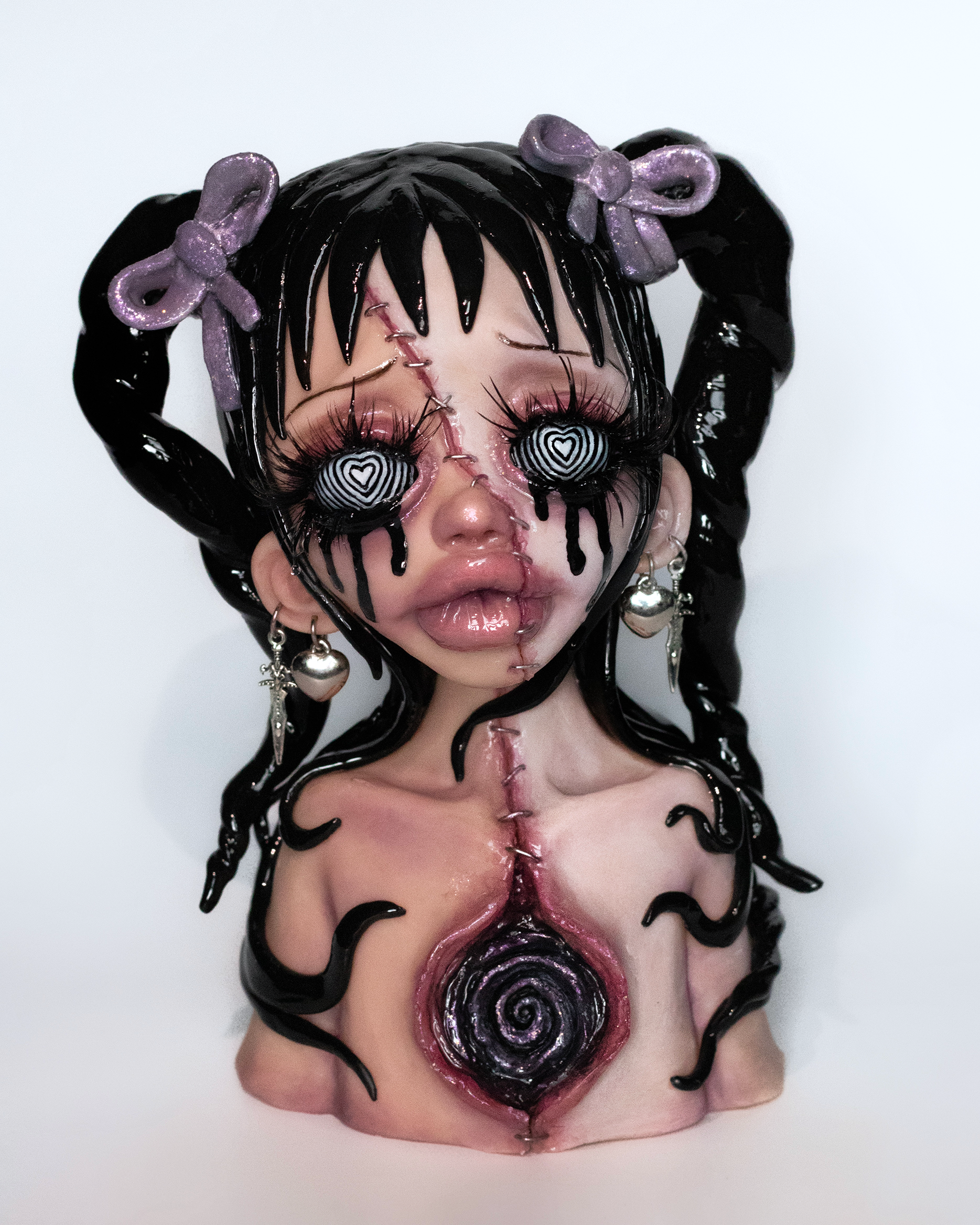
In the series she describes online as “sculpting mental disorders,” PIXIEBLOOD turns internal states into physical characters. DEPRESSION collapses into its own tears, the face stretching downwards as if sadness has acquired gravity. BIPOLAR fuses two heads at the mouth: one pastel and smiling, the other dark and crying, neither allowed to exist without touching the other. BPD is held together by visible stitches while heart-shaped spirals pull the eyes inward.
These works are not clinical diagrams, and they do not pretend to explain a diagnosis. Their power is messier and more intimate: sensation becomes silhouette. A condition that can be flattened into a label suddenly has weight, texture, jewellery and a gaze. The Creep does not ask to be made palatable before it can be seen. It arrives with the feeling turned all the way up.
That is also why the detail matters. PIXIEBLOOD’s language is built from the objects people use to author themselves—piercings, lashes, bows, hair, makeup—and the marks a body is expected to hide. She places both systems on the same surface. Decoration becomes anatomy. The scar is styled; the accessory becomes structural. Nothing is “just” pretty and nothing is “just” grotesque. The face keeps switching sides while you look at it.
Cute has been carrying a weapon
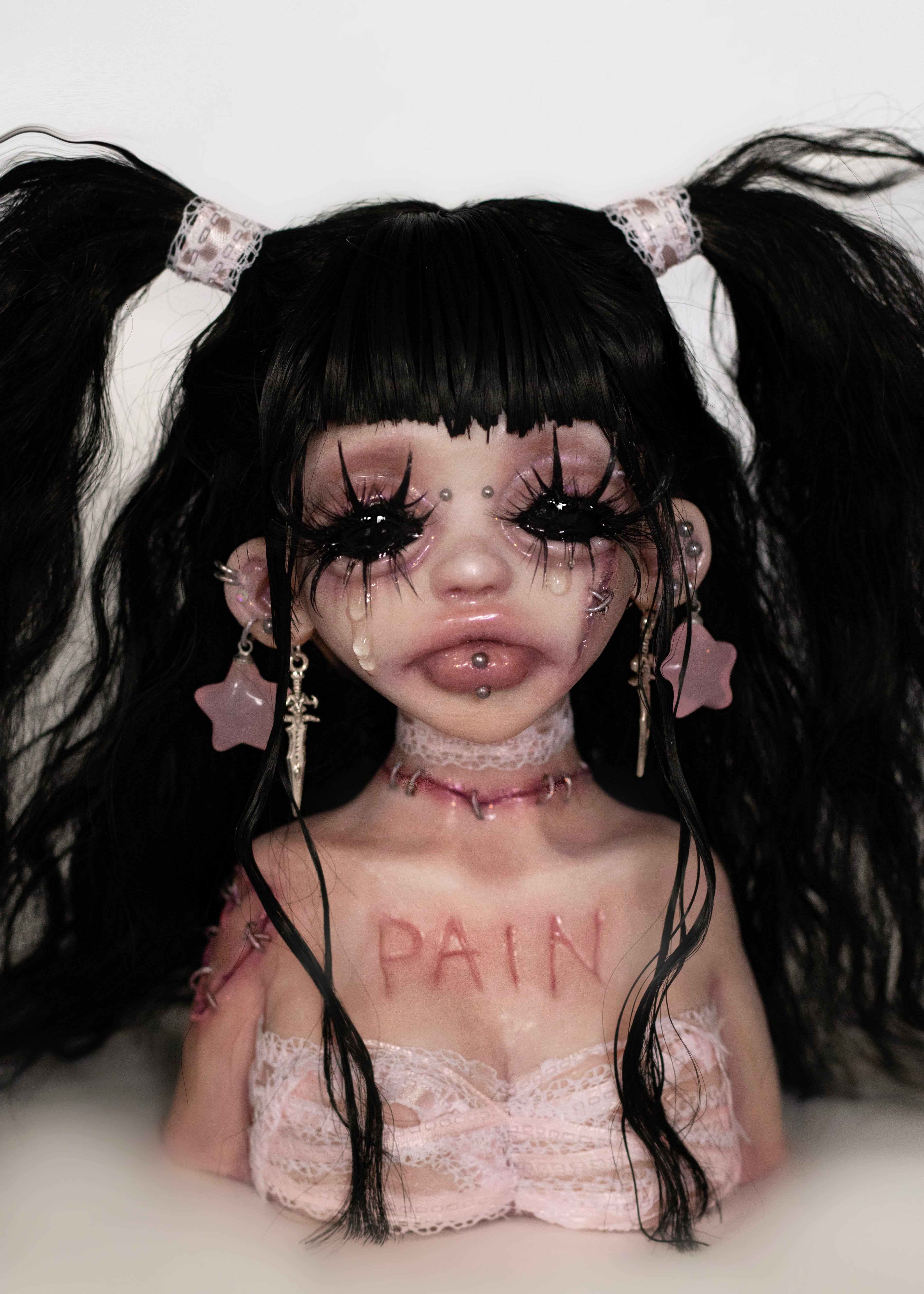
There is a reason these figures move so cleanly through the feed. PIXIEBLOOD understands the grammar of internet beauty—the frontal close-up, the hypnotic eye, the wet highlight, the transformation reveal—then pushes it until the screen feels physically unstable. Her Creeps are intensely photogenic without becoming easy. They seduce the camera and then make the camera nervous.
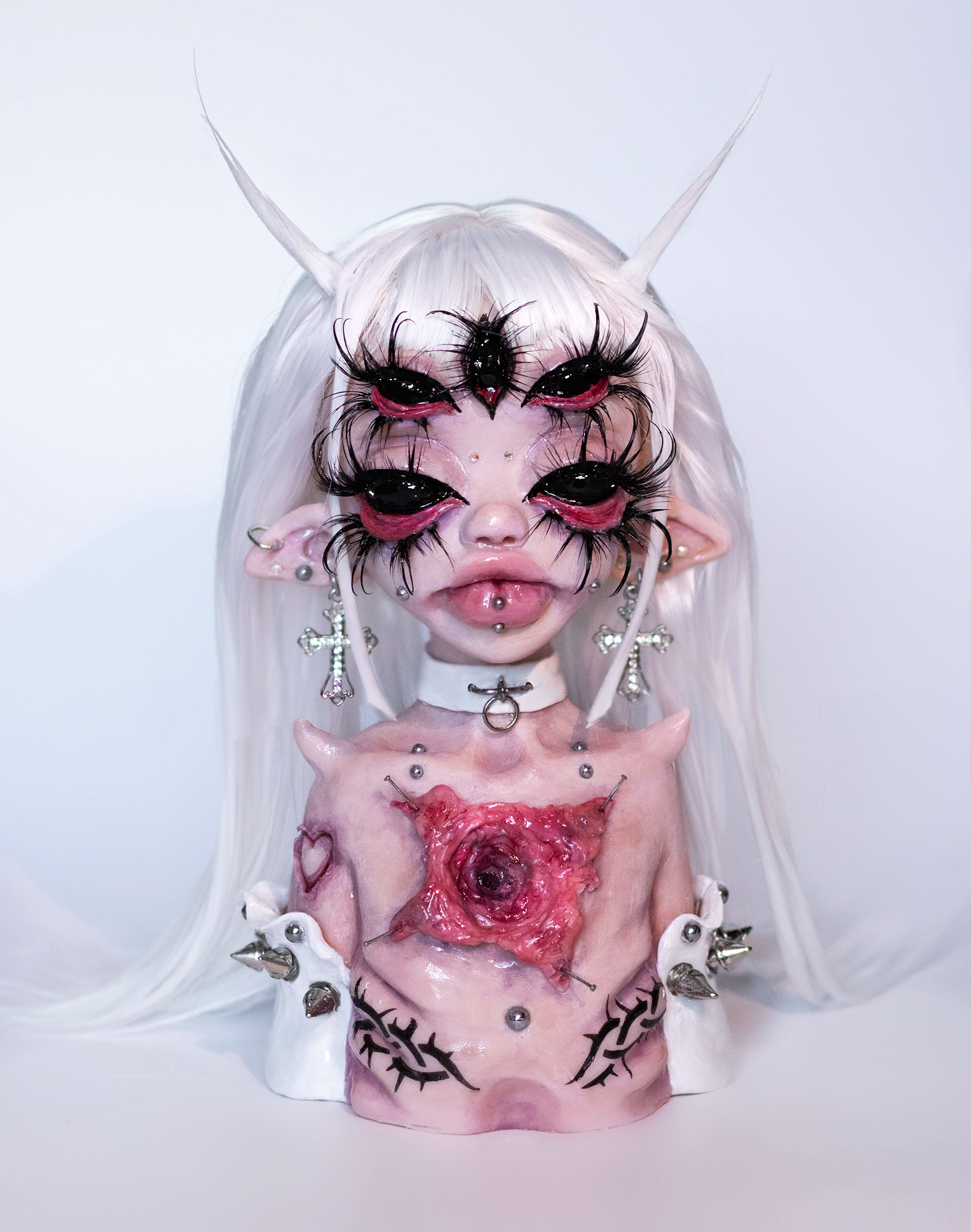
LUST wraps a doll-sized face in black lacquer and spikes, its pupils replaced by perfect pink hearts. HELL RAISER grows extra eyes, elf ears and an open wound that has been pinned to the chest like couture. The visual pleasure is immediate, but it is never passive. You keep finding another puncture, another lash, another tiny decision designed to make the object feel less manufactured and more summoned.
The work belongs to a generation raised with horror, cosmetics and self-invention sharing the same mirror. A face can be a diary, a disguise, a creature and a joke before breakfast. PIXIEBLOOD does not tidy those identities into one tasteful answer. She lets them pile up until the sculpture becomes a whole subculture with a pulse.

Pop culture gets possessed
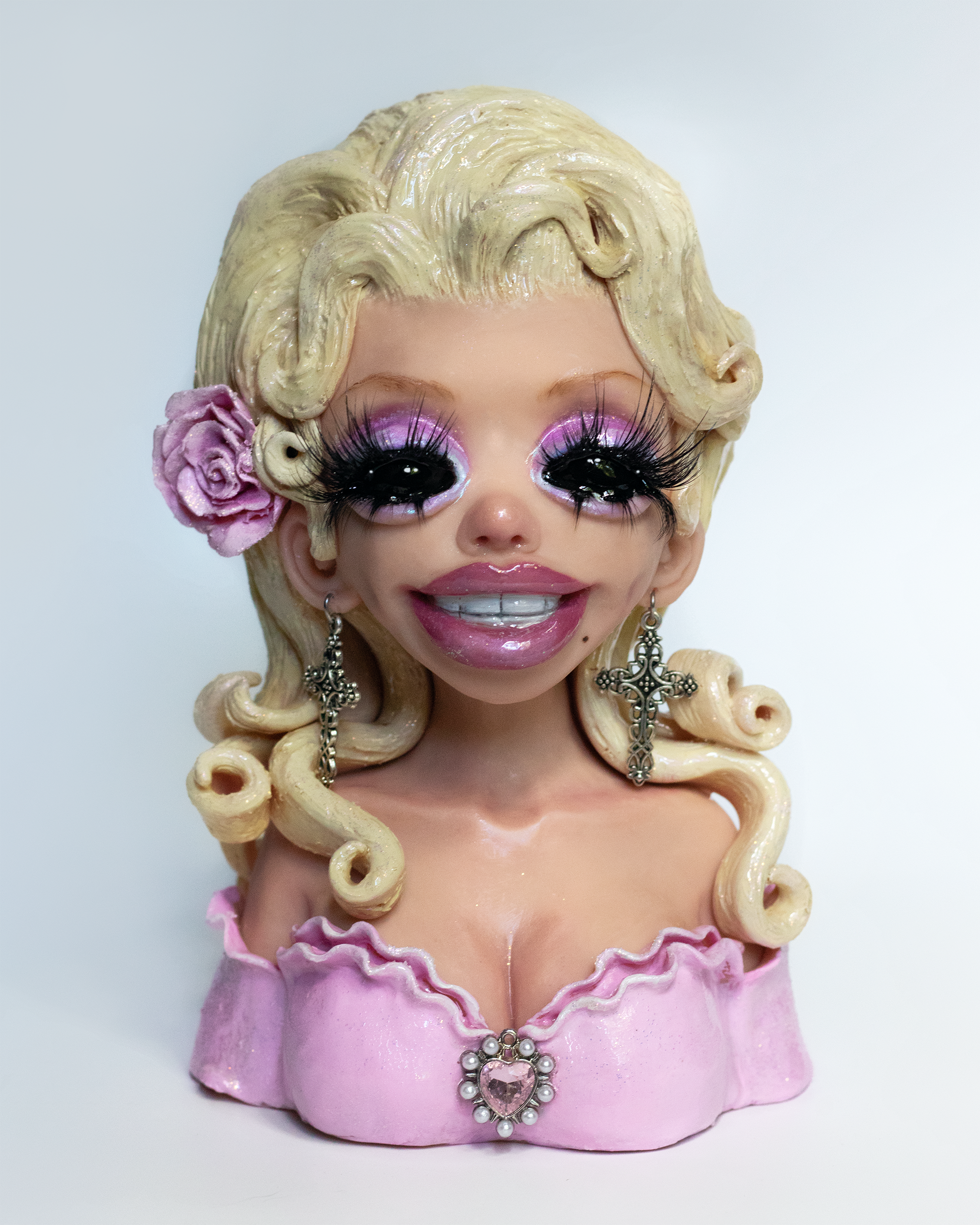
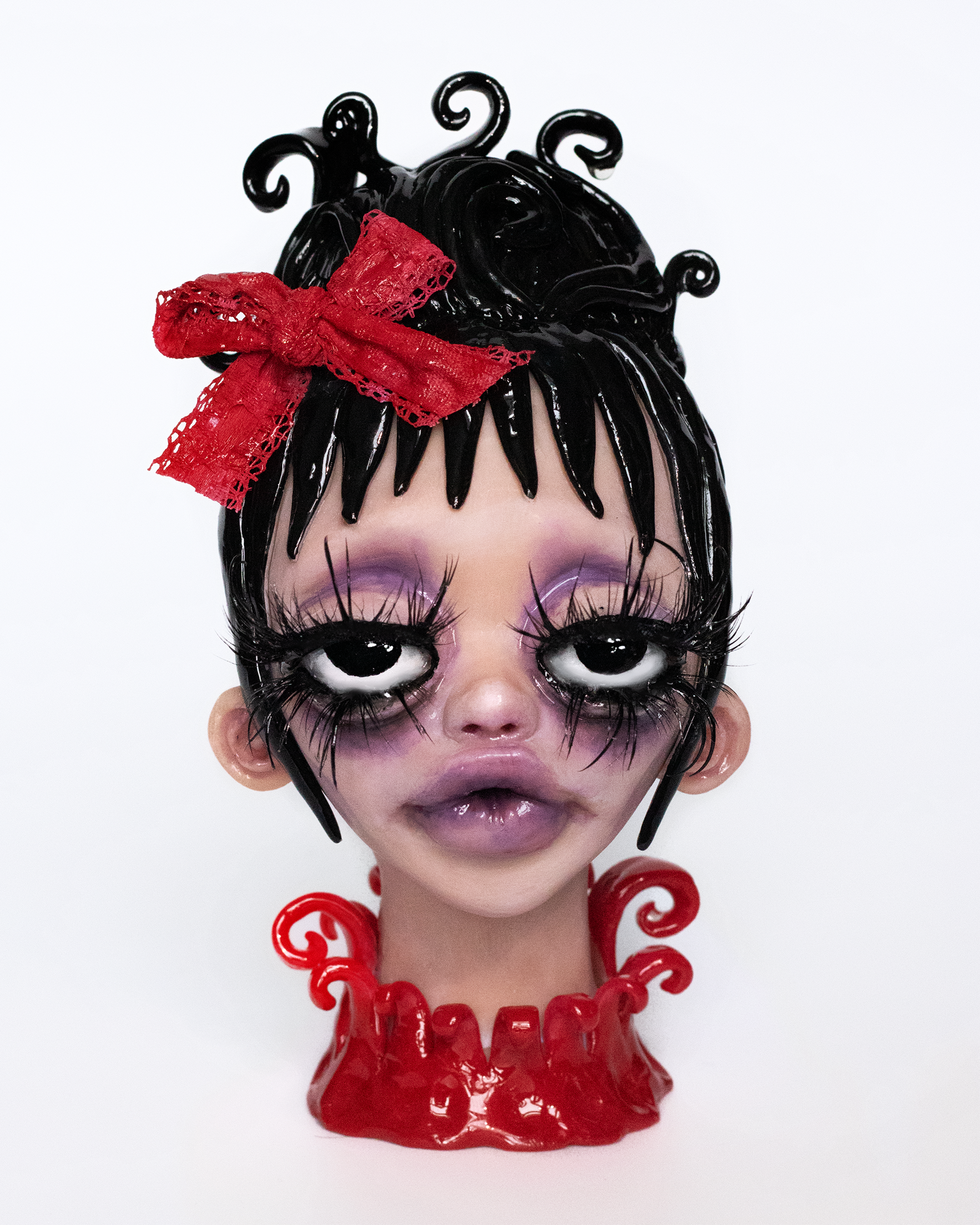
When PIXIEBLOOD works with a familiar face, she does not make tribute merch. She recasts the character inside her own mythology. Dolly Parton becomes a black-eyed apparition in a sugar-pink dress, still radiant, now slightly supernatural. Lydia Deetz keeps the red bow and gothic exhaustion, but her proportions have been pulled into the same feverish family as every other Creep.
That method makes her current Horror Divas direction feel inevitable. These women were already bigger than realism: final girls, femmes fatales and cult icons who taught audiences that glamour could carry a knife. In PIXIEBLOOD’s hands, recognition is only the doorway. The real event is watching a public image mutate into something private, glossy and feral.
The sculpture has a soundtrack
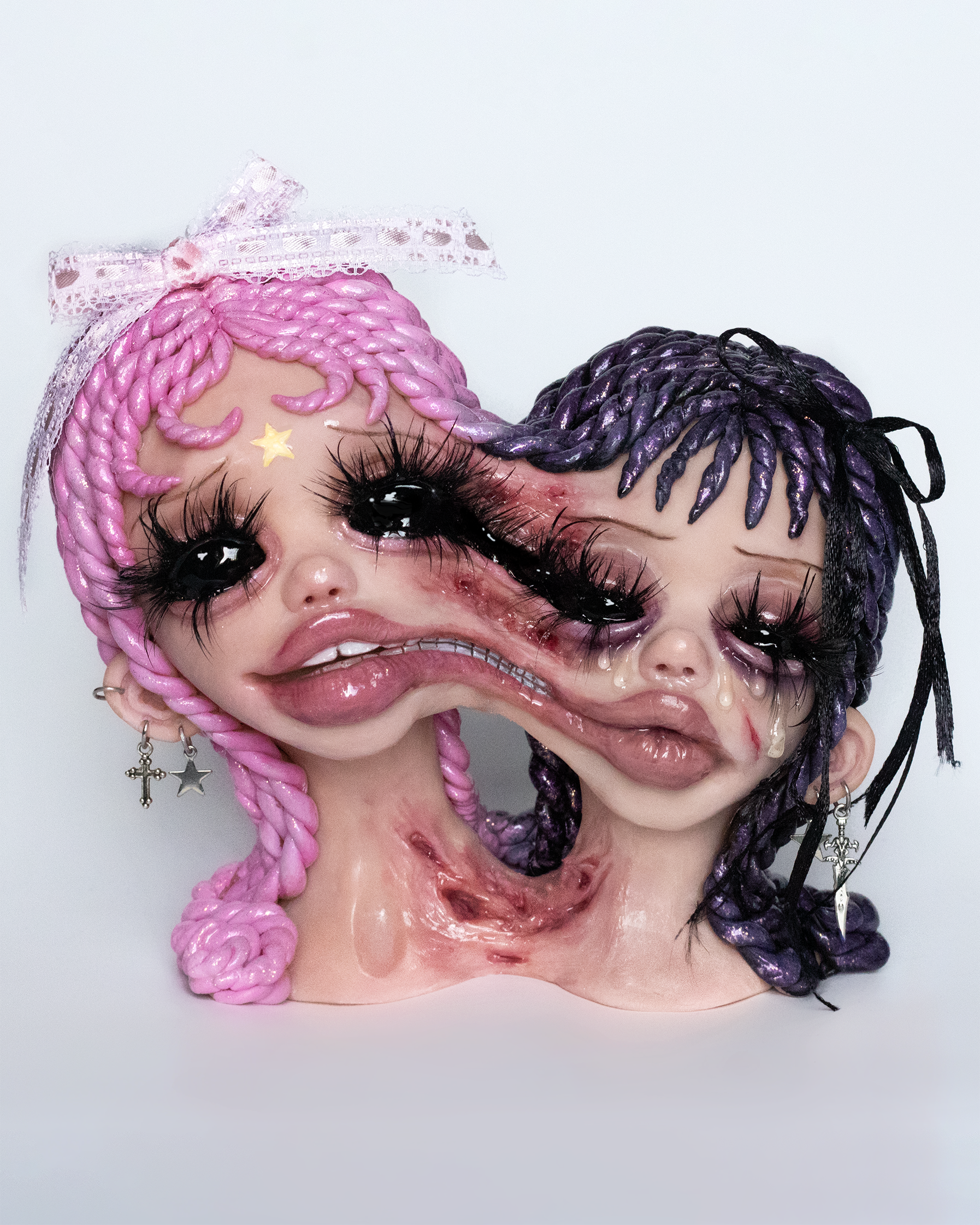
PIXIEBLOOD’s world does not stop at the object. She also makes music as Babyteeth, and the crossover is more than branding. For the Doll Hearts collection, the sculpture Doll&Dagger translates the Babyteeth song “I Have Only a Doll Heart” into physical form. Two heads are joined through the face, one lilac and one violet, their lashes meeting across the seam like a kiss that turned surgical.
It reveals something central about her practice. The Creeps are not isolated products; they are characters moving through a larger emotional system. A song can become a body. A diagnosis can become a hairstyle. A horror heroine can become a collectible altar piece. The same obsessions—attachment, transformation, pain, performance—keep changing medium without losing their teeth.


Too alive to sit pretty
The official shop is crowded with sold-out works, but scarcity is not the most interesting thing about the demand. Collectors are responding to an object that refuses the dead-eyed neutrality of conventional luxury. A Creep has attitude before it has an owner. It enters the room with its own history already leaking out.
That is PIXIEBLOOD’s trick: she makes sculpture feel less like a finished object than a living identity caught mid-transformation. The work is exquisitely controlled, but it never behaves. It is tender without becoming harmless, wounded without becoming weak and cute without asking permission. Culture was never meant to behave. Neither were the dolls.
© 2026 Frenzy Haus. All rights reserved.


Art & Photography
PIXIEBLOOD’s Creeps Are Too Alive to Sit Pretty
The sculptress turns psychic pain, horror heroines and pop obsession into glossy little monsters with wet eyes, sharp teeth and absolutely no interest in behaving.
Text
Noah Cruz
PIXIEBLOOD’s sculptures do not sit politely on a shelf. They stare, leak, split, sprout teeth and wear enough lashes to create their own weather. Their skin is glazed like sugar; their wounds shine like lip gloss. Every face seems caught somewhere between a childhood treasure, a club kid at sunrise and the thing watching from the wardrobe after the lights go out.
The artist calls them Creeps. It is the right word because it refuses the safety of “doll” without draining the work of affection. These figures are meticulously dressed, pierced and styled. Bows are tied. Hair is laid. Tiny silver charms hang beside black, bottomless eyes. Care is everywhere, even when the face has been opened, doubled or pulled past the limits of anatomy. They are not damaged cuteness. They are cuteness after it learned what the world was capable of and decided to become stranger.
That tension is the charge running through PIXIEBLOOD’s universe: beauty and body horror are not opposites here. They flirt. Pink meets scar tissue. Glitter sits beside exposed flesh. The monstrous does not interrupt the fantasy; it completes it. In a culture forever trying to make the feminine small, smooth and easy to consume, the Creep arrives glossy, complicated and impossible to swallow whole.
Give the feeling a face
In the series she describes online as “sculpting mental disorders,” PIXIEBLOOD turns internal states into physical characters. DEPRESSION collapses into its own tears, the face stretching downwards as if sadness has acquired gravity. BIPOLAR fuses two heads at the mouth: one pastel and smiling, the other dark and crying, neither allowed to exist without touching the other. BPD is held together by visible stitches while heart-shaped spirals pull the eyes inward.
These works are not clinical diagrams, and they do not pretend to explain a diagnosis. Their power is messier and more intimate: sensation becomes silhouette. A condition that can be flattened into a label suddenly has weight, texture, jewellery and a gaze. The Creep does not ask to be made palatable before it can be seen. It arrives with the feeling turned all the way up.
That is also why the detail matters. PIXIEBLOOD’s language is built from the objects people use to author themselves—piercings, lashes, bows, hair, makeup—and the marks a body is expected to hide. She places both systems on the same surface. Decoration becomes anatomy. The scar is styled; the accessory becomes structural. Nothing is “just” pretty and nothing is “just” grotesque. The face keeps switching sides while you look at it.
Cute has been carrying a weapon
There is a reason these figures move so cleanly through the feed. PIXIEBLOOD understands the grammar of internet beauty—the frontal close-up, the hypnotic eye, the wet highlight, the transformation reveal—then pushes it until the screen feels physically unstable. Her Creeps are intensely photogenic without becoming easy. They seduce the camera and then make the camera nervous.
LUST wraps a doll-sized face in black lacquer and spikes, its pupils replaced by perfect pink hearts. HELL RAISER grows extra eyes, elf ears and an open wound that has been pinned to the chest like couture. The visual pleasure is immediate, but it is never passive. You keep finding another puncture, another lash, another tiny decision designed to make the object feel less manufactured and more summoned.
The work belongs to a generation raised with horror, cosmetics and self-invention sharing the same mirror. A face can be a diary, a disguise, a creature and a joke before breakfast. PIXIEBLOOD does not tidy those identities into one tasteful answer. She lets them pile up until the sculpture becomes a whole subculture with a pulse.
Pop culture gets possessed
When PIXIEBLOOD works with a familiar face, she does not make tribute merch. She recasts the character inside her own mythology. Dolly Parton becomes a black-eyed apparition in a sugar-pink dress, still radiant, now slightly supernatural. Lydia Deetz keeps the red bow and gothic exhaustion, but her proportions have been pulled into the same feverish family as every other Creep.
That method makes her current Horror Divas direction feel inevitable. These women were already bigger than realism: final girls, femmes fatales and cult icons who taught audiences that glamour could carry a knife. In PIXIEBLOOD’s hands, recognition is only the doorway. The real event is watching a public image mutate into something private, glossy and feral.
The sculpture has a soundtrack
PIXIEBLOOD’s world does not stop at the object. She also makes music as Babyteeth, and the crossover is more than branding. For the Doll Hearts collection, the sculpture Doll&Dagger translates the Babyteeth song “I Have Only a Doll Heart” into physical form. Two heads are joined through the face, one lilac and one violet, their lashes meeting across the seam like a kiss that turned surgical.
It reveals something central about her practice. The Creeps are not isolated products; they are characters moving through a larger emotional system. A song can become a body. A diagnosis can become a hairstyle. A horror heroine can become a collectible altar piece. The same obsessions—attachment, transformation, pain, performance—keep changing medium without losing their teeth.
Too alive to sit pretty
The official shop is crowded with sold-out works, but scarcity is not the most interesting thing about the demand. Collectors are responding to an object that refuses the dead-eyed neutrality of conventional luxury. A Creep has attitude before it has an owner. It enters the room with its own history already leaking out.
That is PIXIEBLOOD’s trick: she makes sculpture feel less like a finished object than a living identity caught mid-transformation. The work is exquisitely controlled, but it never behaves. It is tender without becoming harmless, wounded without becoming weak and cute without asking permission. Culture was never meant to behave. Neither were the dolls.
© 2026 Frenzy Haus. All rights reserved.

Art & Photography
PIXIEBLOOD’s Creeps Are Too Alive to Sit Pretty
The sculptress turns psychic pain, horror heroines and pop obsession into glossy little monsters with wet eyes, sharp teeth and absolutely no interest in behaving.
Text
Noah Cruz
PIXIEBLOOD’s sculptures do not sit politely on a shelf. They stare, leak, split, sprout teeth and wear enough lashes to create their own weather. Their skin is glazed like sugar; their wounds shine like lip gloss. Every face seems caught somewhere between a childhood treasure, a club kid at sunrise and the thing watching from the wardrobe after the lights go out.
The artist calls them Creeps. It is the right word because it refuses the safety of “doll” without draining the work of affection. These figures are meticulously dressed, pierced and styled. Bows are tied. Hair is laid. Tiny silver charms hang beside black, bottomless eyes. Care is everywhere, even when the face has been opened, doubled or pulled past the limits of anatomy. They are not damaged cuteness. They are cuteness after it learned what the world was capable of and decided to become stranger.
That tension is the charge running through PIXIEBLOOD’s universe: beauty and body horror are not opposites here. They flirt. Pink meets scar tissue. Glitter sits beside exposed flesh. The monstrous does not interrupt the fantasy; it completes it. In a culture forever trying to make the feminine small, smooth and easy to consume, the Creep arrives glossy, complicated and impossible to swallow whole.
Give the feeling a face
In the series she describes online as “sculpting mental disorders,” PIXIEBLOOD turns internal states into physical characters. DEPRESSION collapses into its own tears, the face stretching downwards as if sadness has acquired gravity. BIPOLAR fuses two heads at the mouth: one pastel and smiling, the other dark and crying, neither allowed to exist without touching the other. BPD is held together by visible stitches while heart-shaped spirals pull the eyes inward.
These works are not clinical diagrams, and they do not pretend to explain a diagnosis. Their power is messier and more intimate: sensation becomes silhouette. A condition that can be flattened into a label suddenly has weight, texture, jewellery and a gaze. The Creep does not ask to be made palatable before it can be seen. It arrives with the feeling turned all the way up.
That is also why the detail matters. PIXIEBLOOD’s language is built from the objects people use to author themselves—piercings, lashes, bows, hair, makeup—and the marks a body is expected to hide. She places both systems on the same surface. Decoration becomes anatomy. The scar is styled; the accessory becomes structural. Nothing is “just” pretty and nothing is “just” grotesque. The face keeps switching sides while you look at it.
Cute has been carrying a weapon
There is a reason these figures move so cleanly through the feed. PIXIEBLOOD understands the grammar of internet beauty—the frontal close-up, the hypnotic eye, the wet highlight, the transformation reveal—then pushes it until the screen feels physically unstable. Her Creeps are intensely photogenic without becoming easy. They seduce the camera and then make the camera nervous.
LUST wraps a doll-sized face in black lacquer and spikes, its pupils replaced by perfect pink hearts. HELL RAISER grows extra eyes, elf ears and an open wound that has been pinned to the chest like couture. The visual pleasure is immediate, but it is never passive. You keep finding another puncture, another lash, another tiny decision designed to make the object feel less manufactured and more summoned.
The work belongs to a generation raised with horror, cosmetics and self-invention sharing the same mirror. A face can be a diary, a disguise, a creature and a joke before breakfast. PIXIEBLOOD does not tidy those identities into one tasteful answer. She lets them pile up until the sculpture becomes a whole subculture with a pulse.
Pop culture gets possessed
When PIXIEBLOOD works with a familiar face, she does not make tribute merch. She recasts the character inside her own mythology. Dolly Parton becomes a black-eyed apparition in a sugar-pink dress, still radiant, now slightly supernatural. Lydia Deetz keeps the red bow and gothic exhaustion, but her proportions have been pulled into the same feverish family as every other Creep.
That method makes her current Horror Divas direction feel inevitable. These women were already bigger than realism: final girls, femmes fatales and cult icons who taught audiences that glamour could carry a knife. In PIXIEBLOOD’s hands, recognition is only the doorway. The real event is watching a public image mutate into something private, glossy and feral.
The sculpture has a soundtrack
PIXIEBLOOD’s world does not stop at the object. She also makes music as Babyteeth, and the crossover is more than branding. For the Doll Hearts collection, the sculpture Doll&Dagger translates the Babyteeth song “I Have Only a Doll Heart” into physical form. Two heads are joined through the face, one lilac and one violet, their lashes meeting across the seam like a kiss that turned surgical.
It reveals something central about her practice. The Creeps are not isolated products; they are characters moving through a larger emotional system. A song can become a body. A diagnosis can become a hairstyle. A horror heroine can become a collectible altar piece. The same obsessions—attachment, transformation, pain, performance—keep changing medium without losing their teeth.
Too alive to sit pretty
The official shop is crowded with sold-out works, but scarcity is not the most interesting thing about the demand. Collectors are responding to an object that refuses the dead-eyed neutrality of conventional luxury. A Creep has attitude before it has an owner. It enters the room with its own history already leaking out.
That is PIXIEBLOOD’s trick: she makes sculpture feel less like a finished object than a living identity caught mid-transformation. The work is exquisitely controlled, but it never behaves. It is tender without becoming harmless, wounded without becoming weak and cute without asking permission. Culture was never meant to behave. Neither were the dolls.
Get Frenzy straight to your inbox!
Latest
Rachel Leigh Green: The Dolls Are Plastic. The Obsession Isn’t.
Art & Photography

FRENZY FREQUENCY 001: Your Algorithm Has No Taste
Music

Alicia Creti Makes Losing Your Shit Sound Expensive
Music

Miu Miu Killed the Outfit and Left It in Micro-Shorts
Fashion

Hermès Put Quiet Luxury in Its Underwear
Fashion

Lacoste Just Kicked Tennis Whites Out of the Club
Fashion

The Vampire Diaries’ Deadliest Parties, Ranked
Film & TV

Vivienne Westwood Just Put Good Taste Through a Nervous Breakdown
Fashion

The FRENZY Interview: Bo Quinn Makes Beauty Misbehave
Beauty

Megan Fox Is Giving Erectile Dysfunction a Red-Hot Rebrand
Life & Culture
© 2026 Frenzy Haus. All rights reserved.
