Fashion
Prada Gave the Skirt a God Complex
Bras got demoted, Velcro got iced out and 63 skirts behaved like they owned Milan. Miuccia Prada and Raf Simons made the lower half feel omnipotent.

Text

Noah Cruz

Prada did not show skirts. It staged a coronation.

Sixty-three looks bowed to one garment. Bras shrank into punctuation. Shirts waited for instructions. Sweaters were permitted to enter if they understood the hierarchy. Every real decision happened below the navel, where crystal-covered Velcro, fluorescent pleats, floral panels, crinoline shells, Re-Nylon and latex competed for divine attention.

At Fondazione Prada on September 22, Miuccia Prada and Raf Simons gave the skirt a god complex and then spent an entire collection proving it deserved one. Every model wore a skirt. None of the skirts accepted the same definition. Repetition did not flatten the idea. It made the obsession feel absolute.

Watch Prada Spring/Summer 2027 womenswear in full.Video: Prada

The top half knew its place

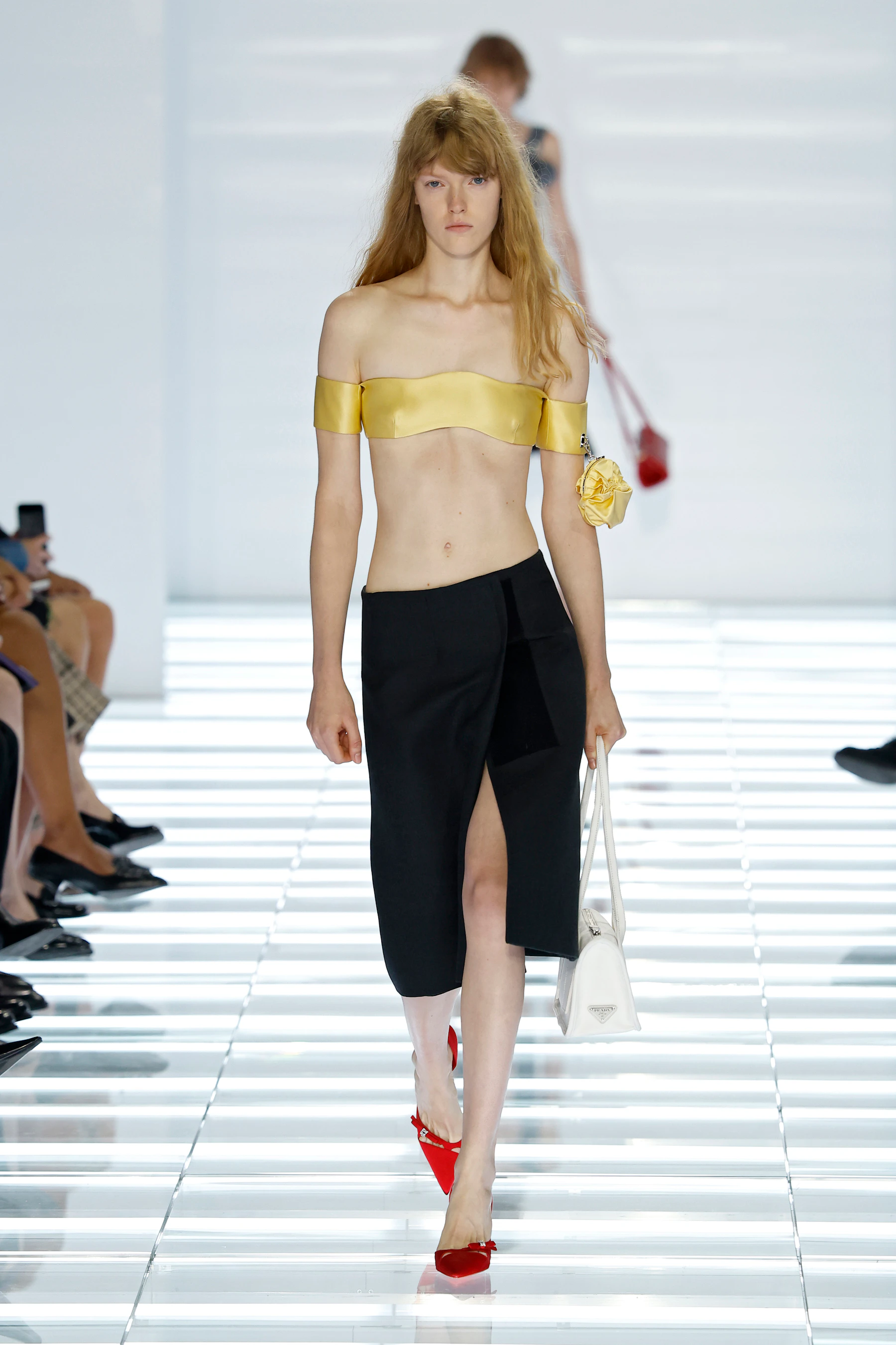
The opening look established the religion immediately: a black lace bra above a tomato-red skirt, sliced so high that the flash of underwear felt less like an accident than a commandment. The equation kept returning—tiny top, almighty bottom. A bandeau faced heavy wool. A harness-like bra submitted to a severe wrap. One yellow fragment came with detached sleeves and a pouch clipped near the breast, as if even the handbag had been told to stay out of the skirt’s territory.

Calling the tops minimal misses the power structure. They were visual white space. The bra was not the provocation; it was the pause before the skirt spoke again. A plain shirt became an altar cloth. A crewneck behaved like crowd control. The lower half arrived with three subplots, an exposed fastening and a bow experiencing a minor spiritual event.

Yes, there was skin, but this was not another naked-dress plea for attention. Exposure was almost administrative. The body became the clean margin around the object. The skirt became the face, the mood and the entire reason the look had entered the building.
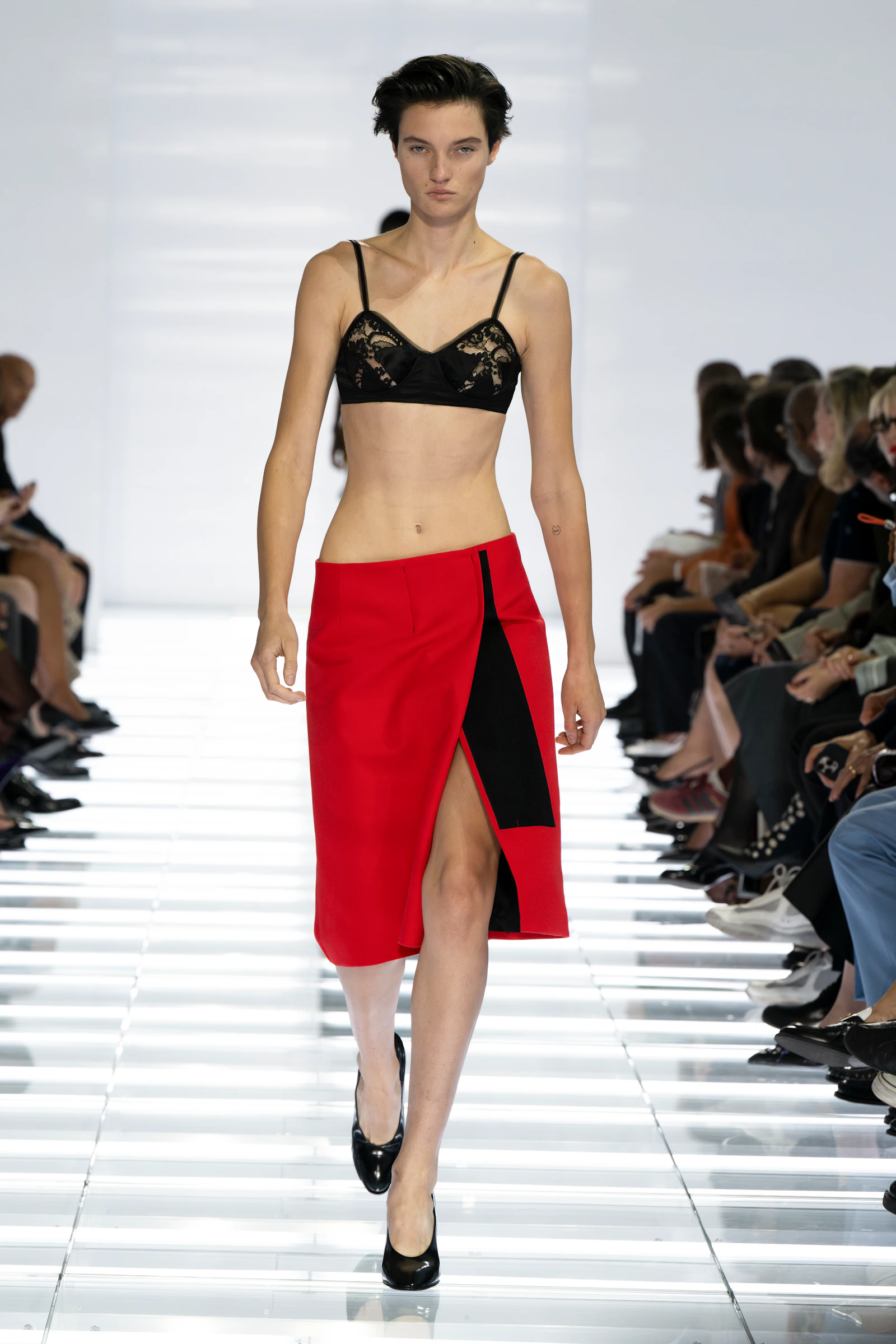
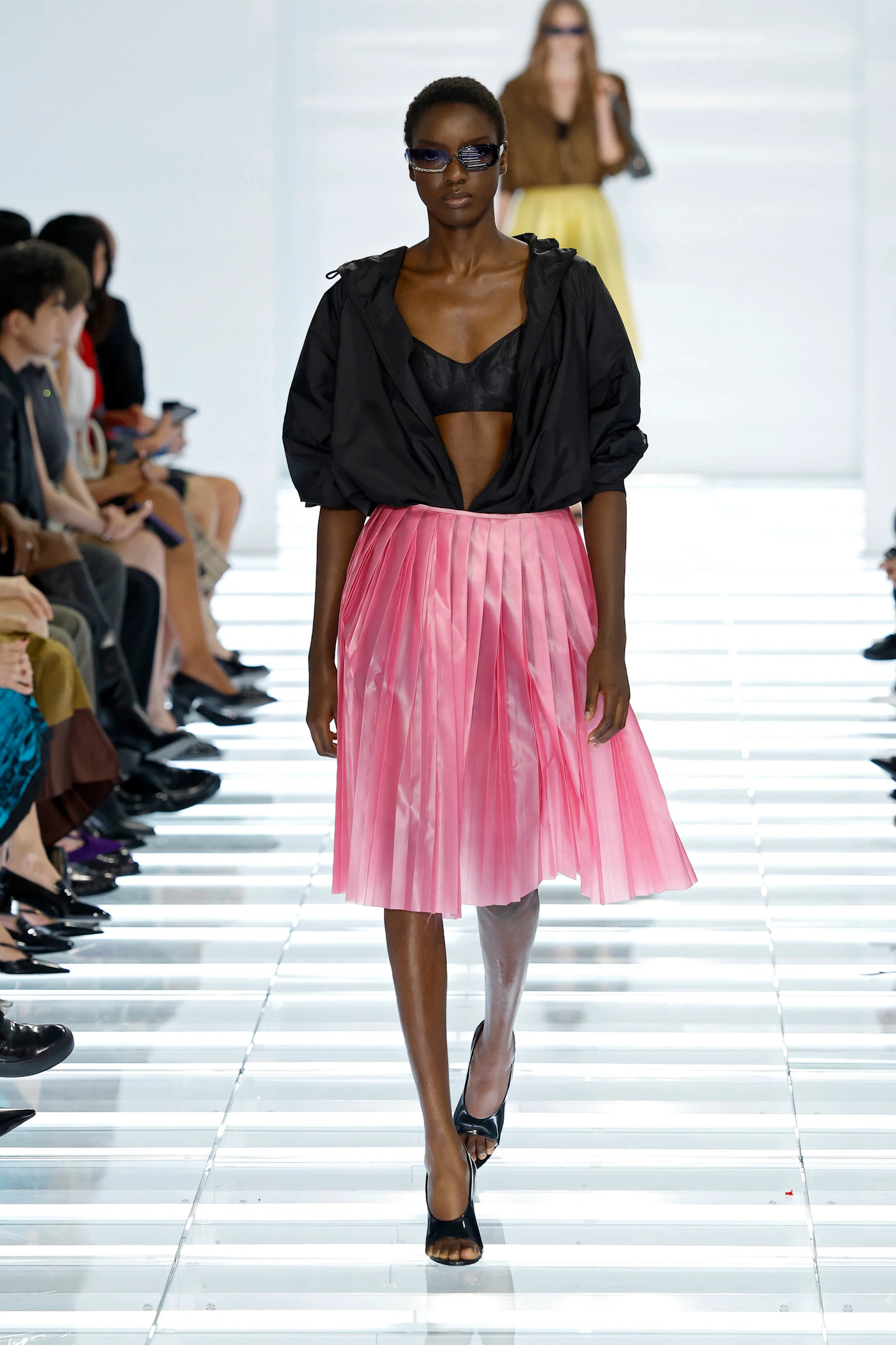
The bra was punctuation. The skirt was scripture.

Velcro got rich

Prada took Velcro—the fastening of school shoes, medical braces and things designed to come off quickly—and gave it a jewellery budget. Contrasting strips held wrap skirts together while clusters of crystals colonised the industrial surface. Giant metal snaps became gems. The mechanics did not disappear into the garment. They arrived iced out and demanding a close-up.

Crinoline was promoted too. The structure normally hidden beneath a skirt moved outside it, becoming shell, cage and halo. Prada’s show notes call the garment “engineered for freedom.” On the runway, that freedom looked highly specific: rip it open, shift the closure, expose the embellishment, conceal it again. Worship came with adjustable settings.

This was decoration with a user manual and utility with a superiority complex. Crystal embroidery did not disguise the Velcro. It made Velcro desirable. Prada understood that the rip, click and adjustment are not backstage mechanics. They are part of the seduction.

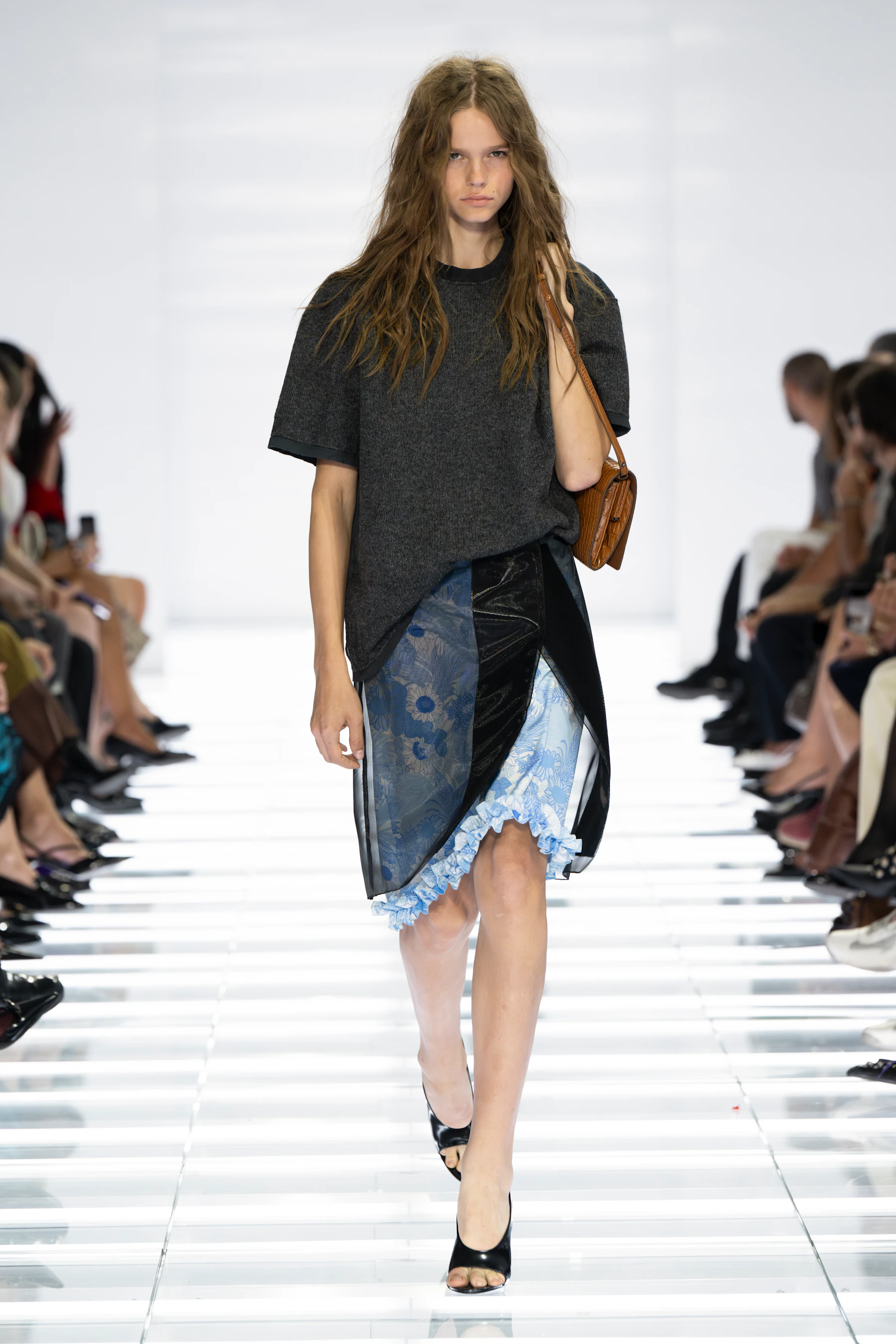
Model in a dark Prada T-shirt and asymmetrical black and blue painted skirt
A brushstroke escaped the canvas and took control of the body.Estrop/Getty Images

History came back hot and slightly dishevelled

Prada has been building this cult for decades. In 2006, Miuccia called the skirt her equivalent of a T-shirt: familiar, useful and open to eccentricity. Even earlier, the travelling Waist Down exhibition isolated designs from the 1998–2004 archive and treated the lower body as enough territory for an entire world.

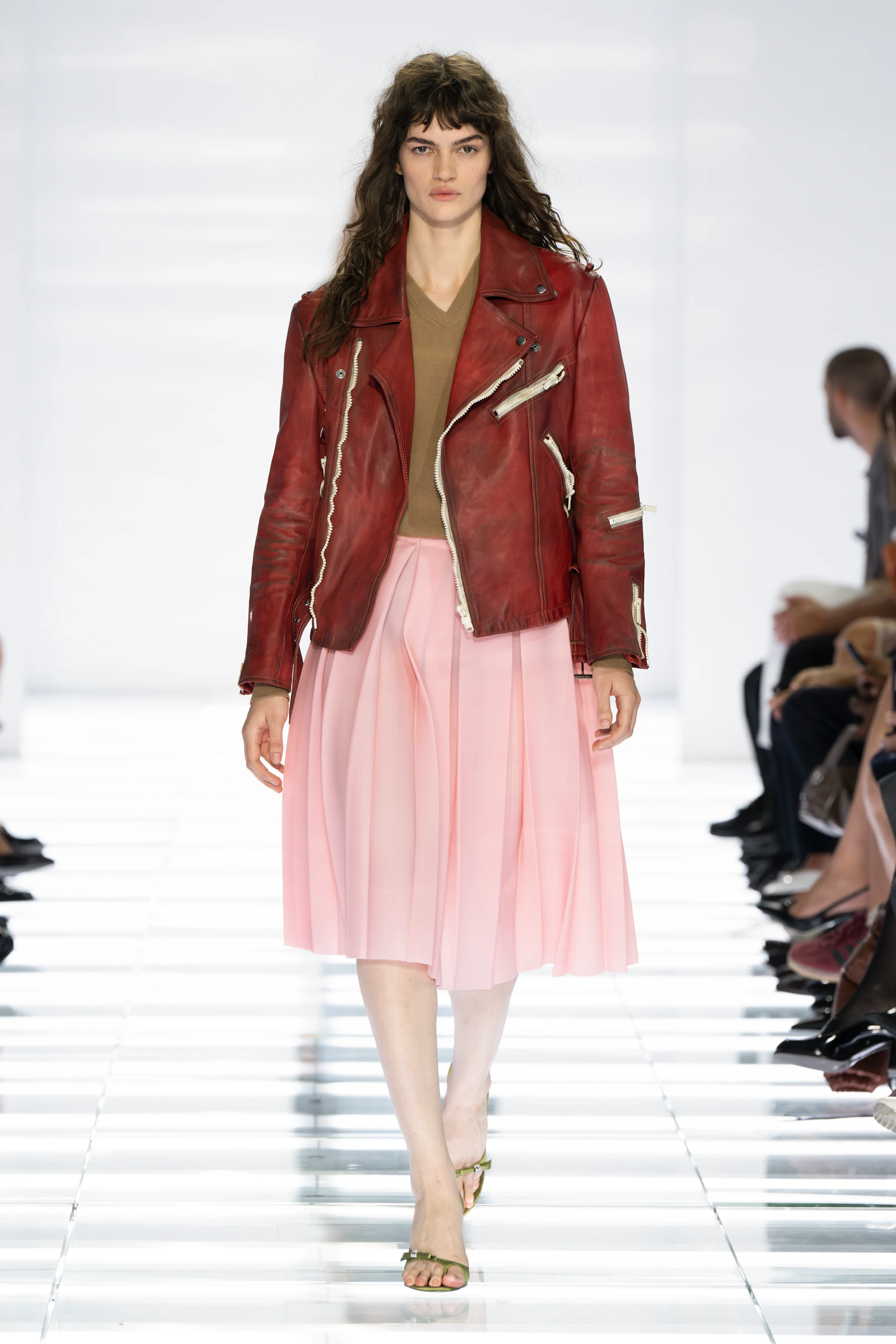
Spring 2027 summoned the old spirits without forcing them into vintage cosplay. The bralette-and-skirt equation flashed back to Miu Miu in 1995. Girlish florals trapped under shiny black nylon whispered about Prada’s 1996 ugly-chic collision. Distressed leather, feral hair and tiny prim bows made sure nobody mistook the archive for a museum.

Prada’s past never behaves like heritage. It behaves like evidence. Different decades grabbed the same look at once; innocence met perversity, polish met damage, grandmother fabric met visible underwear. The house did not resolve the contradictions. It let them flirt in public.

The skirt did not complete the look. It ruled it.

One garment ate the entire moodboard

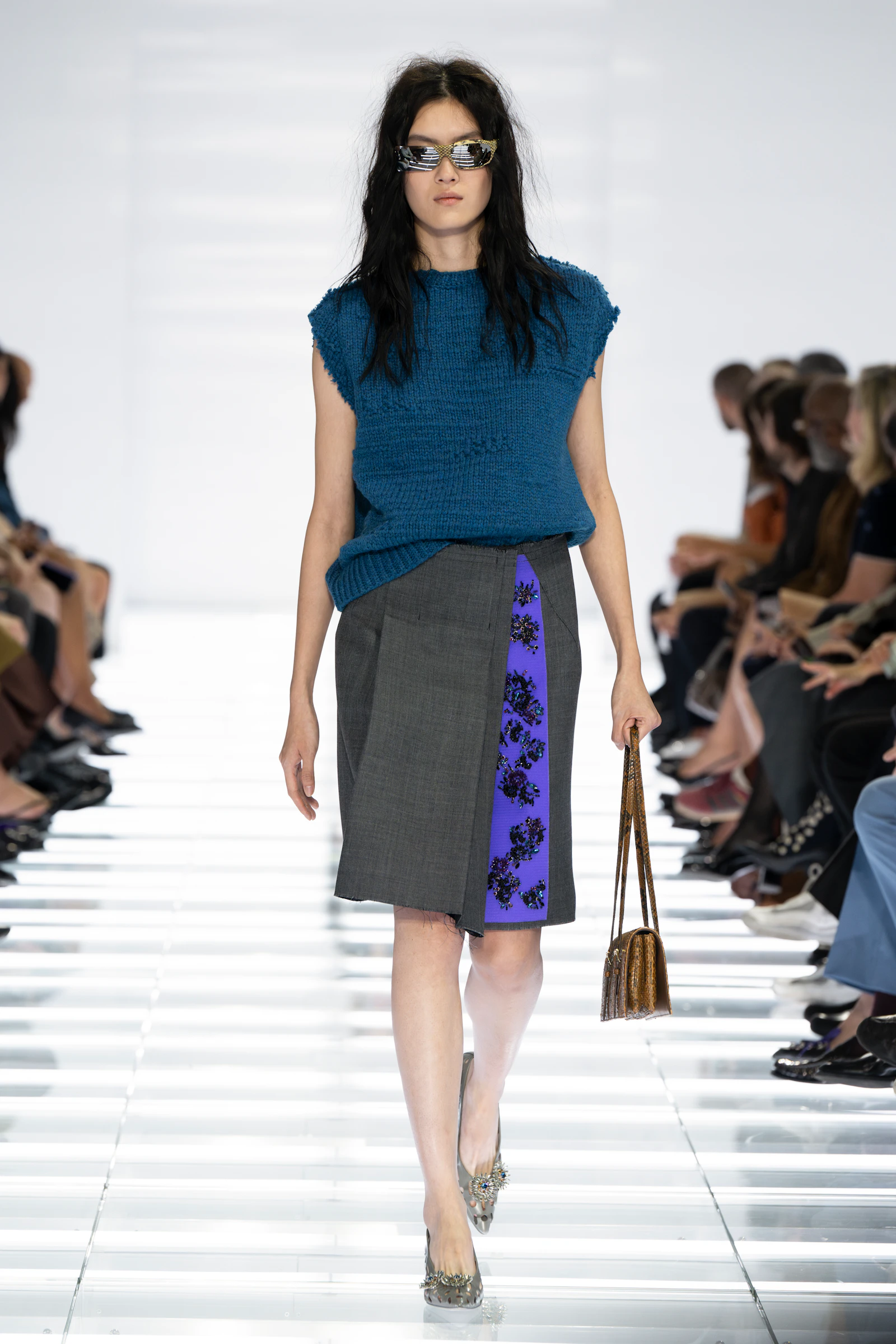
The skirt arrived carrying centuries of baggage: feminine, respectable, sexy, office-safe, school-coded, ceremonial, old-fashioned. Prada unpacked every association and kept none of the rules. A sculptural white volume played innocent. A grey kilt wore a jewel like a weapon. A fitted skirt grew a purple printed wound. A black one opened high enough to turn briefs into styling.

The obsession connected to June’s men’s collection, where Prada and Simons put jeans and T-shirts under interrogation. Raf, who said he had not worn denim in 20 years, talked backstage about common garments becoming individual through combination. Womenswear made that idea hornier, stranger and more emotional. The skirt was not a basic waiting to be perfected. It was a host body that changed meaning whenever another garment touched it.

That made the collection accessible without making it obedient. The central question was instantly legible: how much personality can one familiar shape hold before it becomes a different object? Prada’s answer was 63 looks and still not enough.

Model wearing a yellow Prada bra top with detached sleeves and slim black skirt-trousers
The yellow top arrived in fragments. The black lower half owned the exit.Giovanni Giannoni/WWD via Getty Images

Welcome to the cult of the Prada skirt

Fashion keeps trying to sell the total look: a perfectly resolved identity, searchable, screenshot-ready and available in one swipe. Prada offered a wardrobe with a control problem. Wear the tiny bra or refuse it. Add the sensible knit. Throw on the battered leather jacket. Rip open the Velcro. Let the floral layer escape. The skirt absorbed every contradiction and somehow became more specific.

The power was not in prescribing one Prada woman. It was in giving her a fixed shape and refusing to fix her meaning. Sexy did not cancel practical. Pretty did not cancel strange. Familiarity became a launchpad instead of a limit. The skirt could be modest, obscene, corporate, romantic and mildly possessed before reaching the end of the runway.

Miuccia once said a skirt was like a T-shirt because it could be eccentric without changing you completely. Twenty years later, she and Simons proved the opposite could also be true. Leave the top half almost blank. Put every dangerous idea below the waist. Let the skirt decide who walks out.

Fashion
Prada Gave the Skirt a God Complex
Bras got demoted, Velcro got iced out and 63 skirts behaved like they owned Milan. Miuccia Prada and Raf Simons made the lower half feel omnipotent.

Text

Noah Cruz

Prada did not show skirts. It staged a coronation.

Sixty-three looks bowed to one garment. Bras shrank into punctuation. Shirts waited for instructions. Sweaters were permitted to enter if they understood the hierarchy. Every real decision happened below the navel, where crystal-covered Velcro, fluorescent pleats, floral panels, crinoline shells, Re-Nylon and latex competed for divine attention.

At Fondazione Prada on September 22, Miuccia Prada and Raf Simons gave the skirt a god complex and then spent an entire collection proving it deserved one. Every model wore a skirt. None of the skirts accepted the same definition. Repetition did not flatten the idea. It made the obsession feel absolute.

Watch Prada Spring/Summer 2027 womenswear in full.Video: Prada

The top half knew its place

The opening look established the religion immediately: a black lace bra above a tomato-red skirt, sliced so high that the flash of underwear felt less like an accident than a commandment. The equation kept returning—tiny top, almighty bottom. A bandeau faced heavy wool. A harness-like bra submitted to a severe wrap. One yellow fragment came with detached sleeves and a pouch clipped near the breast, as if even the handbag had been told to stay out of the skirt’s territory.

Calling the tops minimal misses the power structure. They were visual white space. The bra was not the provocation; it was the pause before the skirt spoke again. A plain shirt became an altar cloth. A crewneck behaved like crowd control. The lower half arrived with three subplots, an exposed fastening and a bow experiencing a minor spiritual event.

Yes, there was skin, but this was not another naked-dress plea for attention. Exposure was almost administrative. The body became the clean margin around the object. The skirt became the face, the mood and the entire reason the look had entered the building.
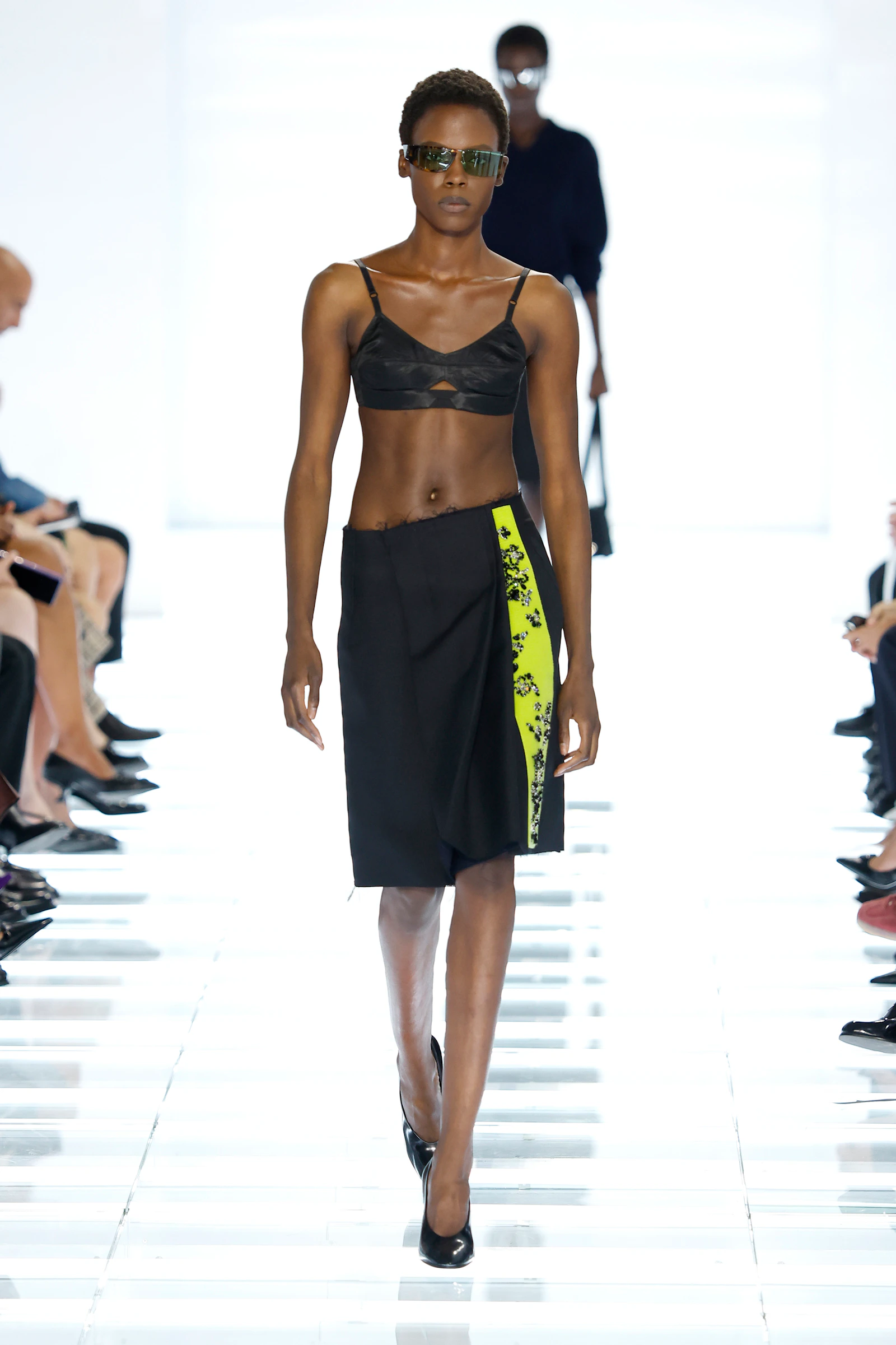
The bra was punctuation. The skirt was scripture.

Velcro got rich

Prada took Velcro—the fastening of school shoes, medical braces and things designed to come off quickly—and gave it a jewellery budget. Contrasting strips held wrap skirts together while clusters of crystals colonised the industrial surface. Giant metal snaps became gems. The mechanics did not disappear into the garment. They arrived iced out and demanding a close-up.

Crinoline was promoted too. The structure normally hidden beneath a skirt moved outside it, becoming shell, cage and halo. Prada’s show notes call the garment “engineered for freedom.” On the runway, that freedom looked highly specific: rip it open, shift the closure, expose the embellishment, conceal it again. Worship came with adjustable settings.

This was decoration with a user manual and utility with a superiority complex. Crystal embroidery did not disguise the Velcro. It made Velcro desirable. Prada understood that the rip, click and adjustment are not backstage mechanics. They are part of the seduction.
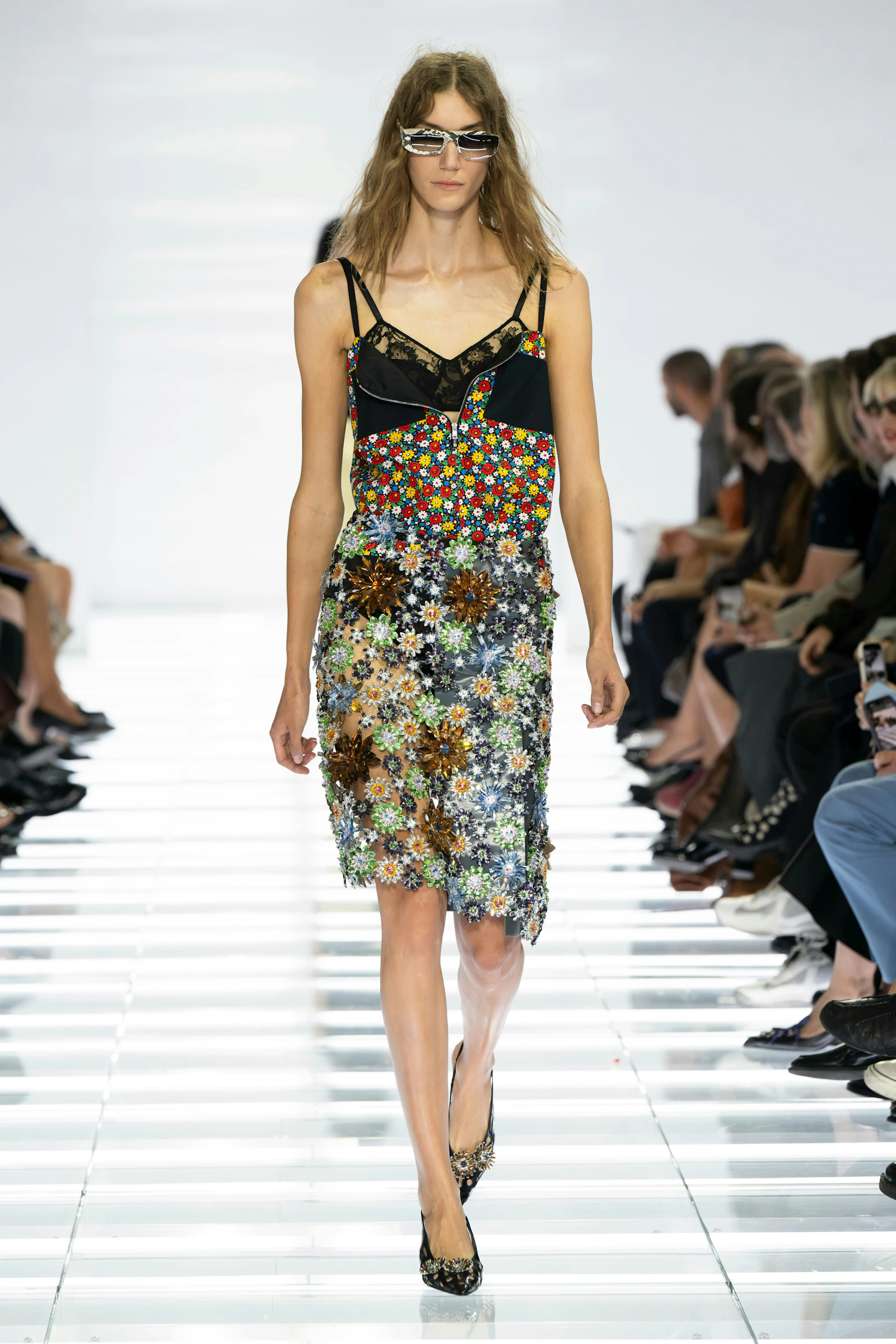
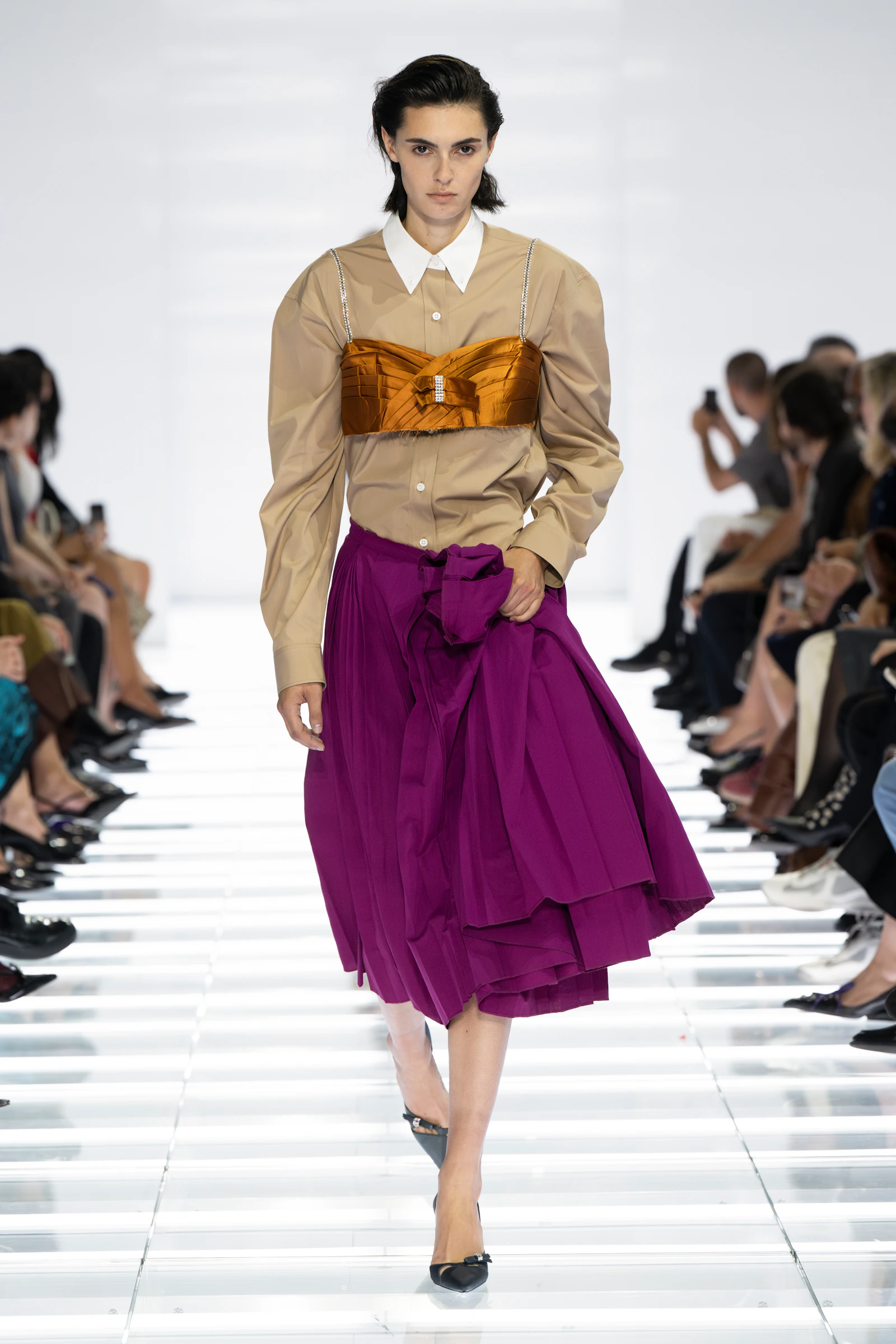
Model in a dark Prada T-shirt and asymmetrical black and blue painted skirt
A brushstroke escaped the canvas and took control of the body.Estrop/Getty Images

History came back hot and slightly dishevelled

Prada has been building this cult for decades. In 2006, Miuccia called the skirt her equivalent of a T-shirt: familiar, useful and open to eccentricity. Even earlier, the travelling Waist Down exhibition isolated designs from the 1998–2004 archive and treated the lower body as enough territory for an entire world.

Spring 2027 summoned the old spirits without forcing them into vintage cosplay. The bralette-and-skirt equation flashed back to Miu Miu in 1995. Girlish florals trapped under shiny black nylon whispered about Prada’s 1996 ugly-chic collision. Distressed leather, feral hair and tiny prim bows made sure nobody mistook the archive for a museum.

Prada’s past never behaves like heritage. It behaves like evidence. Different decades grabbed the same look at once; innocence met perversity, polish met damage, grandmother fabric met visible underwear. The house did not resolve the contradictions. It let them flirt in public.

The skirt did not complete the look. It ruled it.

One garment ate the entire moodboard

The skirt arrived carrying centuries of baggage: feminine, respectable, sexy, office-safe, school-coded, ceremonial, old-fashioned. Prada unpacked every association and kept none of the rules. A sculptural white volume played innocent. A grey kilt wore a jewel like a weapon. A fitted skirt grew a purple printed wound. A black one opened high enough to turn briefs into styling.

The obsession connected to June’s men’s collection, where Prada and Simons put jeans and T-shirts under interrogation. Raf, who said he had not worn denim in 20 years, talked backstage about common garments becoming individual through combination. Womenswear made that idea hornier, stranger and more emotional. The skirt was not a basic waiting to be perfected. It was a host body that changed meaning whenever another garment touched it.

That made the collection accessible without making it obedient. The central question was instantly legible: how much personality can one familiar shape hold before it becomes a different object? Prada’s answer was 63 looks and still not enough.

Model wearing a yellow Prada bra top with detached sleeves and slim black skirt-trousers
The yellow top arrived in fragments. The black lower half owned the exit.Giovanni Giannoni/WWD via Getty Images

Welcome to the cult of the Prada skirt

Fashion keeps trying to sell the total look: a perfectly resolved identity, searchable, screenshot-ready and available in one swipe. Prada offered a wardrobe with a control problem. Wear the tiny bra or refuse it. Add the sensible knit. Throw on the battered leather jacket. Rip open the Velcro. Let the floral layer escape. The skirt absorbed every contradiction and somehow became more specific.

The power was not in prescribing one Prada woman. It was in giving her a fixed shape and refusing to fix her meaning. Sexy did not cancel practical. Pretty did not cancel strange. Familiarity became a launchpad instead of a limit. The skirt could be modest, obscene, corporate, romantic and mildly possessed before reaching the end of the runway.

Miuccia once said a skirt was like a T-shirt because it could be eccentric without changing you completely. Twenty years later, she and Simons proved the opposite could also be true. Leave the top half almost blank. Put every dangerous idea below the waist. Let the skirt decide who walks out.

Fashion
Prada Gave the Skirt a God Complex
Bras got demoted, Velcro got iced out and 63 skirts behaved like they owned Milan. Miuccia Prada and Raf Simons made the lower half feel omnipotent.

Text

Noah Cruz

Prada did not show skirts. It staged a coronation.

Sixty-three looks bowed to one garment. Bras shrank into punctuation. Shirts waited for instructions. Sweaters were permitted to enter if they understood the hierarchy. Every real decision happened below the navel, where crystal-covered Velcro, fluorescent pleats, floral panels, crinoline shells, Re-Nylon and latex competed for divine attention.

At Fondazione Prada on September 22, Miuccia Prada and Raf Simons gave the skirt a god complex and then spent an entire collection proving it deserved one. Every model wore a skirt. None of the skirts accepted the same definition. Repetition did not flatten the idea. It made the obsession feel absolute.

Watch Prada Spring/Summer 2027 womenswear in full.Video: Prada

The top half knew its place

The opening look established the religion immediately: a black lace bra above a tomato-red skirt, sliced so high that the flash of underwear felt less like an accident than a commandment. The equation kept returning—tiny top, almighty bottom. A bandeau faced heavy wool. A harness-like bra submitted to a severe wrap. One yellow fragment came with detached sleeves and a pouch clipped near the breast, as if even the handbag had been told to stay out of the skirt’s territory.

Calling the tops minimal misses the power structure. They were visual white space. The bra was not the provocation; it was the pause before the skirt spoke again. A plain shirt became an altar cloth. A crewneck behaved like crowd control. The lower half arrived with three subplots, an exposed fastening and a bow experiencing a minor spiritual event.

Yes, there was skin, but this was not another naked-dress plea for attention. Exposure was almost administrative. The body became the clean margin around the object. The skirt became the face, the mood and the entire reason the look had entered the building.

The bra was punctuation. The skirt was scripture.

Velcro got rich

Prada took Velcro—the fastening of school shoes, medical braces and things designed to come off quickly—and gave it a jewellery budget. Contrasting strips held wrap skirts together while clusters of crystals colonised the industrial surface. Giant metal snaps became gems. The mechanics did not disappear into the garment. They arrived iced out and demanding a close-up.

Crinoline was promoted too. The structure normally hidden beneath a skirt moved outside it, becoming shell, cage and halo. Prada’s show notes call the garment “engineered for freedom.” On the runway, that freedom looked highly specific: rip it open, shift the closure, expose the embellishment, conceal it again. Worship came with adjustable settings.

This was decoration with a user manual and utility with a superiority complex. Crystal embroidery did not disguise the Velcro. It made Velcro desirable. Prada understood that the rip, click and adjustment are not backstage mechanics. They are part of the seduction.
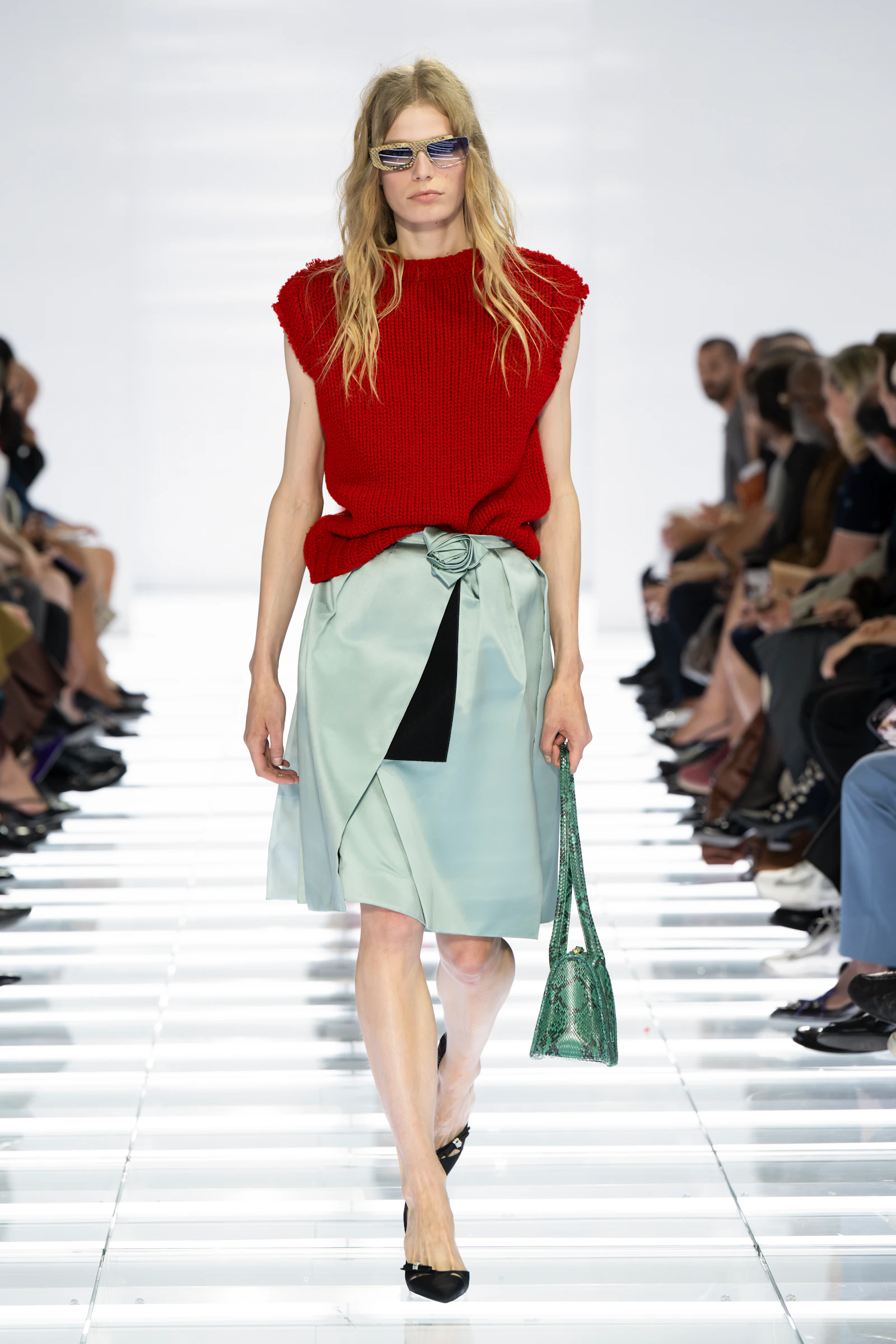
Model in a dark Prada T-shirt and asymmetrical black and blue painted skirt
A brushstroke escaped the canvas and took control of the body.Estrop/Getty Images

History came back hot and slightly dishevelled

Prada has been building this cult for decades. In 2006, Miuccia called the skirt her equivalent of a T-shirt: familiar, useful and open to eccentricity. Even earlier, the travelling Waist Down exhibition isolated designs from the 1998–2004 archive and treated the lower body as enough territory for an entire world.

Spring 2027 summoned the old spirits without forcing them into vintage cosplay. The bralette-and-skirt equation flashed back to Miu Miu in 1995. Girlish florals trapped under shiny black nylon whispered about Prada’s 1996 ugly-chic collision. Distressed leather, feral hair and tiny prim bows made sure nobody mistook the archive for a museum.

Prada’s past never behaves like heritage. It behaves like evidence. Different decades grabbed the same look at once; innocence met perversity, polish met damage, grandmother fabric met visible underwear. The house did not resolve the contradictions. It let them flirt in public.
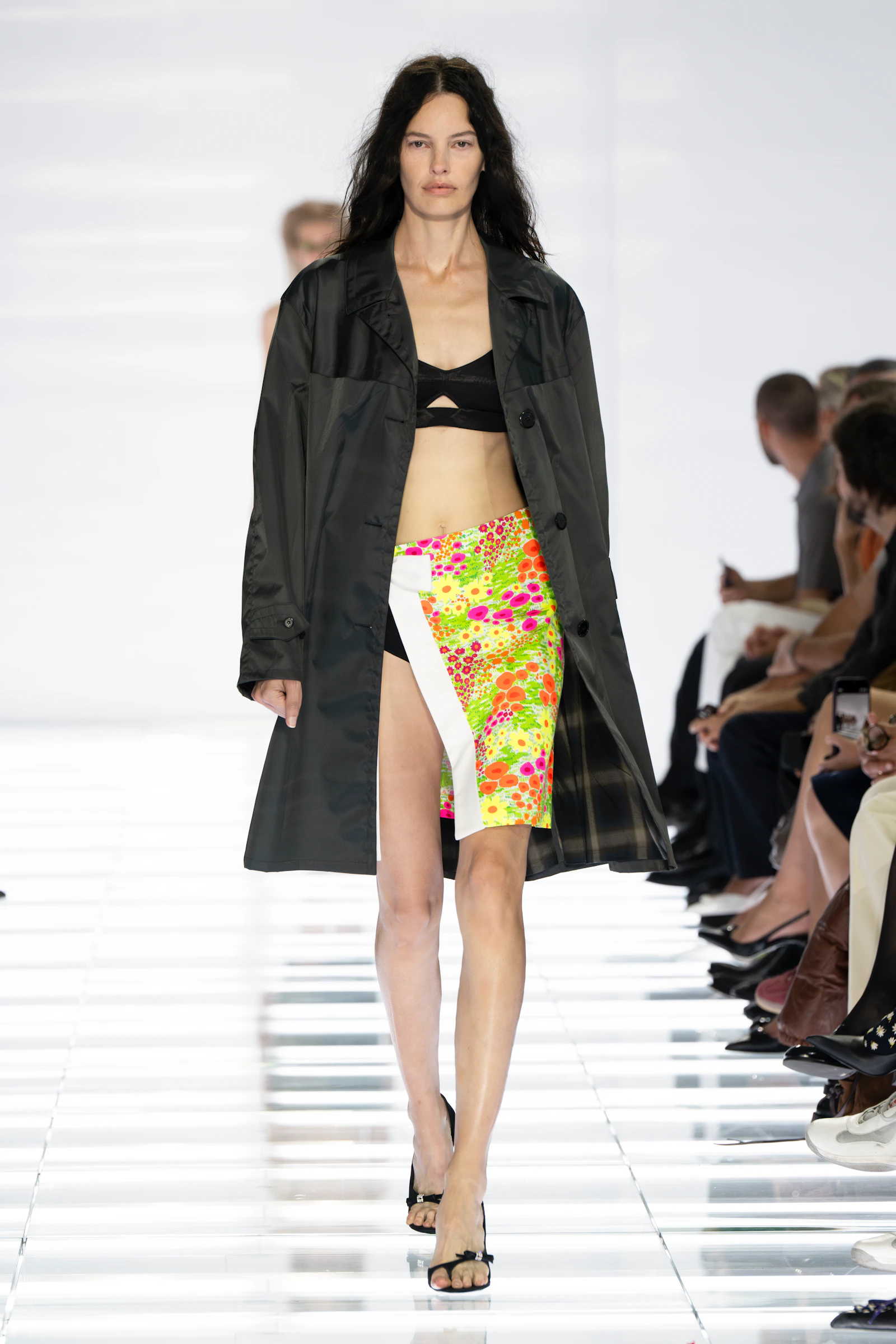
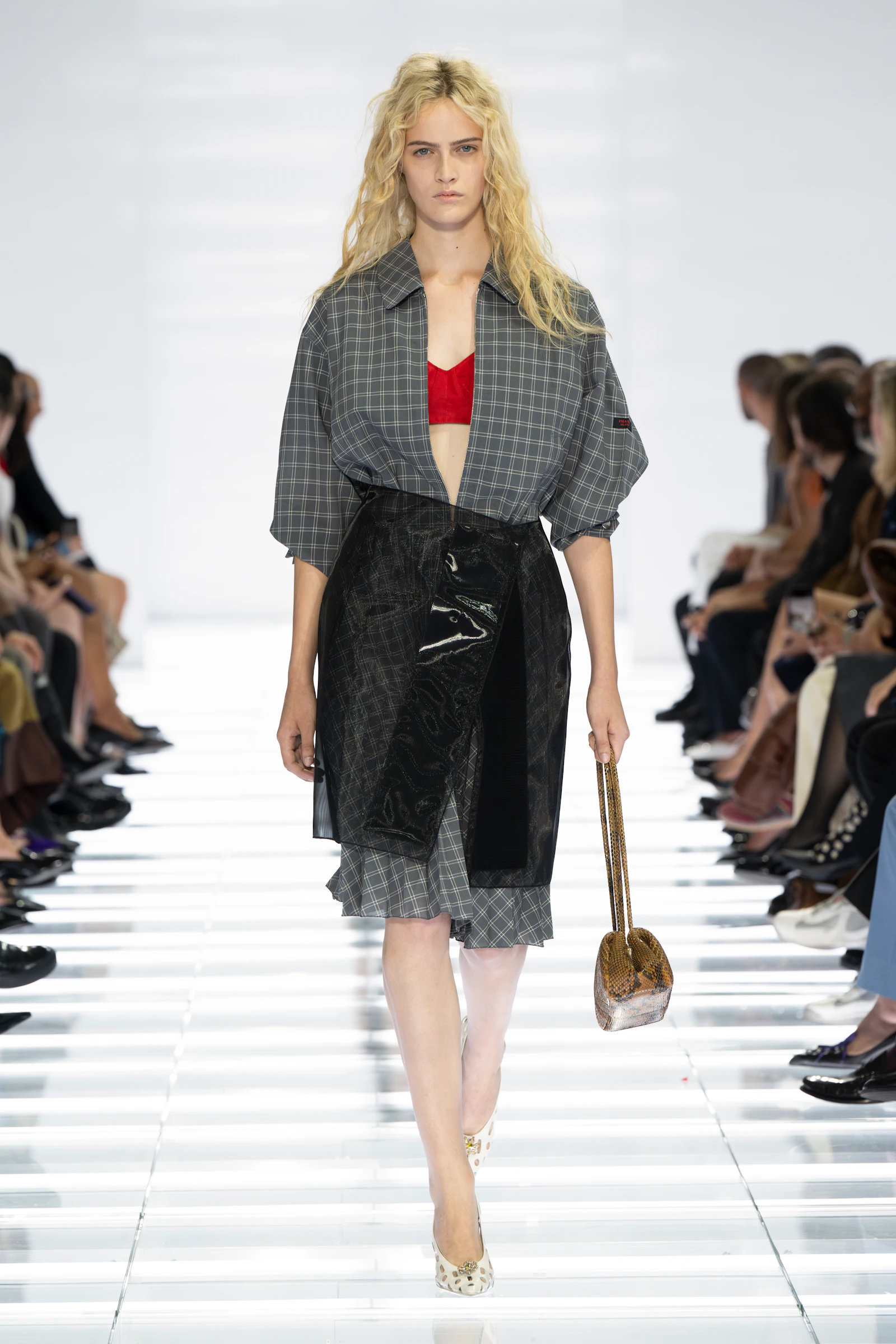
The skirt did not complete the look. It ruled it.

One garment ate the entire moodboard

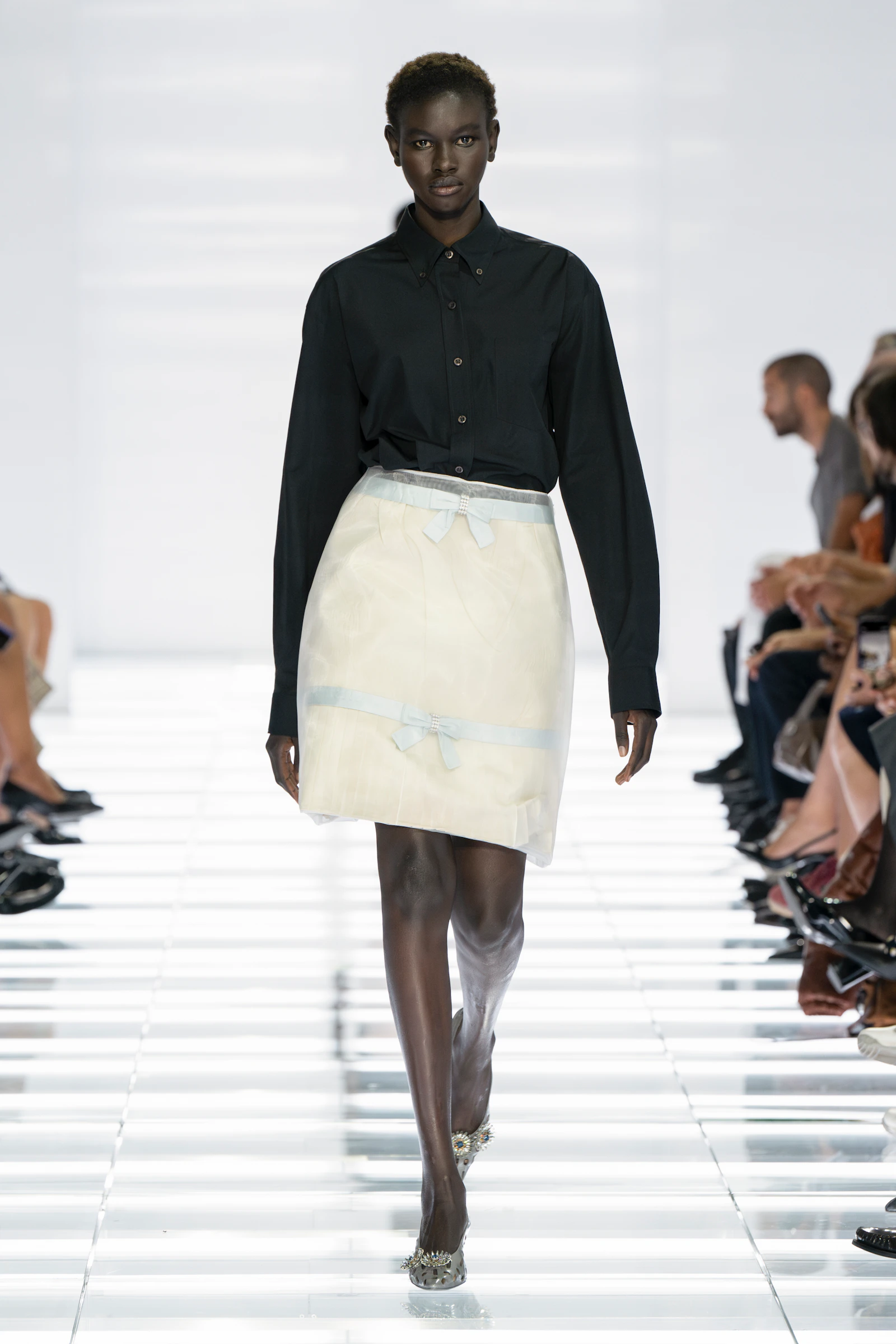
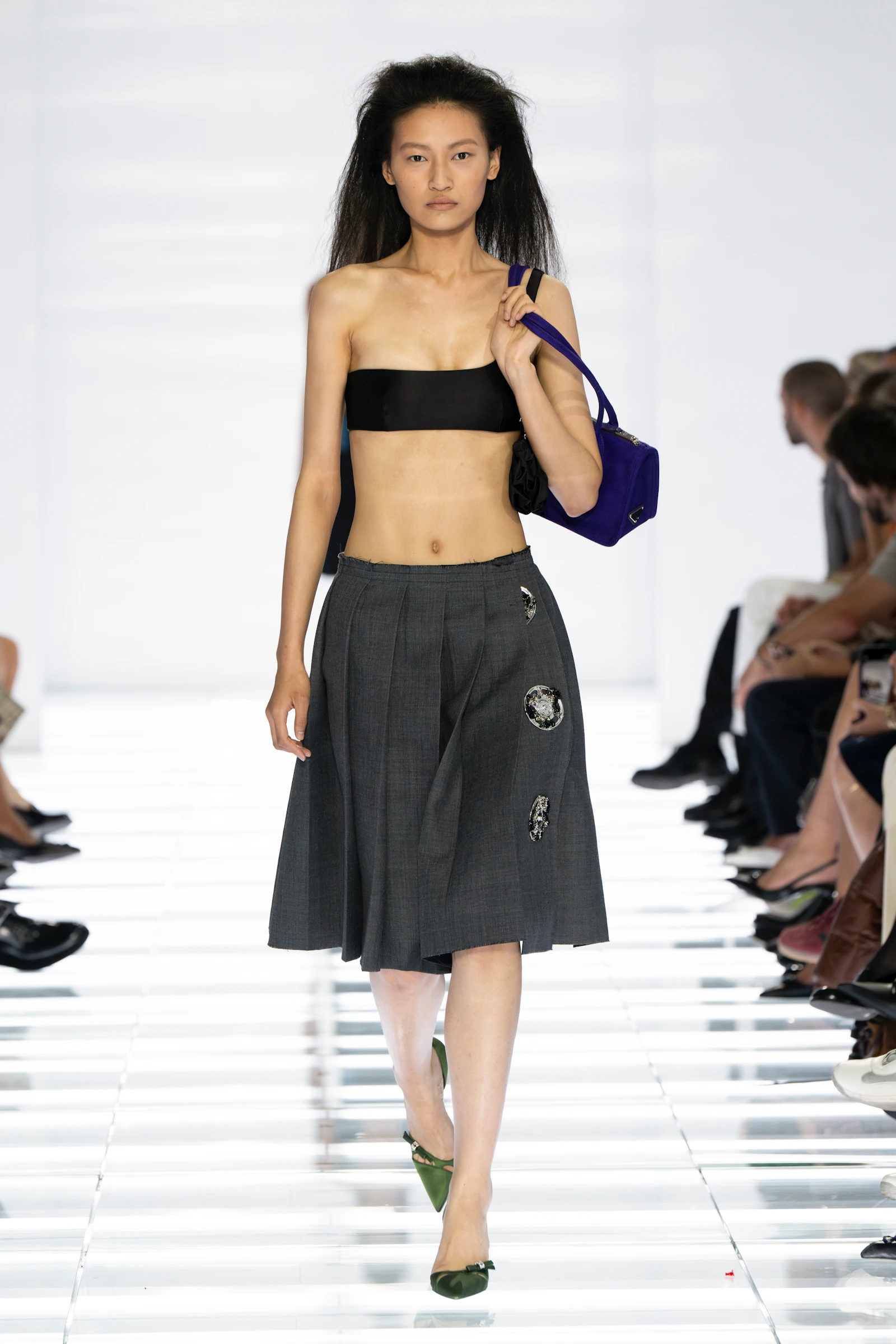
The skirt arrived carrying centuries of baggage: feminine, respectable, sexy, office-safe, school-coded, ceremonial, old-fashioned. Prada unpacked every association and kept none of the rules. A sculptural white volume played innocent. A grey kilt wore a jewel like a weapon. A fitted skirt grew a purple printed wound. A black one opened high enough to turn briefs into styling.

The obsession connected to June’s men’s collection, where Prada and Simons put jeans and T-shirts under interrogation. Raf, who said he had not worn denim in 20 years, talked backstage about common garments becoming individual through combination. Womenswear made that idea hornier, stranger and more emotional. The skirt was not a basic waiting to be perfected. It was a host body that changed meaning whenever another garment touched it.

That made the collection accessible without making it obedient. The central question was instantly legible: how much personality can one familiar shape hold before it becomes a different object? Prada’s answer was 63 looks and still not enough.
Model wearing a yellow Prada bra top with detached sleeves and slim black skirt-trousers
The yellow top arrived in fragments. The black lower half owned the exit.Giovanni Giannoni/WWD via Getty Images

Welcome to the cult of the Prada skirt

Fashion keeps trying to sell the total look: a perfectly resolved identity, searchable, screenshot-ready and available in one swipe. Prada offered a wardrobe with a control problem. Wear the tiny bra or refuse it. Add the sensible knit. Throw on the battered leather jacket. Rip open the Velcro. Let the floral layer escape. The skirt absorbed every contradiction and somehow became more specific.

The power was not in prescribing one Prada woman. It was in giving her a fixed shape and refusing to fix her meaning. Sexy did not cancel practical. Pretty did not cancel strange. Familiarity became a launchpad instead of a limit. The skirt could be modest, obscene, corporate, romantic and mildly possessed before reaching the end of the runway.

Miuccia once said a skirt was like a T-shirt because it could be eccentric without changing you completely. Twenty years later, she and Simons proved the opposite could also be true. Leave the top half almost blank. Put every dangerous idea below the waist. Let the skirt decide who walks out.

Get Frenzy straight to your inbox!
Latest