Music
Punk’s First Women Refuse to Become History
Gina Birch, Lora Logic, Hollie Cook and their co-conspirators are treating fifty years of feminist punk as raw material—and starting where nostalgia usually tells women to stop.

Text

Noah Cruz

Punk has spent fifty years turning women into evidence. A photograph proves they were there. A reissue confirms that the record mattered. A museum label places the correct name beside the correct ripped shirt. Recognition arrives, eventually, but it often comes with a curatorial instruction: please remain historic.

Gina Birch, Lora Logic and Hollie Cook are doing something less obedient. On October 16, Birch of The Raincoats, Logic and Paul Dean of X-Ray Spex, and Cook of The Slits will join Estella Adeyeri and Akiko Matsuura as a one-night supergroup at Electric Brixton. The event, God Save the Queens, marks fifty years of feminist punk with a bill that also includes Vivien Goldman, Rhoda Dakar, Bishi, Celeste Bell, Big Joanie, Essential Logic and HotWax.

The obvious reading is anniversary culture: respected names, foundational songs, one London stage and a museum exhibition waiting nearby. The more useful reading is that the anniversary has created a temporary zone in which old band borders no longer matter. A Raincoat can stand beside a Slit and an X-Ray Spex saxophonist. A daughter can enter the repertoire of her mother. Artists once filed into separate scenes, eras and footnotes can rearrange the archive in public.

This is not a comeback because most of these women never stopped making things. It is a refusal of the idea that a woman’s cultural value increases only after her future has been removed from the picture.

A collage of Gina Birch, Lora Logic and Hollie Cook across three performance portraits
Three histories are being rearranged into one temporary band. Getty Images, via Pitchfork

History keeps trying to seat them

The story of women in punk is routinely told as a correction. First came the recognised canon; later, somebody noticed who had been left out. That chronology is convenient for institutions because it allows exclusion to appear accidental and recovery to appear generous. The women become rediscoveries even when they were visible, audible and influential from the beginning.

The correction can produce beautiful books, documentaries and exhibitions. It can also flatten working artists into a moral lesson about the past. Once somebody is named a pioneer, every new work risks being treated as supplementary material: interesting because of who made it, but secondary to the moment for which they are already famous.

God Save the Queens complicates that script. It precedes an exhibition at London’s Museum of Youth Culture, and many performers have contributed artwork and archival material. Yet the centre of the project is not a display case. It is a live band reimagining Poly Styrene’s songs and a wider she-punk repertoire. The archive moves from wall to stage, where it can be played too loudly, mistimed, altered and made physically present again.

Lora Logic described the original movement as visual art, clothes and noise operating at once. That is a better definition of punk than a fixed list of recordings. A scene survives when its methods remain available—not when every object is preserved in the correct temperature.

God Save the Queens festival artwork in black, white and vivid magenta
The event presents feminist punk as past, present and future—not a sealed anniversary. Up Yours! Collective, via The Line of Best Fit

A supergroup without the usual mythology

Rock supergroups traditionally convert individual fame into a larger masculine monument. Their selling point is accumulation: more virtuosity, more legacy, more names that already fill marquees. This group has a different charge. Its members are not being assembled to prove who was greatest. They are being placed in relation to one another so the categories separating them become less useful.

The Raincoats made rupture sound intimate and communal. X-Ray Spex put consumer culture, plastic identity and a saxophone inside the same fluorescent blast. The Slits treated reggae, dub and punk not as neighbouring territories but as materials that could stain one another. Hollie Cook later built a solo language around lovers rock and tropical pop; Birch has moved through music, film and painting; Logic formed Essential Logic before she was old enough to be treated as an adult by the industry documenting her.

The new configuration does not erase those differences. It makes them usable. A supergroup can become a test: what happens when the women usually introduced through their original bands are allowed to meet as current artists rather than representatives of separate brands?

The women were called historic only after the industry stopped asking what they might make next.

Age removes the audition

Young women in music are asked to arrive complete. They must be visually recognisable, culturally fluent, emotionally available, commercially distinct and easy to explain before the first record has finished loading. A man can spend decades becoming difficult. A woman is often expected to turn difficulty into a coherent product immediately.

Older female artists face another trap. They can be celebrated as survivors provided they reproduce the version of themselves the audience remembers. The industry’s appetite for legacy is strongest when legacy behaves like licensed merchandise: the old image, the old songs, the old rebellion at an agreed volume.

What becomes possible after those expectations lose some force is not freedom from the market. Tickets still have prices, venues still have schedules and anniversaries still sell. But the audition can weaken. The artist no longer has to prove that experimentation will establish a viable young identity. She can make something because the combination interests her, because the people are available, because a song has changed meaning, or because an old method suddenly works against a new problem.

Birch’s recent work makes the point. Her 2025 solo album Trouble followed her first solo record at an age when the conventional career narrative would prefer a definitive retrospective. Instead, she used dub, electronics, spoken voices and domestic memories to make a record that sounded less like a summary than an unlocked room. The video for “Causing Trouble Again” gathered women artists across generations, including Lora Logic. The supergroup is not a return to that impulse. It is one more form of it.

Gina Birch in a recent studio portrait for her album Trouble
Trouble arrived as a second solo album, not a closing statement. Dean Chalkley / Third Man Records

The archive is an instrument

Poly Styrene is central to the night without being available to stand on its stage. Her daughter, Celeste Bell, is part of the programme; her songs will be reworked by musicians whose own histories overlap with hers. That structure avoids the cleanest version of tribute, in which a dead artist becomes an untouchable symbol and everybody else performs reverence around her.

Styrene’s work resists neat preservation anyway. X-Ray Spex wrote about identity as something manufactured, consumed and thrown back at the culture. The music was funny, abrasive and visually radioactive. To inherit it faithfully is not to imitate its surface. It is to retain its permission to make the present look absurd.

An archive can document harm: who received credit, who was patronised, whose work disappeared and whose image was copied without its politics. It can also provide equipment. A flyer offers composition. A stage outfit offers construction. A recording offers a rhythm somebody younger can misuse productively. The point is not that every object must stay alive. The point is that history should not acquire ownership of the people who made it.

Poly Styrene smiling in a close portrait wearing a patterned cap and scarf
Poly Styrene remains central because the questions in her work remain unfinished. Uroica; crop by Memphisto / Wikimedia Commons, CC BY 2.0

Influence is not ownership

The Raincoats became one of those bands whose admirers could be more famous than they were. Kurt Cobain wrote about them, Kim Gordon praised them and generations of independent musicians learned from their looseness. Canonical approval helped keep the records in circulation. It also created a familiar imbalance: the influential women were sometimes best introduced through the men whose work they influenced.

That is how culture launders debt. A younger star names an older woman, the reference becomes proof of the star’s taste, and the woman’s own present-tense practice remains peripheral. Influence turns into a compliment instead of a transfer of attention, resources or authority.

The bill at Electric Brixton proposes something more reciprocal. Big Joanie, HotWax, Estella Adeyeri and Akiko Matsuura do not appear as students waiting for history to approve them. Nor are Birch, Logic, Cook, Goldman and Dakar decorative ancestors. The point of a multi-generational room is not to produce a family tree with respectable roots. It is to let people at different stages of work interrupt one another.
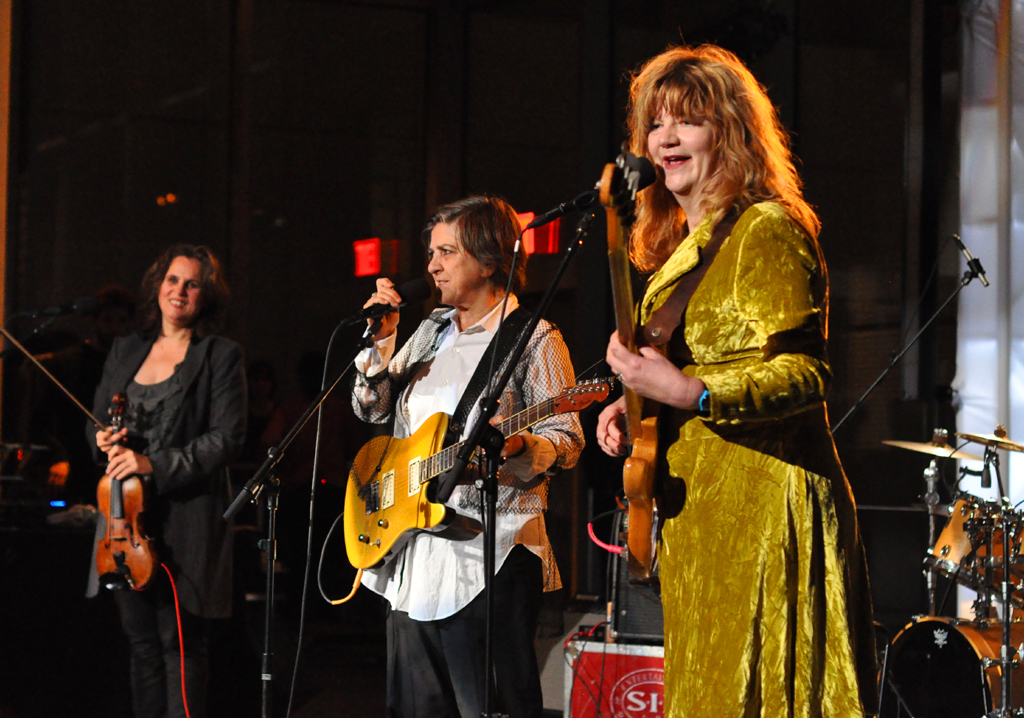
The Raincoats perform with Kathleen Hanna at the Museum of Modern Art in New York in 2010
The Raincoats with Kathleen Hanna: influence becomes most useful when it shares a stage. Jason Persse / Wikimedia Commons, CC BY-SA 2.0

Punk was always larger than sound

One reason women’s punk histories keep returning through exhibitions is that many of the artists never respected the border between music and everything around it. Birch studied art and made films. Logic’s contribution to the Camden exhibition includes previously unseen artwork. Fashion, photocopying, performance, bass, saxophone, slogans and self-documentation were not promotional departments attached to the real work. They were the work.

This matters now because the contemporary music industry is obsessed with the expanded artist. A musician is expected to generate visuals, direct attention, maintain a feed, develop merchandise and behave like a small media company. Women in punk were working across disciplines before this was framed as brand architecture. They did it partly because established infrastructure did not serve them and partly because one form was never enough.

The difference is control. Today’s demand for endless content often extracts every surrounding practice into service of the release cycle. The earlier DIY proposition was messier: the flyer could challenge the song, the clothes could refuse prettiness, and the film could make the performer look stranger rather than more legible. Returning to that model would not mean adopting a vintage aesthetic. It would mean allowing the parts of an artist’s work to disagree.

An archive becomes punk again the moment somebody refuses to keep it still.

Starting again is not starting over

A one-night band can disappear before the industry decides what to do with it. That is part of its appeal. There is no promise of a campaign, no requirement that six histories collapse into a sustainable identity and no obvious ladder from the show to a five-year plan. The performance can remain an encounter rather than the pilot episode of a franchise.

Its value will depend on what happens in the room. A good concept does not guarantee a good set, and feminist lineage does not remove ordinary questions about rehearsal, chemistry or who gets heard. The risk of a living archive is that it can fail in public. A dead one cannot. Failure is therefore not evidence that the experiment was unnecessary; it is evidence that the people involved were treated as artists rather than monuments.

Fifty years after punk announced that permission was optional, women are still asked to justify occupying the present. Young artists must prove they are original. Older artists must prove they are still relevant. The supergroup offers a more interesting answer than either demand deserves. Relevance is not a quality bestowed by youth, consensus or a perfectly preserved debut. It is produced when artists meet the moment with methods that still have friction.

Birch, Logic, Cook and their collaborators are not beginning from nothing. They are beginning from everything they were told should already be enough: the landmark bands, the rediscovered records, the institutional praise, the influence confirmed by other people. Starting again means refusing to let achievement become an exit. The archive is open, the personnel have changed and the next sound has not yet agreed to behave historically.

Music
Punk’s First Women Refuse to Become History
Gina Birch, Lora Logic, Hollie Cook and their co-conspirators are treating fifty years of feminist punk as raw material—and starting where nostalgia usually tells women to stop.

Text

Noah Cruz

Punk has spent fifty years turning women into evidence. A photograph proves they were there. A reissue confirms that the record mattered. A museum label places the correct name beside the correct ripped shirt. Recognition arrives, eventually, but it often comes with a curatorial instruction: please remain historic.

Gina Birch, Lora Logic and Hollie Cook are doing something less obedient. On October 16, Birch of The Raincoats, Logic and Paul Dean of X-Ray Spex, and Cook of The Slits will join Estella Adeyeri and Akiko Matsuura as a one-night supergroup at Electric Brixton. The event, God Save the Queens, marks fifty years of feminist punk with a bill that also includes Vivien Goldman, Rhoda Dakar, Bishi, Celeste Bell, Big Joanie, Essential Logic and HotWax.

The obvious reading is anniversary culture: respected names, foundational songs, one London stage and a museum exhibition waiting nearby. The more useful reading is that the anniversary has created a temporary zone in which old band borders no longer matter. A Raincoat can stand beside a Slit and an X-Ray Spex saxophonist. A daughter can enter the repertoire of her mother. Artists once filed into separate scenes, eras and footnotes can rearrange the archive in public.

This is not a comeback because most of these women never stopped making things. It is a refusal of the idea that a woman’s cultural value increases only after her future has been removed from the picture.

A collage of Gina Birch, Lora Logic and Hollie Cook across three performance portraits
Three histories are being rearranged into one temporary band. Getty Images, via Pitchfork

History keeps trying to seat them

The story of women in punk is routinely told as a correction. First came the recognised canon; later, somebody noticed who had been left out. That chronology is convenient for institutions because it allows exclusion to appear accidental and recovery to appear generous. The women become rediscoveries even when they were visible, audible and influential from the beginning.

The correction can produce beautiful books, documentaries and exhibitions. It can also flatten working artists into a moral lesson about the past. Once somebody is named a pioneer, every new work risks being treated as supplementary material: interesting because of who made it, but secondary to the moment for which they are already famous.

God Save the Queens complicates that script. It precedes an exhibition at London’s Museum of Youth Culture, and many performers have contributed artwork and archival material. Yet the centre of the project is not a display case. It is a live band reimagining Poly Styrene’s songs and a wider she-punk repertoire. The archive moves from wall to stage, where it can be played too loudly, mistimed, altered and made physically present again.

Lora Logic described the original movement as visual art, clothes and noise operating at once. That is a better definition of punk than a fixed list of recordings. A scene survives when its methods remain available—not when every object is preserved in the correct temperature.

God Save the Queens festival artwork in black, white and vivid magenta
The event presents feminist punk as past, present and future—not a sealed anniversary. Up Yours! Collective, via The Line of Best Fit

A supergroup without the usual mythology

Rock supergroups traditionally convert individual fame into a larger masculine monument. Their selling point is accumulation: more virtuosity, more legacy, more names that already fill marquees. This group has a different charge. Its members are not being assembled to prove who was greatest. They are being placed in relation to one another so the categories separating them become less useful.

The Raincoats made rupture sound intimate and communal. X-Ray Spex put consumer culture, plastic identity and a saxophone inside the same fluorescent blast. The Slits treated reggae, dub and punk not as neighbouring territories but as materials that could stain one another. Hollie Cook later built a solo language around lovers rock and tropical pop; Birch has moved through music, film and painting; Logic formed Essential Logic before she was old enough to be treated as an adult by the industry documenting her.

The new configuration does not erase those differences. It makes them usable. A supergroup can become a test: what happens when the women usually introduced through their original bands are allowed to meet as current artists rather than representatives of separate brands?

The women were called historic only after the industry stopped asking what they might make next.

Age removes the audition

Young women in music are asked to arrive complete. They must be visually recognisable, culturally fluent, emotionally available, commercially distinct and easy to explain before the first record has finished loading. A man can spend decades becoming difficult. A woman is often expected to turn difficulty into a coherent product immediately.

Older female artists face another trap. They can be celebrated as survivors provided they reproduce the version of themselves the audience remembers. The industry’s appetite for legacy is strongest when legacy behaves like licensed merchandise: the old image, the old songs, the old rebellion at an agreed volume.

What becomes possible after those expectations lose some force is not freedom from the market. Tickets still have prices, venues still have schedules and anniversaries still sell. But the audition can weaken. The artist no longer has to prove that experimentation will establish a viable young identity. She can make something because the combination interests her, because the people are available, because a song has changed meaning, or because an old method suddenly works against a new problem.

Birch’s recent work makes the point. Her 2025 solo album Trouble followed her first solo record at an age when the conventional career narrative would prefer a definitive retrospective. Instead, she used dub, electronics, spoken voices and domestic memories to make a record that sounded less like a summary than an unlocked room. The video for “Causing Trouble Again” gathered women artists across generations, including Lora Logic. The supergroup is not a return to that impulse. It is one more form of it.

Gina Birch in a recent studio portrait for her album Trouble
Trouble arrived as a second solo album, not a closing statement. Dean Chalkley / Third Man Records

The archive is an instrument

Poly Styrene is central to the night without being available to stand on its stage. Her daughter, Celeste Bell, is part of the programme; her songs will be reworked by musicians whose own histories overlap with hers. That structure avoids the cleanest version of tribute, in which a dead artist becomes an untouchable symbol and everybody else performs reverence around her.

Styrene’s work resists neat preservation anyway. X-Ray Spex wrote about identity as something manufactured, consumed and thrown back at the culture. The music was funny, abrasive and visually radioactive. To inherit it faithfully is not to imitate its surface. It is to retain its permission to make the present look absurd.

An archive can document harm: who received credit, who was patronised, whose work disappeared and whose image was copied without its politics. It can also provide equipment. A flyer offers composition. A stage outfit offers construction. A recording offers a rhythm somebody younger can misuse productively. The point is not that every object must stay alive. The point is that history should not acquire ownership of the people who made it.

Poly Styrene smiling in a close portrait wearing a patterned cap and scarf
Poly Styrene remains central because the questions in her work remain unfinished. Uroica; crop by Memphisto / Wikimedia Commons, CC BY 2.0

Influence is not ownership

The Raincoats became one of those bands whose admirers could be more famous than they were. Kurt Cobain wrote about them, Kim Gordon praised them and generations of independent musicians learned from their looseness. Canonical approval helped keep the records in circulation. It also created a familiar imbalance: the influential women were sometimes best introduced through the men whose work they influenced.

That is how culture launders debt. A younger star names an older woman, the reference becomes proof of the star’s taste, and the woman’s own present-tense practice remains peripheral. Influence turns into a compliment instead of a transfer of attention, resources or authority.

The bill at Electric Brixton proposes something more reciprocal. Big Joanie, HotWax, Estella Adeyeri and Akiko Matsuura do not appear as students waiting for history to approve them. Nor are Birch, Logic, Cook, Goldman and Dakar decorative ancestors. The point of a multi-generational room is not to produce a family tree with respectable roots. It is to let people at different stages of work interrupt one another.

The Raincoats perform with Kathleen Hanna at the Museum of Modern Art in New York in 2010
The Raincoats with Kathleen Hanna: influence becomes most useful when it shares a stage. Jason Persse / Wikimedia Commons, CC BY-SA 2.0

Punk was always larger than sound

One reason women’s punk histories keep returning through exhibitions is that many of the artists never respected the border between music and everything around it. Birch studied art and made films. Logic’s contribution to the Camden exhibition includes previously unseen artwork. Fashion, photocopying, performance, bass, saxophone, slogans and self-documentation were not promotional departments attached to the real work. They were the work.

This matters now because the contemporary music industry is obsessed with the expanded artist. A musician is expected to generate visuals, direct attention, maintain a feed, develop merchandise and behave like a small media company. Women in punk were working across disciplines before this was framed as brand architecture. They did it partly because established infrastructure did not serve them and partly because one form was never enough.

The difference is control. Today’s demand for endless content often extracts every surrounding practice into service of the release cycle. The earlier DIY proposition was messier: the flyer could challenge the song, the clothes could refuse prettiness, and the film could make the performer look stranger rather than more legible. Returning to that model would not mean adopting a vintage aesthetic. It would mean allowing the parts of an artist’s work to disagree.

An archive becomes punk again the moment somebody refuses to keep it still.

Starting again is not starting over

A one-night band can disappear before the industry decides what to do with it. That is part of its appeal. There is no promise of a campaign, no requirement that six histories collapse into a sustainable identity and no obvious ladder from the show to a five-year plan. The performance can remain an encounter rather than the pilot episode of a franchise.

Its value will depend on what happens in the room. A good concept does not guarantee a good set, and feminist lineage does not remove ordinary questions about rehearsal, chemistry or who gets heard. The risk of a living archive is that it can fail in public. A dead one cannot. Failure is therefore not evidence that the experiment was unnecessary; it is evidence that the people involved were treated as artists rather than monuments.

Fifty years after punk announced that permission was optional, women are still asked to justify occupying the present. Young artists must prove they are original. Older artists must prove they are still relevant. The supergroup offers a more interesting answer than either demand deserves. Relevance is not a quality bestowed by youth, consensus or a perfectly preserved debut. It is produced when artists meet the moment with methods that still have friction.

Birch, Logic, Cook and their collaborators are not beginning from nothing. They are beginning from everything they were told should already be enough: the landmark bands, the rediscovered records, the institutional praise, the influence confirmed by other people. Starting again means refusing to let achievement become an exit. The archive is open, the personnel have changed and the next sound has not yet agreed to behave historically.

Music
Punk’s First Women Refuse to Become History
Gina Birch, Lora Logic, Hollie Cook and their co-conspirators are treating fifty years of feminist punk as raw material—and starting where nostalgia usually tells women to stop.

Text

Noah Cruz

Punk has spent fifty years turning women into evidence. A photograph proves they were there. A reissue confirms that the record mattered. A museum label places the correct name beside the correct ripped shirt. Recognition arrives, eventually, but it often comes with a curatorial instruction: please remain historic.

Gina Birch, Lora Logic and Hollie Cook are doing something less obedient. On October 16, Birch of The Raincoats, Logic and Paul Dean of X-Ray Spex, and Cook of The Slits will join Estella Adeyeri and Akiko Matsuura as a one-night supergroup at Electric Brixton. The event, God Save the Queens, marks fifty years of feminist punk with a bill that also includes Vivien Goldman, Rhoda Dakar, Bishi, Celeste Bell, Big Joanie, Essential Logic and HotWax.

The obvious reading is anniversary culture: respected names, foundational songs, one London stage and a museum exhibition waiting nearby. The more useful reading is that the anniversary has created a temporary zone in which old band borders no longer matter. A Raincoat can stand beside a Slit and an X-Ray Spex saxophonist. A daughter can enter the repertoire of her mother. Artists once filed into separate scenes, eras and footnotes can rearrange the archive in public.

This is not a comeback because most of these women never stopped making things. It is a refusal of the idea that a woman’s cultural value increases only after her future has been removed from the picture.

A collage of Gina Birch, Lora Logic and Hollie Cook across three performance portraits
Three histories are being rearranged into one temporary band. Getty Images, via Pitchfork

History keeps trying to seat them

The story of women in punk is routinely told as a correction. First came the recognised canon; later, somebody noticed who had been left out. That chronology is convenient for institutions because it allows exclusion to appear accidental and recovery to appear generous. The women become rediscoveries even when they were visible, audible and influential from the beginning.

The correction can produce beautiful books, documentaries and exhibitions. It can also flatten working artists into a moral lesson about the past. Once somebody is named a pioneer, every new work risks being treated as supplementary material: interesting because of who made it, but secondary to the moment for which they are already famous.

God Save the Queens complicates that script. It precedes an exhibition at London’s Museum of Youth Culture, and many performers have contributed artwork and archival material. Yet the centre of the project is not a display case. It is a live band reimagining Poly Styrene’s songs and a wider she-punk repertoire. The archive moves from wall to stage, where it can be played too loudly, mistimed, altered and made physically present again.

Lora Logic described the original movement as visual art, clothes and noise operating at once. That is a better definition of punk than a fixed list of recordings. A scene survives when its methods remain available—not when every object is preserved in the correct temperature.

God Save the Queens festival artwork in black, white and vivid magenta
The event presents feminist punk as past, present and future—not a sealed anniversary. Up Yours! Collective, via The Line of Best Fit

A supergroup without the usual mythology

Rock supergroups traditionally convert individual fame into a larger masculine monument. Their selling point is accumulation: more virtuosity, more legacy, more names that already fill marquees. This group has a different charge. Its members are not being assembled to prove who was greatest. They are being placed in relation to one another so the categories separating them become less useful.

The Raincoats made rupture sound intimate and communal. X-Ray Spex put consumer culture, plastic identity and a saxophone inside the same fluorescent blast. The Slits treated reggae, dub and punk not as neighbouring territories but as materials that could stain one another. Hollie Cook later built a solo language around lovers rock and tropical pop; Birch has moved through music, film and painting; Logic formed Essential Logic before she was old enough to be treated as an adult by the industry documenting her.

The new configuration does not erase those differences. It makes them usable. A supergroup can become a test: what happens when the women usually introduced through their original bands are allowed to meet as current artists rather than representatives of separate brands?

The women were called historic only after the industry stopped asking what they might make next.

Age removes the audition

Young women in music are asked to arrive complete. They must be visually recognisable, culturally fluent, emotionally available, commercially distinct and easy to explain before the first record has finished loading. A man can spend decades becoming difficult. A woman is often expected to turn difficulty into a coherent product immediately.

Older female artists face another trap. They can be celebrated as survivors provided they reproduce the version of themselves the audience remembers. The industry’s appetite for legacy is strongest when legacy behaves like licensed merchandise: the old image, the old songs, the old rebellion at an agreed volume.

What becomes possible after those expectations lose some force is not freedom from the market. Tickets still have prices, venues still have schedules and anniversaries still sell. But the audition can weaken. The artist no longer has to prove that experimentation will establish a viable young identity. She can make something because the combination interests her, because the people are available, because a song has changed meaning, or because an old method suddenly works against a new problem.

Birch’s recent work makes the point. Her 2025 solo album Trouble followed her first solo record at an age when the conventional career narrative would prefer a definitive retrospective. Instead, she used dub, electronics, spoken voices and domestic memories to make a record that sounded less like a summary than an unlocked room. The video for “Causing Trouble Again” gathered women artists across generations, including Lora Logic. The supergroup is not a return to that impulse. It is one more form of it.

Gina Birch in a recent studio portrait for her album Trouble
Trouble arrived as a second solo album, not a closing statement. Dean Chalkley / Third Man Records

The archive is an instrument

Poly Styrene is central to the night without being available to stand on its stage. Her daughter, Celeste Bell, is part of the programme; her songs will be reworked by musicians whose own histories overlap with hers. That structure avoids the cleanest version of tribute, in which a dead artist becomes an untouchable symbol and everybody else performs reverence around her.

Styrene’s work resists neat preservation anyway. X-Ray Spex wrote about identity as something manufactured, consumed and thrown back at the culture. The music was funny, abrasive and visually radioactive. To inherit it faithfully is not to imitate its surface. It is to retain its permission to make the present look absurd.

An archive can document harm: who received credit, who was patronised, whose work disappeared and whose image was copied without its politics. It can also provide equipment. A flyer offers composition. A stage outfit offers construction. A recording offers a rhythm somebody younger can misuse productively. The point is not that every object must stay alive. The point is that history should not acquire ownership of the people who made it.

Poly Styrene smiling in a close portrait wearing a patterned cap and scarf
Poly Styrene remains central because the questions in her work remain unfinished. Uroica; crop by Memphisto / Wikimedia Commons, CC BY 2.0

Influence is not ownership

The Raincoats became one of those bands whose admirers could be more famous than they were. Kurt Cobain wrote about them, Kim Gordon praised them and generations of independent musicians learned from their looseness. Canonical approval helped keep the records in circulation. It also created a familiar imbalance: the influential women were sometimes best introduced through the men whose work they influenced.

That is how culture launders debt. A younger star names an older woman, the reference becomes proof of the star’s taste, and the woman’s own present-tense practice remains peripheral. Influence turns into a compliment instead of a transfer of attention, resources or authority.

The bill at Electric Brixton proposes something more reciprocal. Big Joanie, HotWax, Estella Adeyeri and Akiko Matsuura do not appear as students waiting for history to approve them. Nor are Birch, Logic, Cook, Goldman and Dakar decorative ancestors. The point of a multi-generational room is not to produce a family tree with respectable roots. It is to let people at different stages of work interrupt one another.

The Raincoats perform with Kathleen Hanna at the Museum of Modern Art in New York in 2010
The Raincoats with Kathleen Hanna: influence becomes most useful when it shares a stage. Jason Persse / Wikimedia Commons, CC BY-SA 2.0

Punk was always larger than sound

One reason women’s punk histories keep returning through exhibitions is that many of the artists never respected the border between music and everything around it. Birch studied art and made films. Logic’s contribution to the Camden exhibition includes previously unseen artwork. Fashion, photocopying, performance, bass, saxophone, slogans and self-documentation were not promotional departments attached to the real work. They were the work.

This matters now because the contemporary music industry is obsessed with the expanded artist. A musician is expected to generate visuals, direct attention, maintain a feed, develop merchandise and behave like a small media company. Women in punk were working across disciplines before this was framed as brand architecture. They did it partly because established infrastructure did not serve them and partly because one form was never enough.

The difference is control. Today’s demand for endless content often extracts every surrounding practice into service of the release cycle. The earlier DIY proposition was messier: the flyer could challenge the song, the clothes could refuse prettiness, and the film could make the performer look stranger rather than more legible. Returning to that model would not mean adopting a vintage aesthetic. It would mean allowing the parts of an artist’s work to disagree.

An archive becomes punk again the moment somebody refuses to keep it still.

Starting again is not starting over

A one-night band can disappear before the industry decides what to do with it. That is part of its appeal. There is no promise of a campaign, no requirement that six histories collapse into a sustainable identity and no obvious ladder from the show to a five-year plan. The performance can remain an encounter rather than the pilot episode of a franchise.

Its value will depend on what happens in the room. A good concept does not guarantee a good set, and feminist lineage does not remove ordinary questions about rehearsal, chemistry or who gets heard. The risk of a living archive is that it can fail in public. A dead one cannot. Failure is therefore not evidence that the experiment was unnecessary; it is evidence that the people involved were treated as artists rather than monuments.

Fifty years after punk announced that permission was optional, women are still asked to justify occupying the present. Young artists must prove they are original. Older artists must prove they are still relevant. The supergroup offers a more interesting answer than either demand deserves. Relevance is not a quality bestowed by youth, consensus or a perfectly preserved debut. It is produced when artists meet the moment with methods that still have friction.

Birch, Logic, Cook and their collaborators are not beginning from nothing. They are beginning from everything they were told should already be enough: the landmark bands, the rediscovered records, the institutional praise, the influence confirmed by other people. Starting again means refusing to let achievement become an exit. The archive is open, the personnel have changed and the next sound has not yet agreed to behave historically.

Get Frenzy straight to your inbox!
Latest