The VMAs have spent four decades trying to recreate the kind of cultural emergency Madonna caused by losing a shoe.
At the inaugural ceremony in 1984, she descended from an enormous wedding cake in lace, pearls and a belt that announced “Boy Toy.” When one of her heels slipped off, Madonna dropped to the floor and turned the accident into choreography. A private moment of panic became a public image. The mistake became the performance.
That conversion—accident into iconography, television into mythology—would become the entire job description of the pop star.
Now the numbers have snapped back into place. Madonna leads the 2026 MTV Video Music Award nominations with 11, ahead of Taylor Swift’s nine. She is nominated for Artist of the Year, while Confessions II – The Film is competing for Video of the Year. “Bring Your Love,” her collaboration with Sabrina Carpenter, appears in both Song of the Year and Best Collaboration.
This is not a lifetime-achievement lap disguised as relevance. Madonna is not being brought back to receive flowers from artists formed inside her influence. She is at the front of the actual competition.
The VMAs learned their language from her
Madonna’s relationship with the VMAs is more than a collection of memorable appearances. It is the ceremony’s grammar.
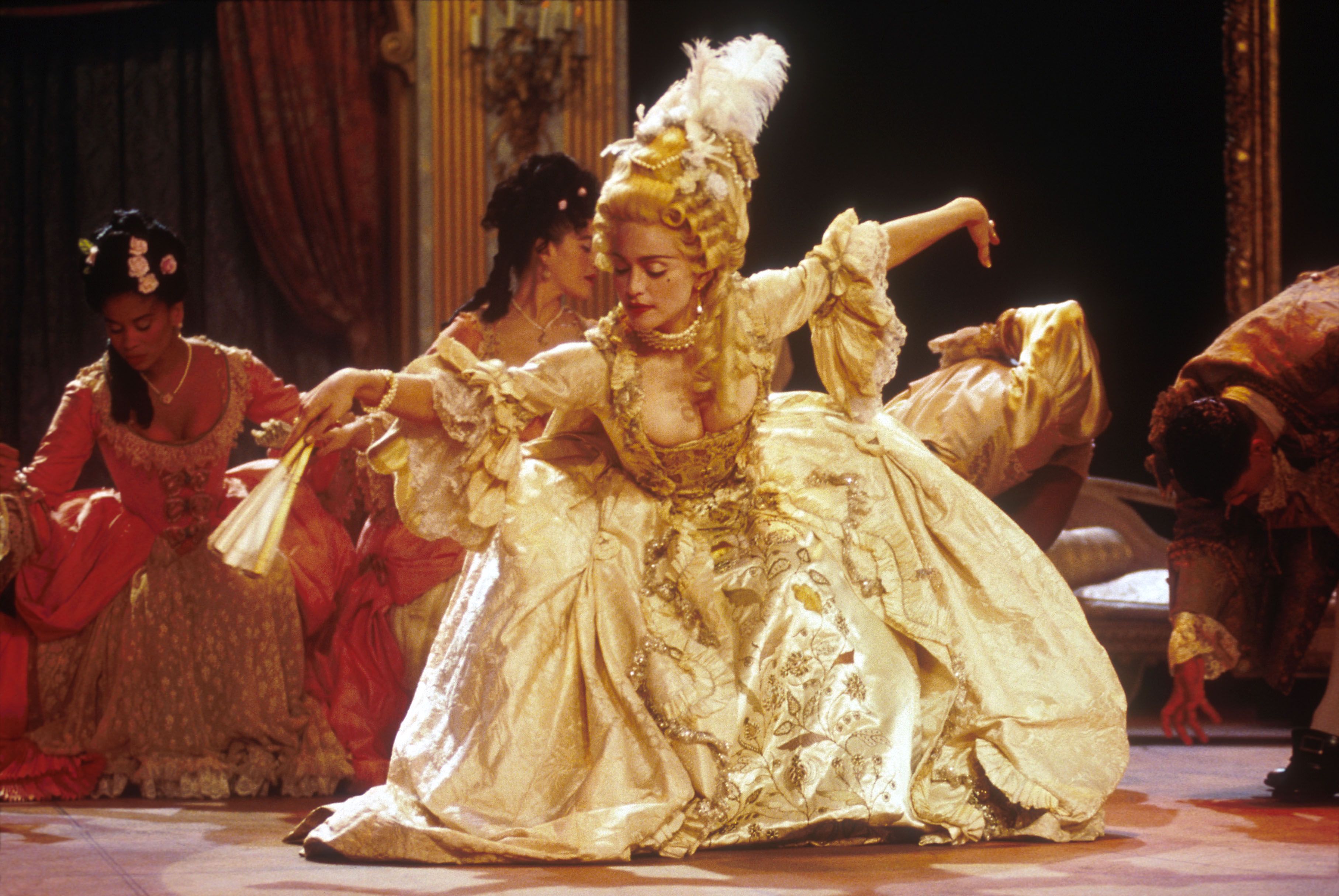
In 1984, the wedding dress turned pop innocence into provocation. In 1990, “Vogue” became an 18th-century court drama filled with powdered wigs, fans, exposed undergarments and choreography that understood camp as a form of precision. In 2003, Madonna placed Britney Spears and Christina Aguilera inside the original bridal fantasy, then ruptured it with a kiss engineered for the television replay.
Each performance understood that the VMAs were never primarily about winning. They were about controlling the image that survived the following morning.
A Madonna performance did not accompany a promotional campaign. It became the campaign. The costume, camera movement, scandal, choreography and press reaction were conceived as parts of the same object. Long before every release required a visual universe and several weeks of fan analysis, she treated pop as an authored system.
Eleven nominations, none of them nostalgic
The important part of Madonna’s 11 nominations is where they appear. Video. Artist. Song. Collaboration. Craft. These are categories concerned with what pop looks and sounds like now, rather than what it once meant.
At the centre is Confessions II – The Film, the extended visual directed by David Toro and Solomon Chase of TORSO. Premiered at Tribeca and released through YouTube in June, it moves through six tracks from Confessions II as one continuous fever dream: bedrooms, cars, arenas, club bathrooms, paparazzi squads and bodies disappearing into a crowd.
The cast resembles a party assembled from several different internet tabs. Sabrina Carpenter, Arca, Honey Dijon, Shygirl, Kate Moss, Julia Garner, Lourdes Leon, Gwendoline Christie and Benedict Cumberbatch all pass through its universe. Celebrity is used less as a luxury accessory than as nightclub material—another face briefly illuminated before the lights move elsewhere.
At a moment when pop visuals are increasingly divided into vertical clips before the full video has even arrived, Madonna made a film. It does not politely separate six songs into individual pieces of content. It makes them share sweat, lighting, architecture and narrative.
This is not a Taylor Swift rivalry
The nomination count makes the obvious headline irresistible: Madonna has 11, Taylor Swift has nine. Swift is currently tied with Beyoncé at 30 career VMA wins, while Madonna enters the ceremony with 19. An impossible clean sweep would place all three on the same number.
But reducing the field to an intergenerational contest misses the more revealing story. Swift and Madonna represent different forms of extreme pop authorship. Swift turns songs, clues, eras and audience memory into a narrative that never completely closes. Madonna treats the image as an intervention: a way of forcing music, fashion, sexuality, religion and celebrity into the same frame until something catches fire.
The VMAs need both models because the ceremony has always depended on artists who understand that attention can be composed.
“Bring Your Love,” Madonna’s collaboration with Sabrina Carpenter, makes the generational exchange even clearer. Carpenter is not presented as an heir waiting to inherit Madonna’s position, and Madonna is not playing the approving elder. They meet inside a visual world built around flirtation, performance and control. There is no torch to pass because Madonna has never behaved as though she is finished carrying it.
The video still matters when Madonna is in it
The VMAs have spent the streaming era searching for their function. Music television no longer decides what enters the culture, and a single awards broadcast cannot manufacture monoculture on command. The contemporary pop image moves through edits, reaction clips, fan accounts, fashion references and screenshots faster than any television schedule can contain it.
Madonna understands that fragmentation because she has always created images designed to survive outside their original context. A wedding dress on a stage. A cone bra. A powdered wig. A kiss captured in a single frame. The images detach from the performances and continue working decades later.
Confessions II – The Film applies the same instinct to the present. It offers enough narrative to invite interpretation and enough surfaces to be cut apart. Its club is both a physical room and an image-distribution machine. Everyone inside it is watching, being watched or attempting to disappear.
The 2026 VMAs contain 26 first-time nominees, evidence that the ceremony is not simply retreating into its archive. Yet placing Madonna at the top of that field creates a useful correction. Newness does not always arrive through a new name. Sometimes it comes from the artist who remembers why the format mattered in the first place.
The VMAs did not give Madonna her stage back. They finally noticed that she never stopped designing it.