
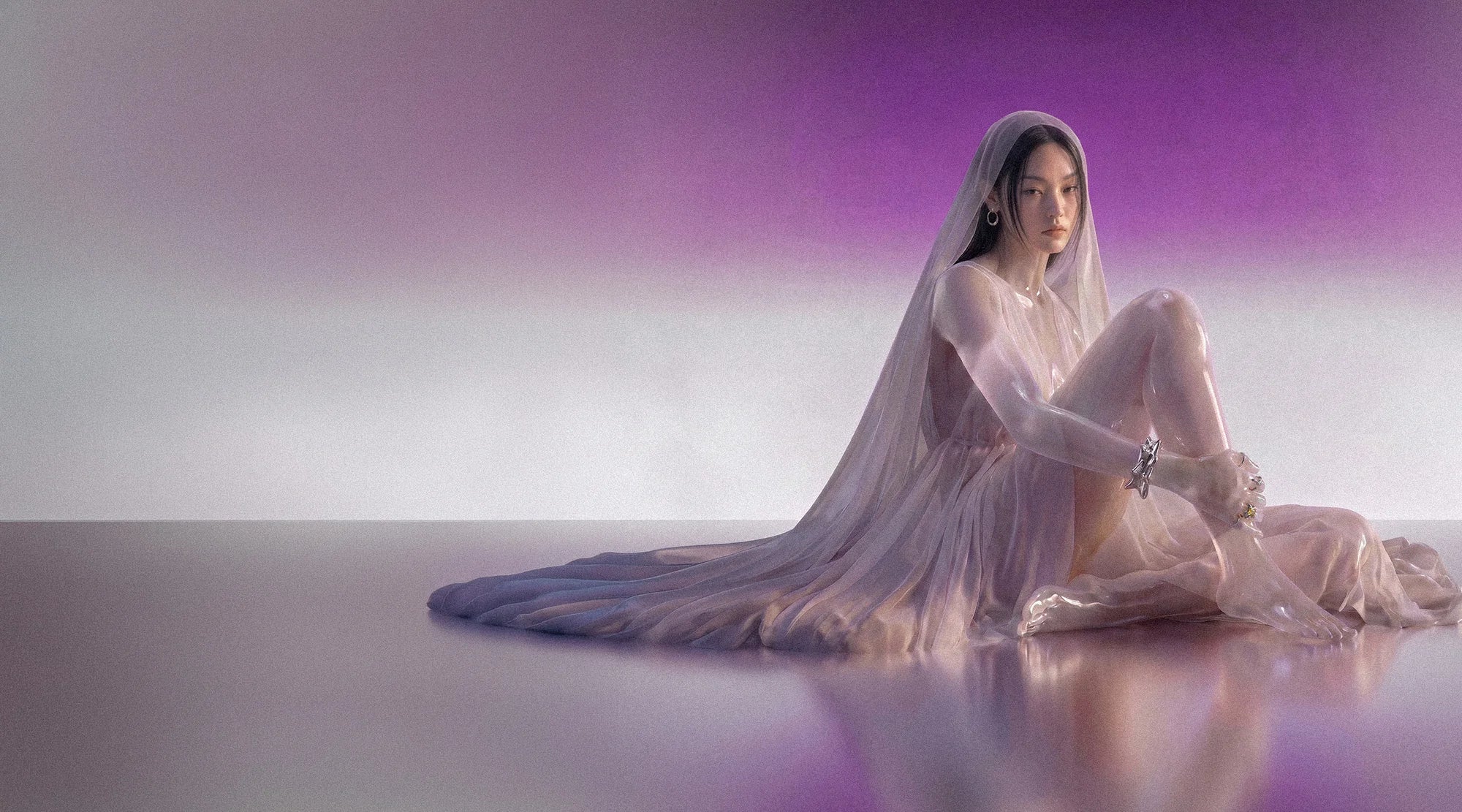
Jewellery has spent centuries promising forever. Graedance is interested in what happens tomorrow morning. The body wakes up different. The mood changes. The hand wants more silver than it did yesterday, the neck wants less, and the person in the mirror has developed a new opinion. A piece worth keeping should be able to survive the edit.
Wear It Different Tomorrow follows three Graedance pieces—the Gravity Ring, the Firo Ring and the Armour Chain Necklace—through three states of the same wearer. Nothing is replaced. The rings travel across the hand, their asymmetry turns towards or away from the room, and the necklace shifts from a low drape to a close line at the throat. The silver stays recognisable while refusing to repeat itself.
That is the seduction of the Naarm label. Graedance does not design jewellery as the polite final detail added once an outfit has finished speaking. Its pieces get involved. They alter posture, redirect a gesture and make bare skin feel deliberately dressed. Put the same ring one joint higher and the entire hand has changed its mind.
This is product design with an emotional alibi. Adaptability is not a technical extra hidden at the bottom of a description; it is the point. Graedance makes talismans for people whose identity will not hold still for a campaign image, a gender category or yesterday’s styling. The jewellery keeps up because standing still was never the fantasy.

A cheap dolphin survived the outfit
Rong Jake Chen did not begin Graedance with a market category. He began with a pair of dolphin earrings he bought for his mother at thirteen, using money from his first job. They cost twenty dollars, were badly made and had started falling apart. She kept them anyway. Years later, Chen understood that their value had escaped the object. The metal was carrying the child who bought it, the mother who saved it and the time neither of them could put back.
That discovery arrived after a career in fashion. Chen came from a Chinese immigrant family where a creative future did not look like the obvious route, then worked across womenswear and menswear before founding Graedance in 2022. Clothing gave him a language. Jewellery offered a memory system. An outfit can define one night; a ring can absorb hundreds of them and still be present when the photographs start lying about how young everybody was.
Graedance treats that longevity as something more alive than durability. The jewellery is built to remain useful as the wearer changes, not simply remain intact in a box. Adjustable rings move between fingers and phalanges. Reversible pieces expose a different curve. The Armour clasp can hide behind the neck or come forward and become the centre of the look. Instead of preserving one perfect arrangement, the design makes space for the next one.
The brand name carries the same logic. Graedance reconstructs grey—the colour too easily treated as indecisive—and turns it into a whole territory between categories. Neither masculine nor feminine, warm nor cold, ornament nor equipment: the point is not to land safely in the middle. The point is to discover how much can happen there. Grey is not the absence of an answer. It is every answer refusing to queue politely.


The dragon gets taken apart
Graedance’s second main collection, Long Ocean, gives that in-between state a mythology. Chen looks to the Eastern dragon and Daoist thought, then dismantles the familiar architecture of masculine power. Talons, scales, whiskers and horns are separated from the complete creature and returned as fragments: a curve around a finger, a drop at the neck, a claw resting over a knuckle. Power becomes something the wearer can rearrange rather than something inherited whole.
The campaign moves through four acts—arrival, meeting, confrontation and dance. Two figures reach the same symbolic water, recognise each other, test their force and eventually find rhythm. It is a sharp piece of storytelling because the conflict does not end in domination. Rigidity softens into movement. Armour reveals instead of shielding. The masculine object is not destroyed; it is liberated from having to perform masculinity the same way every day.
The jewellery makes that idea physical. Gravity catches the invisible pull between bodies in a liquid profile that can sit at the base of a finger or climb the hand. Firo is built around a turn: rotate its intentional asymmetry and a different edge appears. Armour borrows the visual memory of chainmail, then lets its custom links drape like water across the collarbone. Protection, transformation and attraction become things you can style before leaving the house.
Nothing about the concept asks the product to disappear beneath it. That matters. The rings are beautiful before their philosophy is explained; the necklace has enough presence to lead a bare torso or interrupt a white shirt. Graedance gives the object a story without turning it into homework. You can arrive for the silver and discover the worldview after it has already changed your hand.
First: keep it close
The restrained version does not mean minimal. It means private. Wear Gravity low at the base of the finger, where its liquid shape reads almost like part of the hand. Turn Firo’s widest curve inward. Let Armour fall softly at the collarbone with the signature hook clasp behind the neck. Against washed cotton, fine knit or bare skin, the metal appears slowly—less announcement than magnetic field.
This is where the pieces reveal their control. The silver catches light without needing an entire stack to justify itself. Gravity gives the hand a different centre. Firo interrupts the circle just enough to make the eye return. Armour traces the body rather than sitting on top of it. The wearer is not performing restraint for approval; they are deciding how much access the room receives.
The look works because each piece has a complete silhouette at low volume. Graedance’s idea of adaptability never requires the jewellery to become visually neutral. Even turned inward, the rings retain their strange organic contour. Even clasped at the back, Armour makes a custom line across the chest. Quiet is still a design decision, and this silver knows exactly where it was placed.


Then: move the metal
For the second mood, nothing new enters the frame. The existing pieces simply stop behaving the way they did five minutes ago. Gravity moves higher along the finger. Firo rotates so its asymmetry cuts outward. Armour shortens and the hook comes around to the front, turning a fastening into a focal point. The jewellery does not change costume; it changes posture.
That small movement has an outsized effect because adornment sits on the parts of the body we use to communicate. Hands point, touch, refuse and invite. The neck carries breath, tension and the tiny physical betrayals that arrive before speech. Moving a ring by one joint or tightening a chain changes how those gestures are framed. Graedance makes the transition feel less like styling and more like editing body language.
This is the version for a look in motion: a shirt unbuttoned after dark, tailoring with the sleeves pushed up, a tank top that leaves the collarbone available. The pieces provide continuity without demanding repetition. Somebody who saw you at six would recognise the silver at midnight. They might not recognise what it has persuaded you to do with it.

Finally: let the jewellery lead
The third mood stops treating silver as punctuation and lets it write the sentence. Stack Gravity with Firo so their curves interrupt each other. Bring them up the hand where every gesture becomes visible. Pull Armour close to the throat, place the hook dead centre and let the custom links sit directly against skin. The outfit can become simpler because the jewellery has accepted responsibility for the tension.
Confrontational does not have to mean aggressive. Here it means impossible to misread. The same pieces that looked intimate in the first arrangement now define the body from across the room. Their power comes from recognition: we have seen this silver before, but the wearer has decided to make it explicit. Graedance understands that a statement piece becomes more interesting when the statement can change.
The final styling also makes the collection’s genderless design feel practical rather than theoretical. A chain can be armour without belonging to one body. A claw can turn inward for intimacy or outward for impact without either direction being assigned a gender. The wearer chooses the meaning, then retains the right to reverse it tomorrow. That freedom is the luxury.


Good jewellery should collect evidence
Graedance handcrafts its pieces in recycled 925 sterling silver and leaves the metal free of anti-tarnish coatings or chemical treatments. That choice allows a patina to develop with wear. The surface becomes less like a product sealed at purchase and more like a record: the air around it, the skin beneath it, the nights it stayed on longer than planned. It can be polished back to brightness, but it is also allowed to look lived with.
For Chen, sentiment and adaptability belong to the same design system. A piece gathers meaning because it survives multiple versions of the wearer. That is why the practical details matter: Gravity adjusts across sizes and positions; Firo’s open, asymmetrical form responds to a changing hand; Armour can be worn tight, loose, forward or reversed. The jewellery earns memory by remaining useful enough to stay close.
The three products also offer clear entrances into the brand. The Firo Ring delivers transformation in its cleanest form: one rotation, another outline. The Gravity Ring is built for stacking, shifting and the visual pull between bodies. The Armour Chain Necklace takes the largest share of space, but its custom links remain fluid enough to follow the chest rather than dominate it.
Direct product discovery belongs inside the editorial because desire should have somewhere to go. The point is not to flatten these objects into shopping units. It is to show why a particular ring deserves the hand, how the necklace behaves on skin and what becomes possible after the first photograph. Graedance does not sell one finished look. It sells the equipment for several.


Tomorrow is part of the design
The most compelling thing about Graedance is not that one piece can be worn several ways. Plenty of jewellery can be adjusted. It is that the brand understands change as something worth designing for. Bodies fluctuate. Gender moves. Taste develops nerve, loses it, finds a different kind. The object does not punish that instability. It treats it as creative material.
So wear the ring low today and high tomorrow. Hide the hook beneath a collar, then bring it forward against bare skin. Let the silver begin restrained, turn confrontational and end somewhere language has not caught yet. None of those versions cancels the one before it. The jewellery holds them together without asking which was the real you.
That is a better promise than forever frozen in place. Graedance offers permanence with room to move: the same metal, gathering different evidence, on a person allowed to keep becoming. Explore the complete Graedance collection. Tomorrow is already touching it.











