Fashion
Is the Hermès Birkin Entering Its Cringe Era?
Influencers did not kill fashion’s ultimate status bag; they made its private code public, turning scarcity into a feed, an acquisition game and the world’s most recognisable performance of wealth.

Text

Noah Cruz

In three days, fashion told readers to hold their bags like Jane Birkin, found wealthy women who felt embarrassed to carry theirs and declared the Birkin in a reputational crisis. The world’s rarest everyday bag did not die over one long weekend. Its social grammar changed.

The panic began with an image ordinary enough for Instagram: three influencers at a wedding, three Birkins placed where the camera could not miss them. A Reddit post titled They did it, they killed the Birkin turned the photograph into a funeral notice. The complaint was not that the bags were ugly, fake or newly affordable. It was that the performance had become obvious. Everyone was holding the same answer to a question luxury is supposed to leave mysterious.

This is the strange 2026 position of the Hermès Birkin. The object remains expensive, difficult to acquire and commercially hot. The code around it has become free. A person no longer needs access to a boutique, a collector’s closet or a particular social room to understand the silhouette, the waiting-game mythology and the exact reaction its owner hopes to produce. The bag is still scarce. The fantasy now has unlimited inventory.
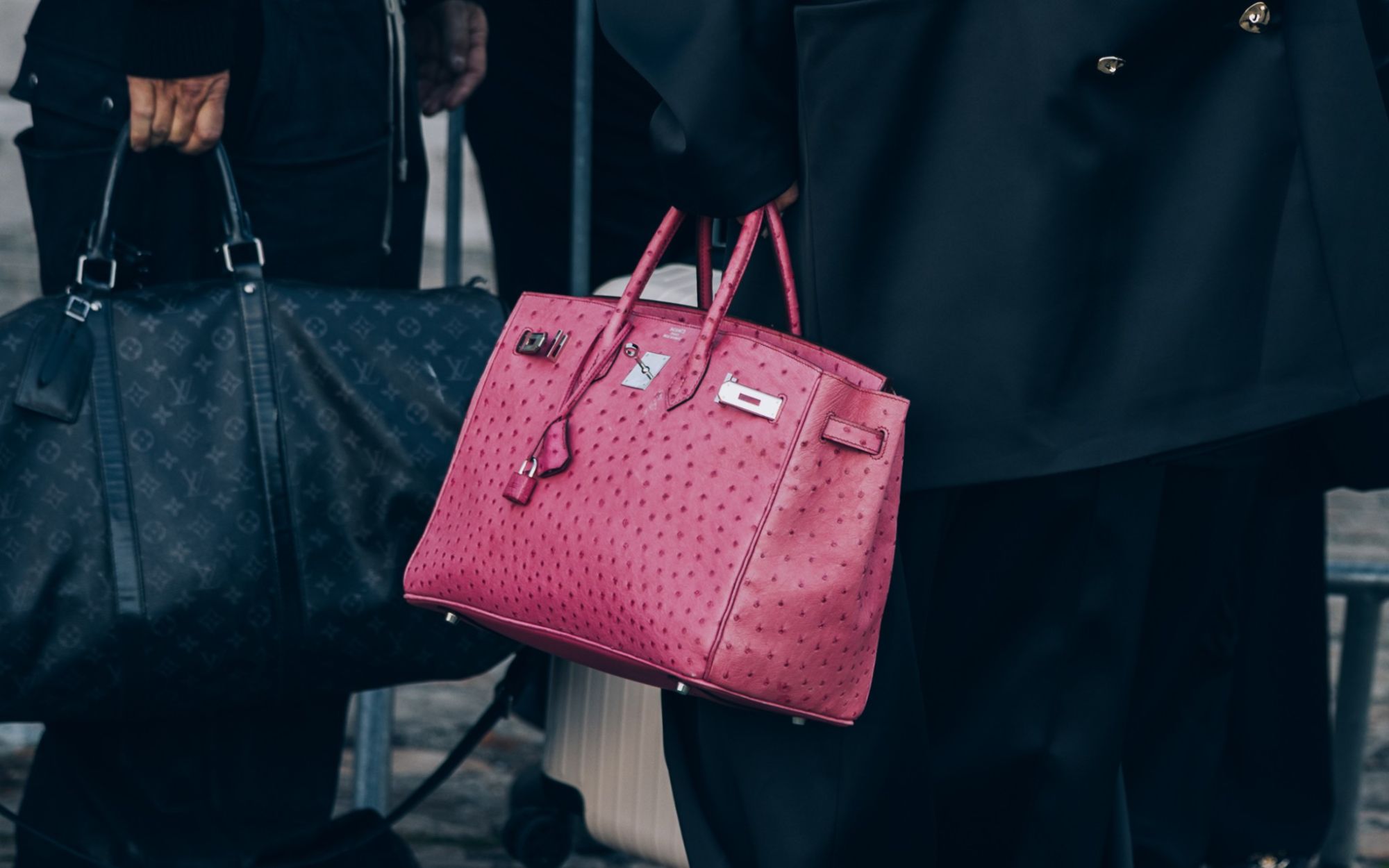
Pink ostrich Hermès Birkin carried beside a dark monogrammed travel bag
The Birkin is logo-free only in the most literal sense.Image via nss magazine

Fashion’s loudest logo-free bag

The Birkin has no repeating monogram and no giant name across its front. It does not need one. Two handles, a flap, two straps, a turn-lock and a small padlock are enough to produce instant recognition. That recognition is the achievement and the problem. Hermès built a design so specific that the outline now behaves like a logo more efficiently than a logo could.

Status objects survive on a precise imbalance. Enough people must recognise them for ownership to matter, but not so many that the message becomes blunt. Research on luxury signalling has long distinguished between products that announce their price and subtler goods legible mainly to people inside the same expensive world. The Birkin once occupied both positions at once: globally famous, yet still protected by the feeling that only a small circle understood how one actually entered the room.

Sex and the City made that room part of mass culture in 2001, when Samantha Jones tried to jump the queue by saying the bag was for Lucy Liu. The joke depended on exclusion. Two decades later, the exclusion remains, but the queue itself has become entertainment. TikTok explains purchase histories. YouTube tours collections. Instagram photographs the offer inside the boutique. The audience may never own the object, but it knows the script.

Fashion Week guest in a mustard coat carrying a taupe Birkin on a Paris street
A silhouette can become a public language without becoming a mass product.Phil Oh / Vogue

Scarcity survived; secrecy did not

The word “mainstream” is doing two jobs in the current backlash. It can mean widely owned, which the Birkin plainly is not. It can also mean widely understood, which it unquestionably is. Resale platforms, vintage dealers, rental memberships, authentication videos, replicas and unashamed dupes have separated cultural access from boutique access. The image moves even when the leather does not.

The prices make literal ubiquity impossible. Sotheby’s says a classic leather Birkin bought from a boutique begins at $13,500 in 2026, while pristine examples can exceed $30,000 on the secondary market. Those figures come from a company that sells the bags, not an independent consumer index, but they clarify the central contradiction: the Birkin can be financially remote and visually overfamiliar at exactly the same time.

Algorithms intensify the mismatch. A feed does not show the statistical frequency of an object; it shows whatever keeps a particular viewer looking. Watch one unboxing and ten more arrive. Follow a collector and every breakfast table begins to contain orange boxes. The experience of “everyone having one” is produced less by ownership than by repetition. A luxury object designed to be encountered occasionally is being rendered at the speed of content.
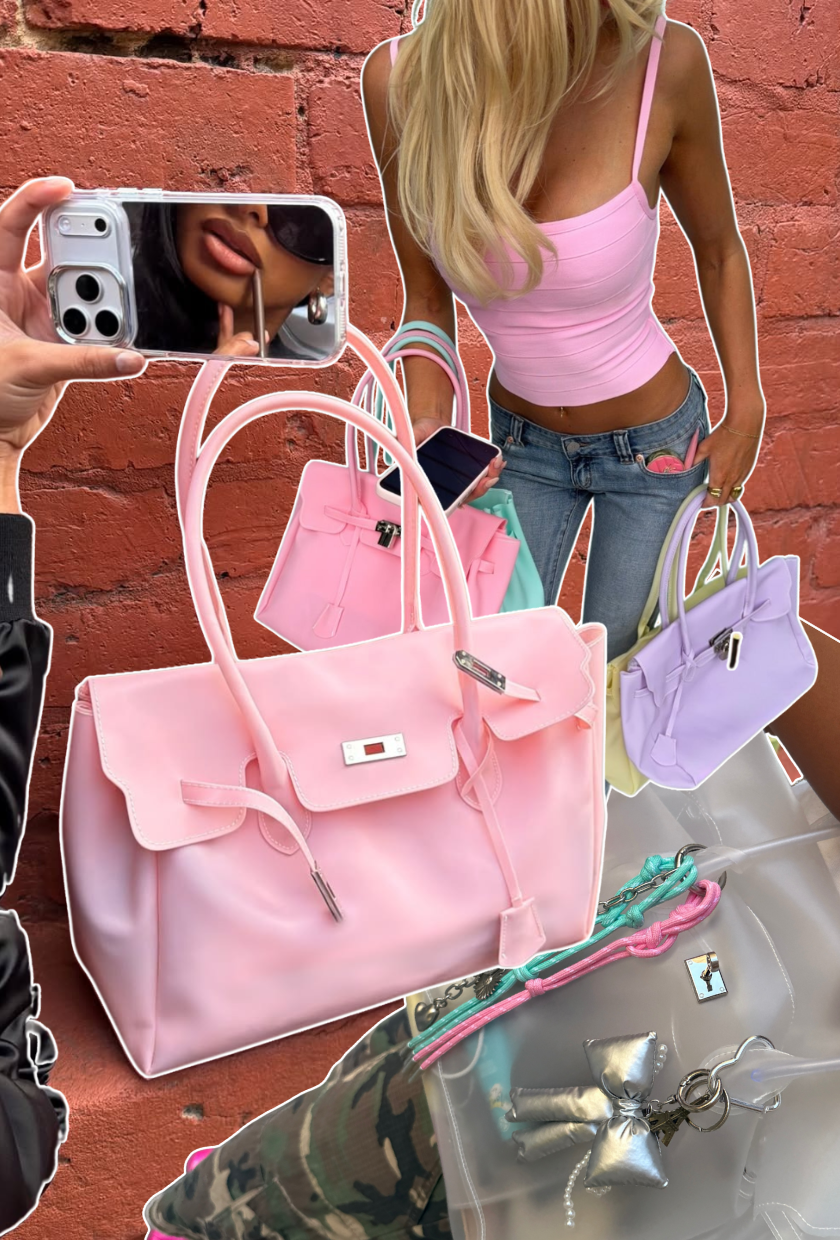
Collage of pastel jelly handbags, smartphones and social-media imagery
The Jelly Firkin keeps the silhouette and turns exclusivity into a joke anyone can carry.Who What Wear

The Hermès game became the content

A Birkin was never only a bag. It was also an encounter: the appointment, the relationship with a sales associate, the possibility of an offer and the uncertainty of colour, leather or size. Clients and resale specialists describe purchase histories and annual limits, but Hermès publishes no universal spending formula or official global waiting list. That ambiguity once strengthened the aura. Now it supplies an endless genre of explainers.

On social media, the invisible labour of access becomes visible effort. The viewer sees shopping recaps, boutique hauls, advice about what to buy before asking for a quota bag and the final unboxing staged as a graduation. The content may be useful, generous or simply fun. It also reveals how much compliance sits behind the fantasy of effortless arrival.

That is where the cringe enters. Cringe is rarely a judgment about cost alone; it is a judgment about trying too visibly. The same bag reads differently when it appears battered under an arm, closed inside a collector’s archive or centred in a photograph so carefully that every person seems to be posing beside the product. The object has not changed. The amount of visible intention around it has.

The Birkin did not become common. Knowing what it means did.

Cringe is doing class work

The backlash also deserves suspicion. “Old money” style has spent years teaching the internet that correct wealth should be quiet, natural and almost apologetic. Then, when younger women, influencers and people outside inherited luxury circles learn the code, the code is declared vulgar. The gate moves at the moment somebody new reaches it.

Much of the commentary is intensely gendered. A male collector can display watches in a safe and be treated as an investor. A woman arranges handbags behind glass and becomes a symbol of empty consumption. Influencer culture deserves criticism when it turns private life into permanent advertising, but “tacky” often disguises a simpler discomfort: the wrong person has made an elite object legible on her own platform.

This does not make every Birkin image interesting. It means taste cannot be rescued by pretending wealth becomes virtuous when performed with better posture. The current rejection of obvious luxury is still a status move. Calling the obvious symbol embarrassing allows another symbol—less recognisable, less copied, more difficult to search—to inherit its social work.

Yellow travertine sculpture shaped like a Birkin and carved with the words Thou Shalt Not Covet
Barbara Segal made the command inside the object impossible to miss.Barbara Segal / CC BY-SA 4.0

The numbers refuse the obituary

If the Birkin is in a cultural cringe era, Hermès has not yet reported a commercial one. The group’s first-half 2026 results recorded €8.163 billion in revenue, up 6.1 per cent at constant exchange rates. Leather Goods and Saddlery generated €3.761 billion and grew 9.8 per cent on the same basis. That category includes far more than Birkins, so it cannot prove the health of one model. It does make a social-media funeral sound premature.

The resale market tells a similarly inconvenient story. Sotheby’s says it has sold nearly $100 million in Birkins since 2021 and that its Birkin sales grew more than 70 per cent in 2025. Marketplace data is interested data, and a high auction result does not describe every owner’s experience. Still, the figures show that an object can lose a degree of insider cool while gaining liquidity, visibility and collector demand.

Commercial heat and symbolic cool are not the same temperature. Sometimes they move in opposite directions. The more recognisable a bag becomes, the larger its pool of aspirational buyers can grow; the same recognition makes fashion’s most restless participants search for a signal their feeds have not already explained. Hermès can keep selling the Birkin while the people who once used it as private punctuation move on to a quieter word.

Rows of Hermès bags displayed at a Sotheby’s auction preview in Hong Kong
Scarcity becomes inventory when the bags enter the secondary-market showroom.CW HADIC M223 KSUM / CC BY-SA 4.0

Jane Birkin never performed the Birkin

The bag’s origin story contains the exit from its current problem. Hermès dates the idea to 1984, when Jane Birkin sat beside executive chairman Jean-Louis Dumas on a flight from Paris to London and complained that she could not find a practical bag for life with a young child. He sketched a spacious holdall with room for baby bottles. The fantasy began with utility.

The prototype made in 1985 was not kept pristine. Birkin carried it for almost a decade, overloaded it, scratched it, added stickers and suspended a nail clipper from a strap. Its uneven surface recorded a life that did not pause to preserve resale value. When that exact bag sold at Sotheby’s in July 2025 for €8,582,500—$10.1 million—it became the most expensive handbag sold at auction not despite the damage, but because the damage belonged to her.

The irony is almost too perfect. In an ordinary resale listing, condition is one of the strongest price factors: store-fresh bags command premiums and visible wear usually reduces value. Jane Birkin’s bag reversed the market because every mark made the object less interchangeable. The most valuable Birkin in the world was valuable because it could not be mistaken for anybody else’s.

Jane Birkin’s original black Hermès prototype showing scratches, softened leather and worn handles
The prototype carries a person’s history where a pristine bag carries market condition.Sotheby’s

Luxury can survive being copied. It struggles when the performance becomes predictable.

The next flex looks careless

Fashion is already styling an answer. Bags are being held under the arm instead of correctly carried, left open instead of ceremonially closed and stuffed until their architecture softens. Coveteur called it the Jane Birkin hold: straps ignored, polish interrupted by one slightly undone gesture. Alex Consani’s New York Birkin, open and full of paper, looked less like a trophy than a portable desk.

This is not the end of status. It is status changing its accent. Nonchalance is valuable precisely because it suggests insulation from value: the owner appears too busy, too secure or too attached to worry about a scratch. The performance says the bag is expensive; the better performance says that expense has become ordinary enough to forget.

The Birkin will survive its cringe era because it is too well made, too economically protected and too embedded in fashion’s imagination to disappear on command. What may not survive is its ability to guarantee taste simply by entering the frame. The bag no longer whispers membership in a secret world. It arrives with subtitles.

That is not death. It is the cost of becoming an icon. A design can remain rare after its meaning becomes common, and it can remain desirable after desire becomes embarrassing to display. The next Birkin will not necessarily be another bag. It will be whatever fashion recognises one second before the feed teaches everybody else how to recognise it too.

Fashion
Is the Hermès Birkin Entering Its Cringe Era?
Influencers did not kill fashion’s ultimate status bag; they made its private code public, turning scarcity into a feed, an acquisition game and the world’s most recognisable performance of wealth.

Text

Noah Cruz

In three days, fashion told readers to hold their bags like Jane Birkin, found wealthy women who felt embarrassed to carry theirs and declared the Birkin in a reputational crisis. The world’s rarest everyday bag did not die over one long weekend. Its social grammar changed.

The panic began with an image ordinary enough for Instagram: three influencers at a wedding, three Birkins placed where the camera could not miss them. A Reddit post titled They did it, they killed the Birkin turned the photograph into a funeral notice. The complaint was not that the bags were ugly, fake or newly affordable. It was that the performance had become obvious. Everyone was holding the same answer to a question luxury is supposed to leave mysterious.

This is the strange 2026 position of the Hermès Birkin. The object remains expensive, difficult to acquire and commercially hot. The code around it has become free. A person no longer needs access to a boutique, a collector’s closet or a particular social room to understand the silhouette, the waiting-game mythology and the exact reaction its owner hopes to produce. The bag is still scarce. The fantasy now has unlimited inventory.

Pink ostrich Hermès Birkin carried beside a dark monogrammed travel bag
The Birkin is logo-free only in the most literal sense.Image via nss magazine

Fashion’s loudest logo-free bag

The Birkin has no repeating monogram and no giant name across its front. It does not need one. Two handles, a flap, two straps, a turn-lock and a small padlock are enough to produce instant recognition. That recognition is the achievement and the problem. Hermès built a design so specific that the outline now behaves like a logo more efficiently than a logo could.

Status objects survive on a precise imbalance. Enough people must recognise them for ownership to matter, but not so many that the message becomes blunt. Research on luxury signalling has long distinguished between products that announce their price and subtler goods legible mainly to people inside the same expensive world. The Birkin once occupied both positions at once: globally famous, yet still protected by the feeling that only a small circle understood how one actually entered the room.

Sex and the City made that room part of mass culture in 2001, when Samantha Jones tried to jump the queue by saying the bag was for Lucy Liu. The joke depended on exclusion. Two decades later, the exclusion remains, but the queue itself has become entertainment. TikTok explains purchase histories. YouTube tours collections. Instagram photographs the offer inside the boutique. The audience may never own the object, but it knows the script.

Fashion Week guest in a mustard coat carrying a taupe Birkin on a Paris street
A silhouette can become a public language without becoming a mass product.Phil Oh / Vogue

Scarcity survived; secrecy did not

The word “mainstream” is doing two jobs in the current backlash. It can mean widely owned, which the Birkin plainly is not. It can also mean widely understood, which it unquestionably is. Resale platforms, vintage dealers, rental memberships, authentication videos, replicas and unashamed dupes have separated cultural access from boutique access. The image moves even when the leather does not.

The prices make literal ubiquity impossible. Sotheby’s says a classic leather Birkin bought from a boutique begins at $13,500 in 2026, while pristine examples can exceed $30,000 on the secondary market. Those figures come from a company that sells the bags, not an independent consumer index, but they clarify the central contradiction: the Birkin can be financially remote and visually overfamiliar at exactly the same time.

Algorithms intensify the mismatch. A feed does not show the statistical frequency of an object; it shows whatever keeps a particular viewer looking. Watch one unboxing and ten more arrive. Follow a collector and every breakfast table begins to contain orange boxes. The experience of “everyone having one” is produced less by ownership than by repetition. A luxury object designed to be encountered occasionally is being rendered at the speed of content.

Collage of pastel jelly handbags, smartphones and social-media imagery
The Jelly Firkin keeps the silhouette and turns exclusivity into a joke anyone can carry.Who What Wear

The Hermès game became the content

A Birkin was never only a bag. It was also an encounter: the appointment, the relationship with a sales associate, the possibility of an offer and the uncertainty of colour, leather or size. Clients and resale specialists describe purchase histories and annual limits, but Hermès publishes no universal spending formula or official global waiting list. That ambiguity once strengthened the aura. Now it supplies an endless genre of explainers.

On social media, the invisible labour of access becomes visible effort. The viewer sees shopping recaps, boutique hauls, advice about what to buy before asking for a quota bag and the final unboxing staged as a graduation. The content may be useful, generous or simply fun. It also reveals how much compliance sits behind the fantasy of effortless arrival.

That is where the cringe enters. Cringe is rarely a judgment about cost alone; it is a judgment about trying too visibly. The same bag reads differently when it appears battered under an arm, closed inside a collector’s archive or centred in a photograph so carefully that every person seems to be posing beside the product. The object has not changed. The amount of visible intention around it has.

The Birkin did not become common. Knowing what it means did.

Cringe is doing class work

The backlash also deserves suspicion. “Old money” style has spent years teaching the internet that correct wealth should be quiet, natural and almost apologetic. Then, when younger women, influencers and people outside inherited luxury circles learn the code, the code is declared vulgar. The gate moves at the moment somebody new reaches it.

Much of the commentary is intensely gendered. A male collector can display watches in a safe and be treated as an investor. A woman arranges handbags behind glass and becomes a symbol of empty consumption. Influencer culture deserves criticism when it turns private life into permanent advertising, but “tacky” often disguises a simpler discomfort: the wrong person has made an elite object legible on her own platform.

This does not make every Birkin image interesting. It means taste cannot be rescued by pretending wealth becomes virtuous when performed with better posture. The current rejection of obvious luxury is still a status move. Calling the obvious symbol embarrassing allows another symbol—less recognisable, less copied, more difficult to search—to inherit its social work.

Yellow travertine sculpture shaped like a Birkin and carved with the words Thou Shalt Not Covet
Barbara Segal made the command inside the object impossible to miss.Barbara Segal / CC BY-SA 4.0

The numbers refuse the obituary

If the Birkin is in a cultural cringe era, Hermès has not yet reported a commercial one. The group’s first-half 2026 results recorded €8.163 billion in revenue, up 6.1 per cent at constant exchange rates. Leather Goods and Saddlery generated €3.761 billion and grew 9.8 per cent on the same basis. That category includes far more than Birkins, so it cannot prove the health of one model. It does make a social-media funeral sound premature.

The resale market tells a similarly inconvenient story. Sotheby’s says it has sold nearly $100 million in Birkins since 2021 and that its Birkin sales grew more than 70 per cent in 2025. Marketplace data is interested data, and a high auction result does not describe every owner’s experience. Still, the figures show that an object can lose a degree of insider cool while gaining liquidity, visibility and collector demand.

Commercial heat and symbolic cool are not the same temperature. Sometimes they move in opposite directions. The more recognisable a bag becomes, the larger its pool of aspirational buyers can grow; the same recognition makes fashion’s most restless participants search for a signal their feeds have not already explained. Hermès can keep selling the Birkin while the people who once used it as private punctuation move on to a quieter word.

Rows of Hermès bags displayed at a Sotheby’s auction preview in Hong Kong
Scarcity becomes inventory when the bags enter the secondary-market showroom.CW HADIC M223 KSUM / CC BY-SA 4.0

Jane Birkin never performed the Birkin

The bag’s origin story contains the exit from its current problem. Hermès dates the idea to 1984, when Jane Birkin sat beside executive chairman Jean-Louis Dumas on a flight from Paris to London and complained that she could not find a practical bag for life with a young child. He sketched a spacious holdall with room for baby bottles. The fantasy began with utility.

The prototype made in 1985 was not kept pristine. Birkin carried it for almost a decade, overloaded it, scratched it, added stickers and suspended a nail clipper from a strap. Its uneven surface recorded a life that did not pause to preserve resale value. When that exact bag sold at Sotheby’s in July 2025 for €8,582,500—$10.1 million—it became the most expensive handbag sold at auction not despite the damage, but because the damage belonged to her.

The irony is almost too perfect. In an ordinary resale listing, condition is one of the strongest price factors: store-fresh bags command premiums and visible wear usually reduces value. Jane Birkin’s bag reversed the market because every mark made the object less interchangeable. The most valuable Birkin in the world was valuable because it could not be mistaken for anybody else’s.

Jane Birkin’s original black Hermès prototype showing scratches, softened leather and worn handles
The prototype carries a person’s history where a pristine bag carries market condition.Sotheby’s

Luxury can survive being copied. It struggles when the performance becomes predictable.

The next flex looks careless

Fashion is already styling an answer. Bags are being held under the arm instead of correctly carried, left open instead of ceremonially closed and stuffed until their architecture softens. Coveteur called it the Jane Birkin hold: straps ignored, polish interrupted by one slightly undone gesture. Alex Consani’s New York Birkin, open and full of paper, looked less like a trophy than a portable desk.

This is not the end of status. It is status changing its accent. Nonchalance is valuable precisely because it suggests insulation from value: the owner appears too busy, too secure or too attached to worry about a scratch. The performance says the bag is expensive; the better performance says that expense has become ordinary enough to forget.

The Birkin will survive its cringe era because it is too well made, too economically protected and too embedded in fashion’s imagination to disappear on command. What may not survive is its ability to guarantee taste simply by entering the frame. The bag no longer whispers membership in a secret world. It arrives with subtitles.

That is not death. It is the cost of becoming an icon. A design can remain rare after its meaning becomes common, and it can remain desirable after desire becomes embarrassing to display. The next Birkin will not necessarily be another bag. It will be whatever fashion recognises one second before the feed teaches everybody else how to recognise it too.

Fashion
Is the Hermès Birkin Entering Its Cringe Era?
Influencers did not kill fashion’s ultimate status bag; they made its private code public, turning scarcity into a feed, an acquisition game and the world’s most recognisable performance of wealth.

Text

Noah Cruz

In three days, fashion told readers to hold their bags like Jane Birkin, found wealthy women who felt embarrassed to carry theirs and declared the Birkin in a reputational crisis. The world’s rarest everyday bag did not die over one long weekend. Its social grammar changed.

The panic began with an image ordinary enough for Instagram: three influencers at a wedding, three Birkins placed where the camera could not miss them. A Reddit post titled They did it, they killed the Birkin turned the photograph into a funeral notice. The complaint was not that the bags were ugly, fake or newly affordable. It was that the performance had become obvious. Everyone was holding the same answer to a question luxury is supposed to leave mysterious.

This is the strange 2026 position of the Hermès Birkin. The object remains expensive, difficult to acquire and commercially hot. The code around it has become free. A person no longer needs access to a boutique, a collector’s closet or a particular social room to understand the silhouette, the waiting-game mythology and the exact reaction its owner hopes to produce. The bag is still scarce. The fantasy now has unlimited inventory.

Pink ostrich Hermès Birkin carried beside a dark monogrammed travel bag
The Birkin is logo-free only in the most literal sense.Image via nss magazine

Fashion’s loudest logo-free bag

The Birkin has no repeating monogram and no giant name across its front. It does not need one. Two handles, a flap, two straps, a turn-lock and a small padlock are enough to produce instant recognition. That recognition is the achievement and the problem. Hermès built a design so specific that the outline now behaves like a logo more efficiently than a logo could.

Status objects survive on a precise imbalance. Enough people must recognise them for ownership to matter, but not so many that the message becomes blunt. Research on luxury signalling has long distinguished between products that announce their price and subtler goods legible mainly to people inside the same expensive world. The Birkin once occupied both positions at once: globally famous, yet still protected by the feeling that only a small circle understood how one actually entered the room.

Sex and the City made that room part of mass culture in 2001, when Samantha Jones tried to jump the queue by saying the bag was for Lucy Liu. The joke depended on exclusion. Two decades later, the exclusion remains, but the queue itself has become entertainment. TikTok explains purchase histories. YouTube tours collections. Instagram photographs the offer inside the boutique. The audience may never own the object, but it knows the script.

Fashion Week guest in a mustard coat carrying a taupe Birkin on a Paris street
A silhouette can become a public language without becoming a mass product.Phil Oh / Vogue

Scarcity survived; secrecy did not

The word “mainstream” is doing two jobs in the current backlash. It can mean widely owned, which the Birkin plainly is not. It can also mean widely understood, which it unquestionably is. Resale platforms, vintage dealers, rental memberships, authentication videos, replicas and unashamed dupes have separated cultural access from boutique access. The image moves even when the leather does not.

The prices make literal ubiquity impossible. Sotheby’s says a classic leather Birkin bought from a boutique begins at $13,500 in 2026, while pristine examples can exceed $30,000 on the secondary market. Those figures come from a company that sells the bags, not an independent consumer index, but they clarify the central contradiction: the Birkin can be financially remote and visually overfamiliar at exactly the same time.

Algorithms intensify the mismatch. A feed does not show the statistical frequency of an object; it shows whatever keeps a particular viewer looking. Watch one unboxing and ten more arrive. Follow a collector and every breakfast table begins to contain orange boxes. The experience of “everyone having one” is produced less by ownership than by repetition. A luxury object designed to be encountered occasionally is being rendered at the speed of content.

Collage of pastel jelly handbags, smartphones and social-media imagery
The Jelly Firkin keeps the silhouette and turns exclusivity into a joke anyone can carry.Who What Wear

The Hermès game became the content

A Birkin was never only a bag. It was also an encounter: the appointment, the relationship with a sales associate, the possibility of an offer and the uncertainty of colour, leather or size. Clients and resale specialists describe purchase histories and annual limits, but Hermès publishes no universal spending formula or official global waiting list. That ambiguity once strengthened the aura. Now it supplies an endless genre of explainers.

On social media, the invisible labour of access becomes visible effort. The viewer sees shopping recaps, boutique hauls, advice about what to buy before asking for a quota bag and the final unboxing staged as a graduation. The content may be useful, generous or simply fun. It also reveals how much compliance sits behind the fantasy of effortless arrival.

That is where the cringe enters. Cringe is rarely a judgment about cost alone; it is a judgment about trying too visibly. The same bag reads differently when it appears battered under an arm, closed inside a collector’s archive or centred in a photograph so carefully that every person seems to be posing beside the product. The object has not changed. The amount of visible intention around it has.

The Birkin did not become common. Knowing what it means did.

Cringe is doing class work

The backlash also deserves suspicion. “Old money” style has spent years teaching the internet that correct wealth should be quiet, natural and almost apologetic. Then, when younger women, influencers and people outside inherited luxury circles learn the code, the code is declared vulgar. The gate moves at the moment somebody new reaches it.

Much of the commentary is intensely gendered. A male collector can display watches in a safe and be treated as an investor. A woman arranges handbags behind glass and becomes a symbol of empty consumption. Influencer culture deserves criticism when it turns private life into permanent advertising, but “tacky” often disguises a simpler discomfort: the wrong person has made an elite object legible on her own platform.

This does not make every Birkin image interesting. It means taste cannot be rescued by pretending wealth becomes virtuous when performed with better posture. The current rejection of obvious luxury is still a status move. Calling the obvious symbol embarrassing allows another symbol—less recognisable, less copied, more difficult to search—to inherit its social work.

Yellow travertine sculpture shaped like a Birkin and carved with the words Thou Shalt Not Covet
Barbara Segal made the command inside the object impossible to miss.Barbara Segal / CC BY-SA 4.0

The numbers refuse the obituary

If the Birkin is in a cultural cringe era, Hermès has not yet reported a commercial one. The group’s first-half 2026 results recorded €8.163 billion in revenue, up 6.1 per cent at constant exchange rates. Leather Goods and Saddlery generated €3.761 billion and grew 9.8 per cent on the same basis. That category includes far more than Birkins, so it cannot prove the health of one model. It does make a social-media funeral sound premature.

The resale market tells a similarly inconvenient story. Sotheby’s says it has sold nearly $100 million in Birkins since 2021 and that its Birkin sales grew more than 70 per cent in 2025. Marketplace data is interested data, and a high auction result does not describe every owner’s experience. Still, the figures show that an object can lose a degree of insider cool while gaining liquidity, visibility and collector demand.

Commercial heat and symbolic cool are not the same temperature. Sometimes they move in opposite directions. The more recognisable a bag becomes, the larger its pool of aspirational buyers can grow; the same recognition makes fashion’s most restless participants search for a signal their feeds have not already explained. Hermès can keep selling the Birkin while the people who once used it as private punctuation move on to a quieter word.

Rows of Hermès bags displayed at a Sotheby’s auction preview in Hong Kong
Scarcity becomes inventory when the bags enter the secondary-market showroom.CW HADIC M223 KSUM / CC BY-SA 4.0

Jane Birkin never performed the Birkin

The bag’s origin story contains the exit from its current problem. Hermès dates the idea to 1984, when Jane Birkin sat beside executive chairman Jean-Louis Dumas on a flight from Paris to London and complained that she could not find a practical bag for life with a young child. He sketched a spacious holdall with room for baby bottles. The fantasy began with utility.

The prototype made in 1985 was not kept pristine. Birkin carried it for almost a decade, overloaded it, scratched it, added stickers and suspended a nail clipper from a strap. Its uneven surface recorded a life that did not pause to preserve resale value. When that exact bag sold at Sotheby’s in July 2025 for €8,582,500—$10.1 million—it became the most expensive handbag sold at auction not despite the damage, but because the damage belonged to her.

The irony is almost too perfect. In an ordinary resale listing, condition is one of the strongest price factors: store-fresh bags command premiums and visible wear usually reduces value. Jane Birkin’s bag reversed the market because every mark made the object less interchangeable. The most valuable Birkin in the world was valuable because it could not be mistaken for anybody else’s.

Jane Birkin’s original black Hermès prototype showing scratches, softened leather and worn handles
The prototype carries a person’s history where a pristine bag carries market condition.Sotheby’s

Luxury can survive being copied. It struggles when the performance becomes predictable.

The next flex looks careless

Fashion is already styling an answer. Bags are being held under the arm instead of correctly carried, left open instead of ceremonially closed and stuffed until their architecture softens. Coveteur called it the Jane Birkin hold: straps ignored, polish interrupted by one slightly undone gesture. Alex Consani’s New York Birkin, open and full of paper, looked less like a trophy than a portable desk.

This is not the end of status. It is status changing its accent. Nonchalance is valuable precisely because it suggests insulation from value: the owner appears too busy, too secure or too attached to worry about a scratch. The performance says the bag is expensive; the better performance says that expense has become ordinary enough to forget.

The Birkin will survive its cringe era because it is too well made, too economically protected and too embedded in fashion’s imagination to disappear on command. What may not survive is its ability to guarantee taste simply by entering the frame. The bag no longer whispers membership in a secret world. It arrives with subtitles.

That is not death. It is the cost of becoming an icon. A design can remain rare after its meaning becomes common, and it can remain desirable after desire becomes embarrassing to display. The next Birkin will not necessarily be another bag. It will be whatever fashion recognises one second before the feed teaches everybody else how to recognise it too.

Get Frenzy straight to your inbox!
Latest