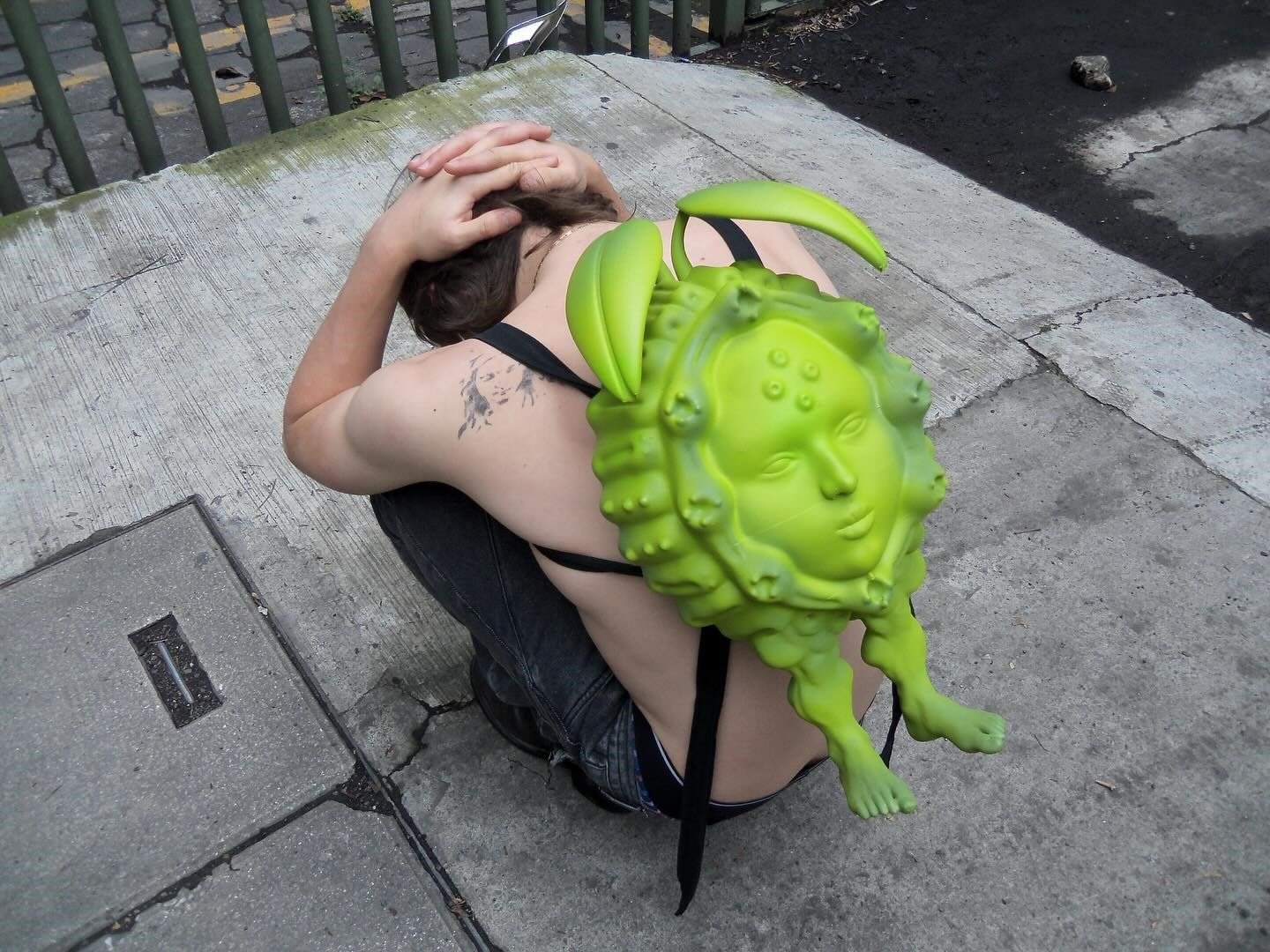
The lime-green thing on Eduardo Espinosa’s back has a serene face, a crown of smaller heads and four loose limbs. It is bright enough to be spotted across a Mexico City pavement and strange enough to suggest it may leave without him. Technically, it is a backpack. Emotionally, it has already become the main character.
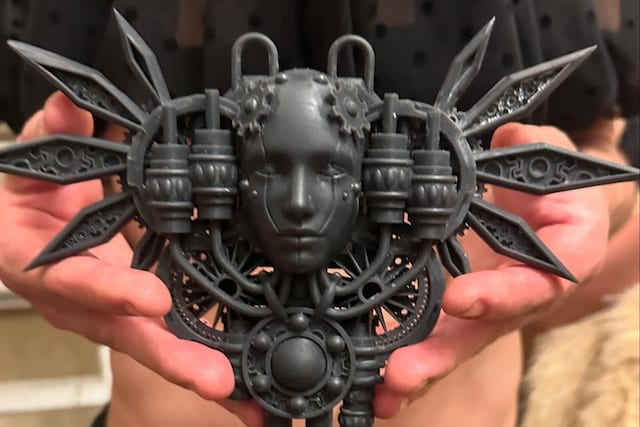
Espinosa, the 24-year-old artist better known online as Ice Blade, makes accessories with the energy of objects pulled from a game before the designers finished explaining what they do. Speakers grow feet. Bags collect claws, suckers, hands and faces. Black components cling to a shoulder like equipment for a mission that begins after dark.
The appeal is not simply that these objects are surreal. Fashion has spent decades turning lobsters, lips, telephones and tiny houses into things that can be carried. What feels new is the amount of life the object appears to possess. It is not an image printed on a standard bag. The bag itself has become the creature.
That shift is travelling through a generation of accessory designers raised with game inventories, anime relics, digital sculpture and characters whose personalities can be understood from one silhouette. Their objects do not finish an outfit politely. They interrupt it, alter the wearer’s posture and arrive with enough implied lore to make a logo feel underwritten.
The supporting character has quit
Accessories used to be described as punctuation. The outfit made the statement; the shoe, bag or necklace supplied the final mark. The metaphor made hierarchy sound natural. Clothes belonged to the body. Accessories waited at the edge, detachable and secondary, useful when the look needed proof of taste or money.
Creature objects reverse that order. Their recognisable anatomy—eyes, teeth, spines, feet—produces an immediate social encounter. People look twice, ask questions, laugh, recoil or move closer. A plain black dress can function as background while the object performs. The smallest part of the look creates the longest conversation.
This helps explain why designers can push an accessory further than a full garment. A pair of trousers still has to negotiate sitting down. A jacket must survive weather, shoulders and doors. A bag can be a shrine, companion, joke, warning or portable sculpture while retaining one brutally simple function: there has to be somewhere inside it to put a phone.
A speaker learned to grow limbs
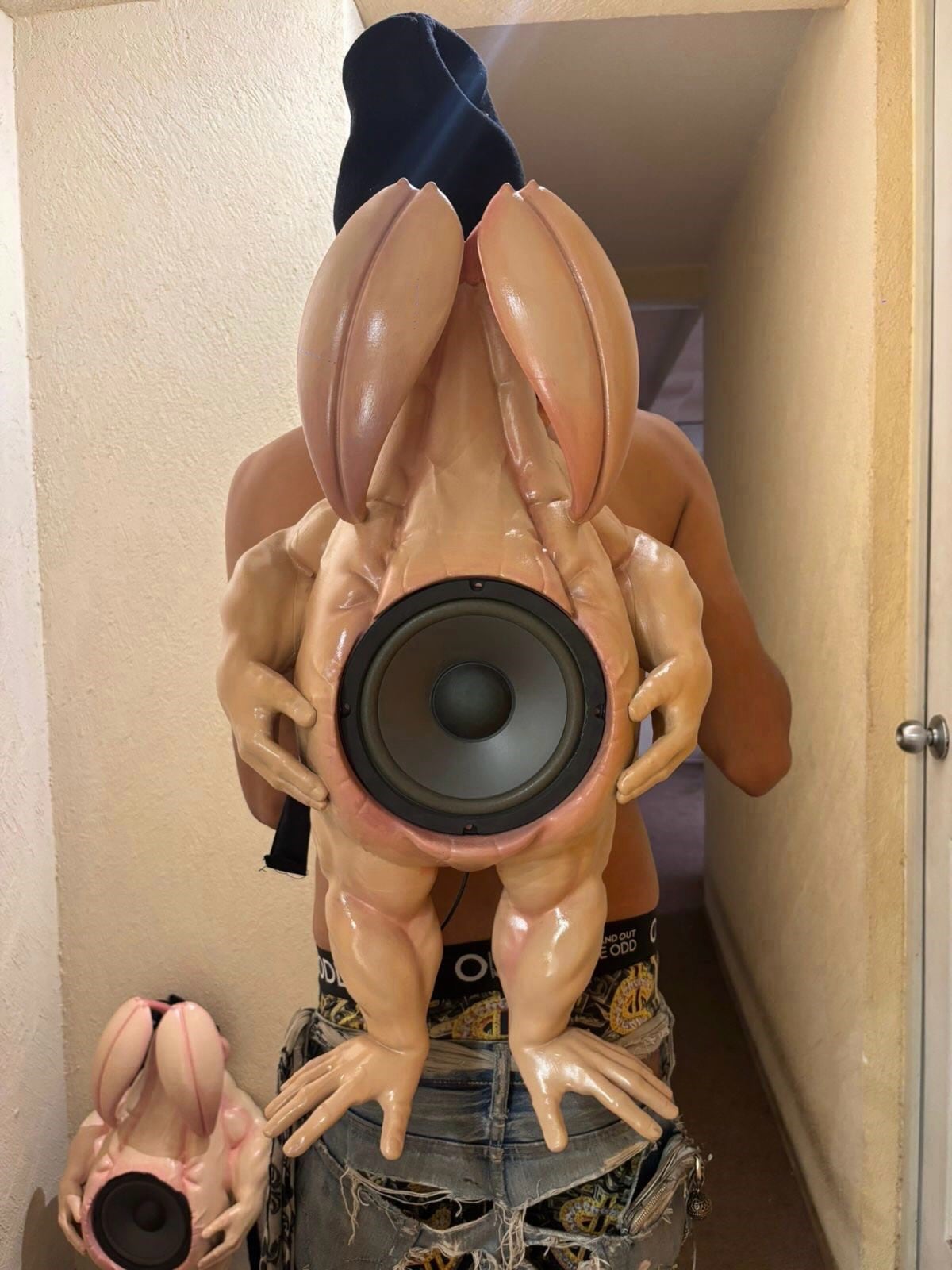
Ice Blade’s most convincing object may be a speaker backpack that resembles a pale humanoid plant. Its torso holds the speaker cone. Long feet hang below it. Hands grip the circular driver as though the creature is carrying its own voice. The body is not decoration around the technology; it explains what the technology does.
The reference began in public space rather than science fiction. In a published interview with Dazed, Espinosa recalled vendors he saw on the Mexico City metro as a child, carrying speakers on their backs while selling compilation CDs. His version transforms that memory into equipment for a different city: part sound system, part mascot, part body.
It is also a useful correction to the idea that experimental fashion must choose between form and function. The speaker works because it looks alive, and the creature feels alive because sound comes from its chest. Utility becomes the special effect.
The inventory screen escaped into real life
Espinosa taught himself 3D modelling through YouTube at 16, then moved through graphic design, show design and fashion work for names including Mowalola and Barragán. His education matters because the software did not arrive as a neutral production tool. It arrived beside games, music visuals and online image culture. The same screen contained the tutorial, the fantasy and the audience.
Video games train players to understand objects as condensed stories. A blade can signal the civilisation that forged it. A helmet may contain a history of vanished battles. A useless-looking charm turns out to change the rules of the entire world. The inventory is where narrative becomes portable.
Fashion has begun to borrow that density. Vogue’s recent survey of game fashion describes digital dress as a place where players test identities and where designers can encode specific cultural craft. The traffic now moves both ways. Objects imagined with a game’s visual logic are entering physical wardrobes, complete with exaggerated silhouettes, impossible anatomy and the promise of hidden abilities.
The accessory stopped completing the outfit. It started writing the plot.
A logo is not enough lore
The old status object asked to be recognised quickly. Its codes were stable: a shape, clasp, print or monogram connected the wearer to a house and its price. The social pleasure came from fluency. You either knew what the object meant or you did not.
Creature accessories offer a different kind of recognition. Their maker may be unfamiliar, but their attitude is obvious. Grace Ling’s 3D-printed Butt Bag and body-part jewellery do not need a visible monogram because the anatomy is the signature. In a Vogue Singapore interview, Ling linked that approach to anthropomorphism: giving the inanimate enough humanity to trigger an emotional response.
The object therefore acts less like membership in an established club and more like evidence of a personal universe. It tells strangers what kind of fiction, humour or unease the wearer wants to carry. A logo says who produced the bag. A creature suggests where it came from and what might happen next.
Pop stars became pocket gods
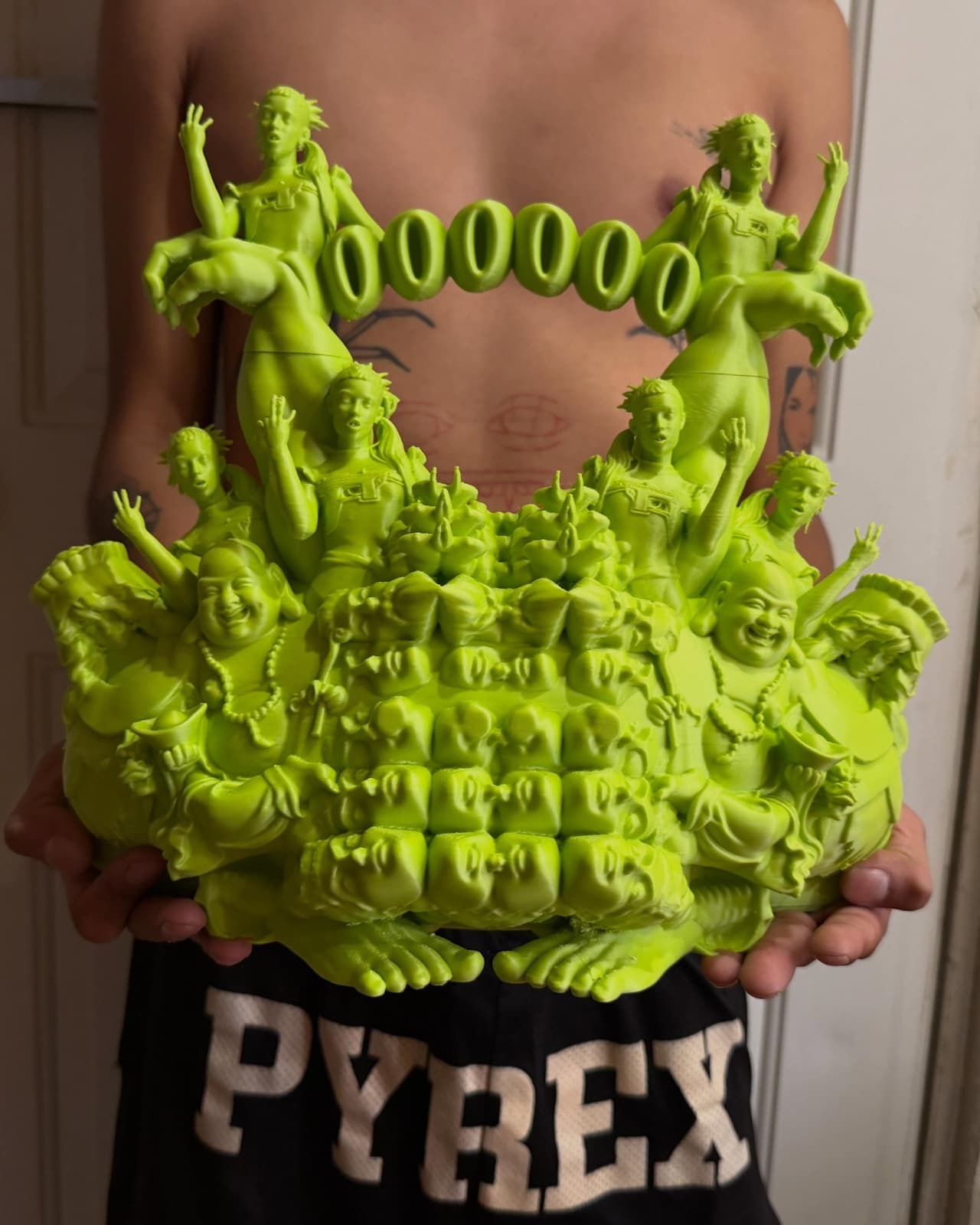
Ice Blade’s most circulated bags turn Björk, Yolandi Visser and Buddha into dense assemblies of faces, hands and bodies. He has described them as a “pantheon of gods of pop culture,” which explains both their irreverence and their strange coherence. The celebrity is not placed on merchandise. The celebrity is absorbed into an altar you can take to the club.
This is fandom converted into architecture. Online devotion already has ritual behaviour: images are collected, appearances archived, lyrics interpreted, enemies identified and anniversaries observed. The sculptural bag gives that intensity a physical container. It makes the wearer’s private hierarchy public without reducing it to a slogan.
There is a joke inside the reverence. The bag treats celebrity with the visual gravity of sacred art while acknowledging how absurd it is to carry one’s gods beside lip balm and a charger. That tension protects the object from becoming simple tribute. Adoration and perversion can occupy the same fluorescent surface.
The reference needs roots
The danger of world-building is that every symbol begins to look available. Digital moodboards detach images from the people and places that made them; software makes fragments easy to reproduce at high speed. A creature assembled from cultural references can feel rich while saying very little about its own position.
Espinosa’s answer is specificity. He grew up in Tizayuca, Hidalgo, and moved to Mexico City around 11 years ago. He has spoken about pre-Hispanic ideas of nature, roots and plants as influences, while resisting literal reproduction that could turn those histories into borrowed surface. The metro vendor matters beside the anime character. Plants vs. Zombies matters beside the sculptural tradition. The work gains force from collision, not from pretending every source is interchangeable.
This is where the best creature accessories separate themselves from algorithmic weirdness. Their strangeness has a location. The object does not merely ask, “Have you seen anything like me?” It can answer the more interesting question: “Why did I grow here?”
The future bag opens like a flower
The living-object impulse is not limited to faces and limbs. A new accessories generation is giving objects behaviour. In a 2026 Istituto Marangoni survey of emerging designers, Emma Sissa’s bags and shoes attach like carnivorous plants and are engineered to be dismantled for repair. Nicola Molin hides sensors inside bags that split or unfold when touched. Manuele Gratteri lets sprouts, petals, mould and burned felt move through headpieces as states of desire and decay.
These projects replace static ornament with a sequence. Touch this point. Watch the shell open. Remove the damaged component. Let the material change. The object becomes memorable because the wearer learns how to interact with it, not only how to photograph it.
That behaviour can also make experimentation more responsible. A bag that resembles a living system invites questions about maintenance, mutation and repair. If its parts can be recovered rather than discarded, personality and longevity stop being opposing values. The weird object may survive precisely because nobody wants to replace the character they have already met.
A logo tells you who made the object. A creature tells you what world it escaped from.
The body becomes part of the prop
Creature accessories do not remain self-contained. Their claws grip straps. Their weight changes how a shoulder drops. A bag with a face appears to look past the person carrying it; a body-shaped piece makes the wearer seem doubled. The accessory expands the cast.
That physical relationship is central to Kexuan Liu’s Reality ~ Reality’, a project of wet-moulded leather body forms that sit between accessory, prosthesis and garment. The pieces ask wearers to lift, support and feel the weight of another shape. Instead of offering escape from the body, the fantasy returns attention to it.
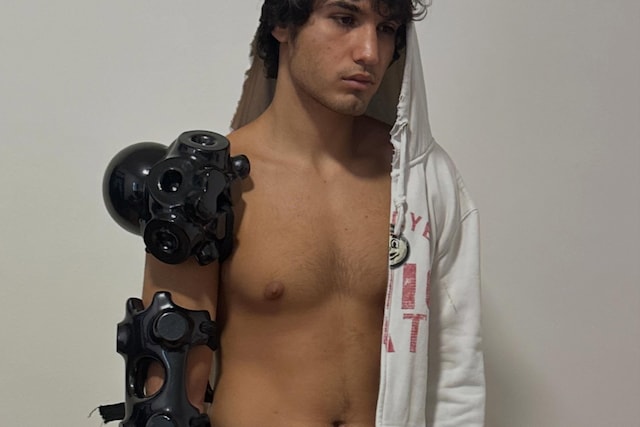
Ice Blade’s shoulder objects operate with a similar ambiguity. They could be armour, parasites, instruments or parts of a machine that only activates when worn. The body completes their meaning, but it does not fully control it. The most alive accessories always preserve a little independence.
Small objects can carry entire worlds
The fashion object currently fighting for attention is competing with more than other products. It is competing with characters, games, filters, fandoms and feeds that can deliver a complete universe in seconds. A merely beautiful accessory risks becoming another smooth image among thousands.
The creature answers with presence. It creates a relationship before it creates aspiration. It may be funny, unsettling, protective or impossible to classify, but it gives the wearer something more useful than quiet perfection: a part to play.
Espinosa calls his objects “magical gadgets.” The phrase works because neither word is decorative. A gadget performs. Magic changes the conditions around it. The future handbag will still carry keys, but it may also grow limbs, make noise, demand care and stare back. At that point, choosing an accessory starts to look less like shopping and more like casting.